
We took the short train ride (90 minutes) from Orvieto down to Rome and spent 5 nights in Rome. There is so much to see there – we could have easily spent twice that and merely scratched the surface but we were able to see quite a bit in that time. Because it was early February and “off season”, it wasn’t as crowded – but it was still pretty crowded at some sights. I can’t imagine it in the summer/peak season. The nice thing about the time we went was that the weather was pretty nice. It was around 60F and sunny most days (we had one day of rain). We did get some tickets in advance to make sure we didn’t miss out on must-see sights, like the Colosseum and the Vatican Museums – but we only got them a few days in advance rather than weeks or months (meaning we could plan around the weather forecast to an extent).
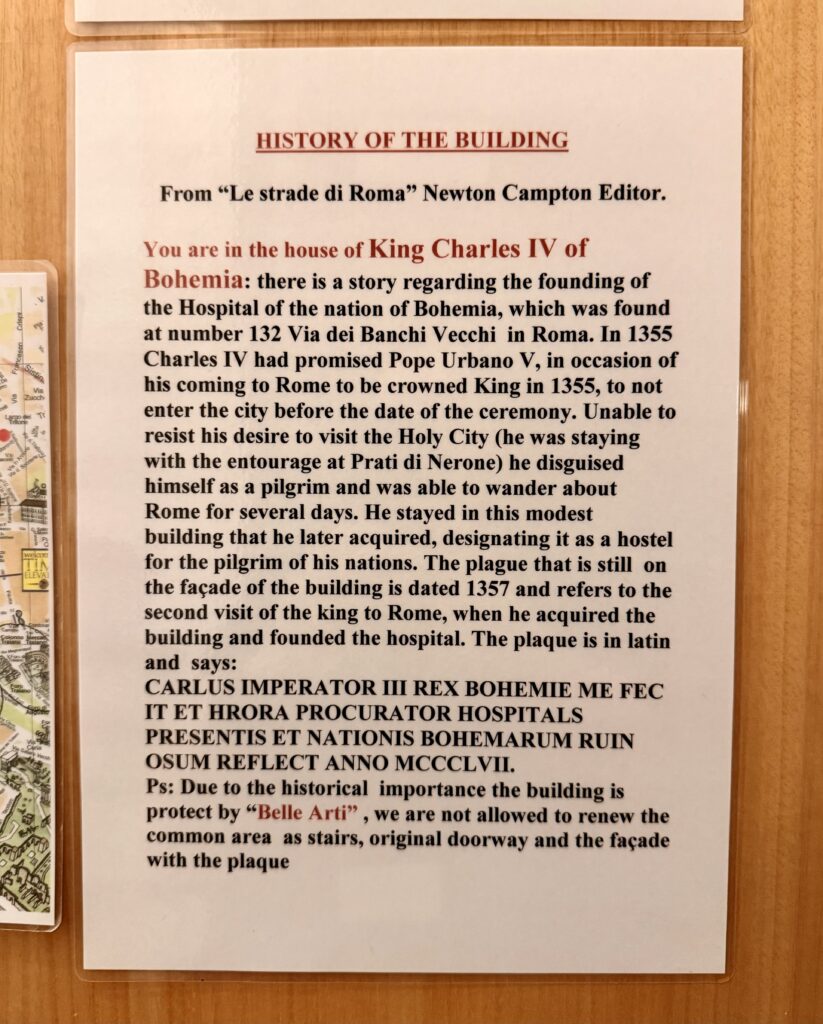
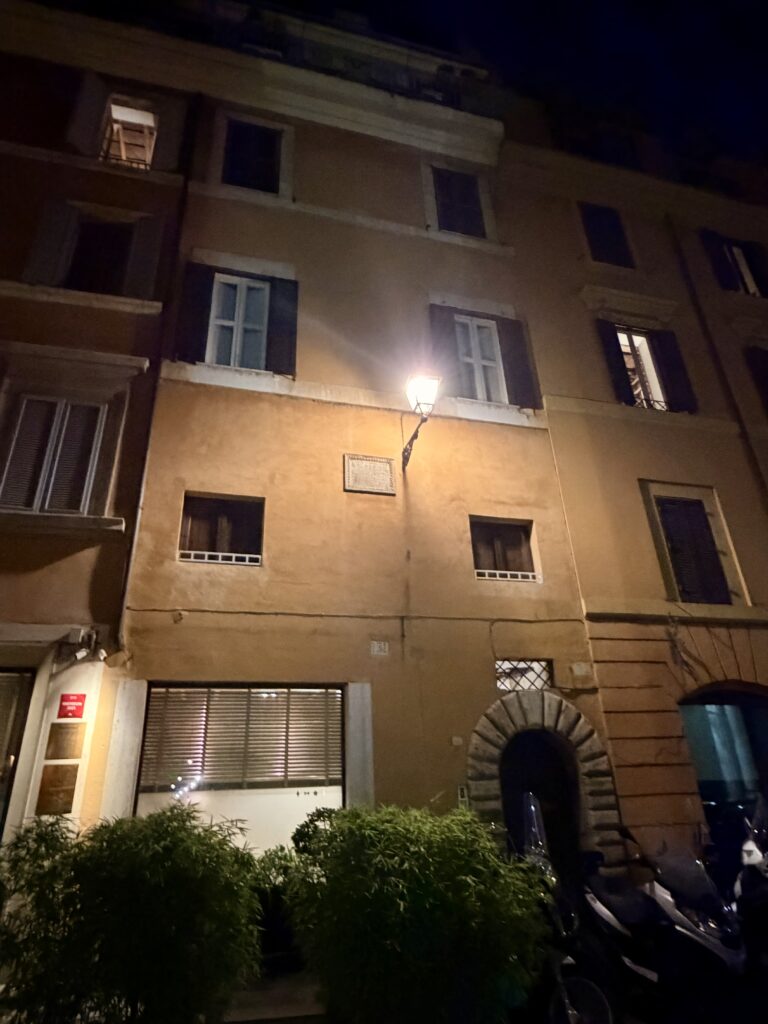
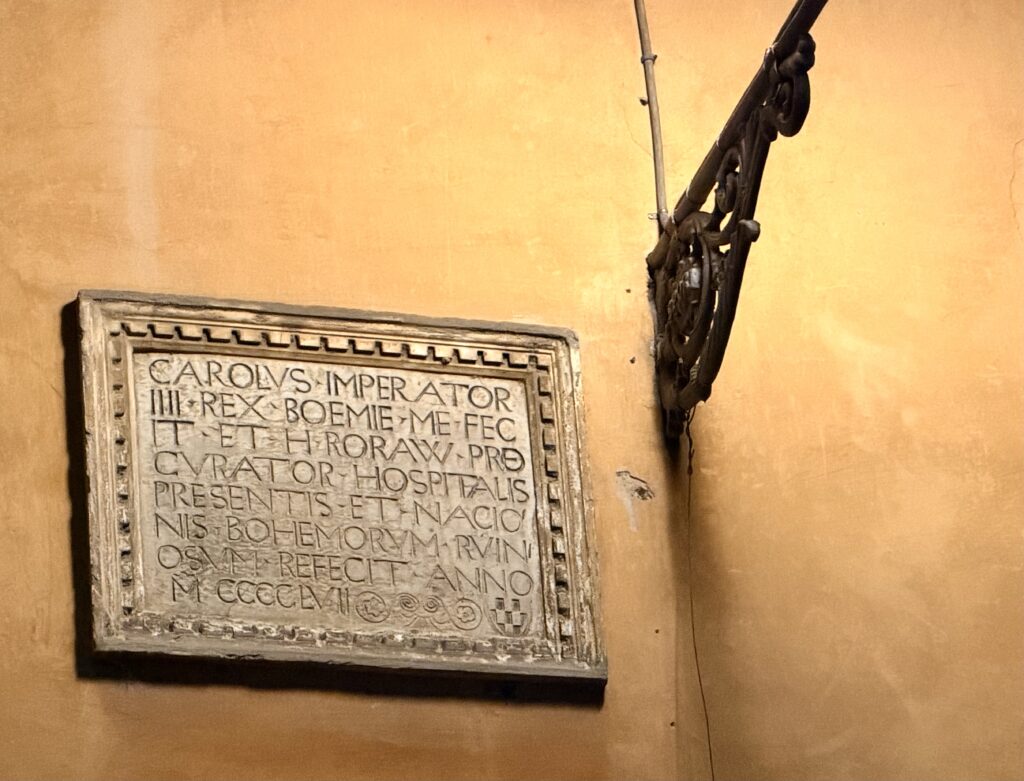
We got into Roma Termini (the main train station) then took a bus over to our VRBO near Chiesa Nuova (in the Centro Storico area of Rome). It was a really great apartment to relax in and was very convenient for getting around Rome (https://vrbo.onelink.me/ItNz/xg1pxexv) – we paid about $200/night for this place and when I looked today for more popular times of year, it was more like $500/night! It does have 2 bedrooms so would be easy to share between 2 couples to split that cost but off-season travel was a bargain! It’s also a historic building – the host was apologizing for the stairs (definitely not the steepest or most narrow we have seen in our travels though!). Because the building has historic significance, they can’t change the common areas of the building. It’s a cool story – they had an explanation of the history inside the apartment.
Itinerary
We ended up splitting our time in Rome up like this:
Day 1 (Sun 01 Feb): self-guided walking tour (the “Heart of Rome” walk using the Rick Steves Audio Europe app). One thing to take note of when planning is that a bunch of sights in Rome are free on the 1st Sunday of the month. So it was a good day to walk around but would not have been the best day for some ticketed activities since they were packed. (https://www.romewise.com/rome-free-sunday.html?srsltid=AfmBOopj_GIslIPrH6ac0HTaEKtJ1E7kIdsft8qL8SqdiYHDaTRrv0Hw). By the way, I’ve mentioned the Rick Steves Audio Europe app a few times – it’s a great free app that has a ton of self-guided walking tours and also interviews with locals. It’s nice because we didn’t want to carry around travel guide books and we could just pop in blue tooth earbuds and walk without looking at a book. I also discovered later in our travels that some of his full guidebooks are available for purchase in the iPhone Books app – very handy to have the information without having to carry a physical book.
Day 2 (Mon 02 Feb): Colosseum, Roman Forum, Palantine Hill (single ticket includes all three; the Colosseum is a timed entry; https://ticketing.colosseo.it/en/) so we started at the Colosseum with a 10:15 AM entry and then were able to take our time at the others and not have to worry about getting back to the Colosseum at a certain time.
Day 3 (Tue 03 Feb): day trip to Pompeii (https://pompeiisites.org/en/buy-tickets/) – I’ll be doing a separate post for this
Day 4 (Wed 04 Feb): Vatican Museums, St. Peters Basilica, lunch with a friend who lives in Rome, then the Pantheon (this ended up being our one rainy day so we picked indoor stuff based on the forecast) (https://tickets.museivaticani.va/home/calendar/visit/MV-Biglietti/1). We did the Vatican Museums first with an 8:00 am entry admission ticket (self-guided) then St. Peters Basilica after that. The Basilica is free but you can pay €7 for a timed entry which allows you to go through a much shorter security line.
St Peter’s Basilica
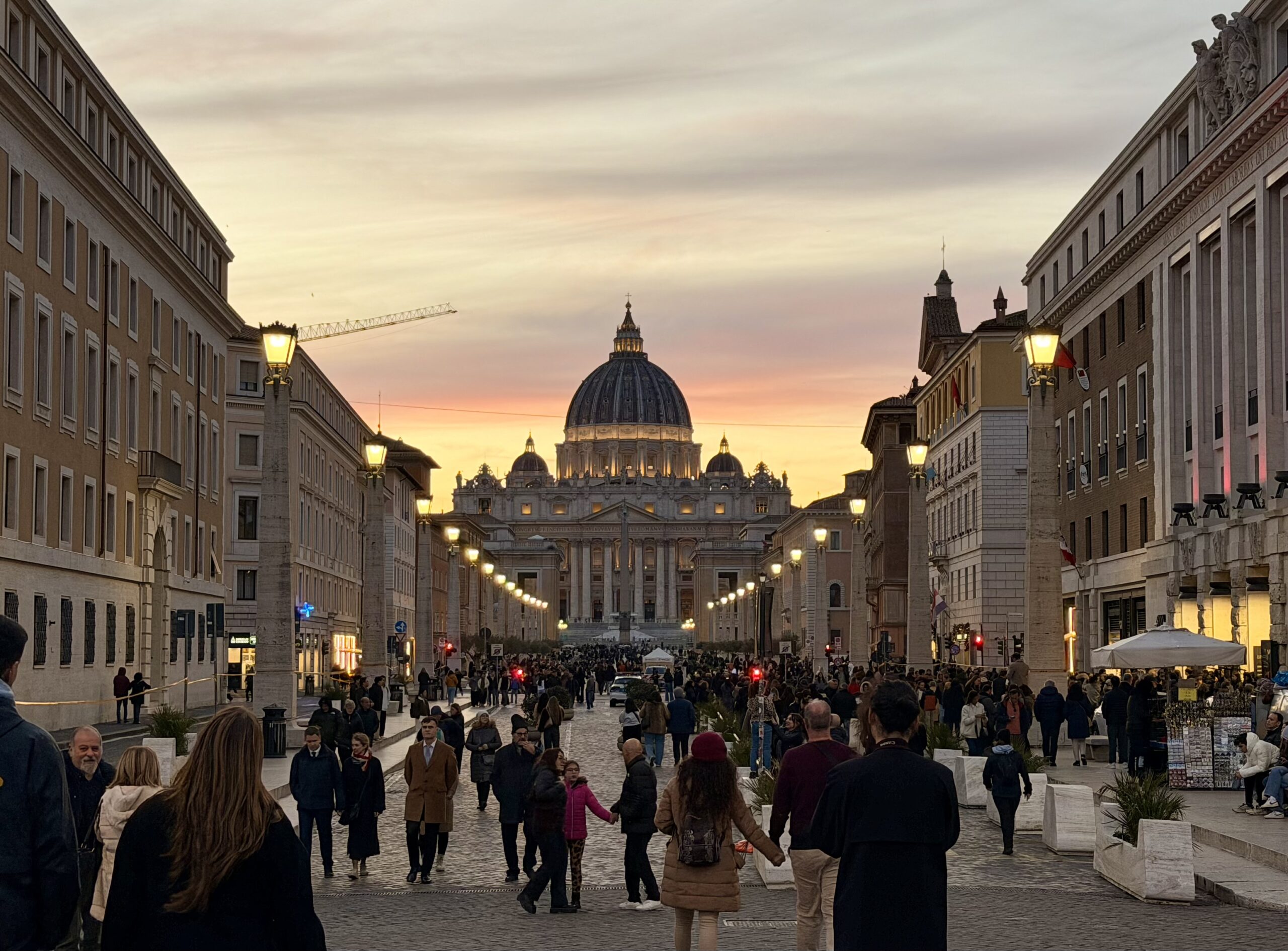
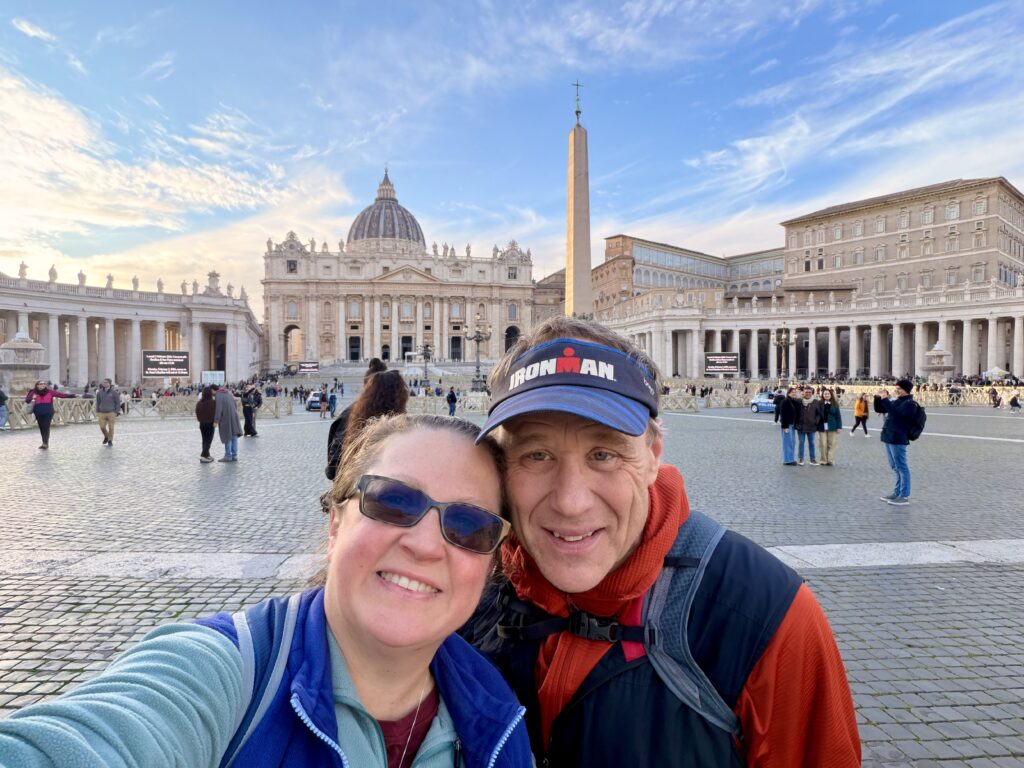
You can see the dome of St. Peter’s from all over Rome. We walked to Vatican City our first day there and it was beautiful to see just as the sun was setting!
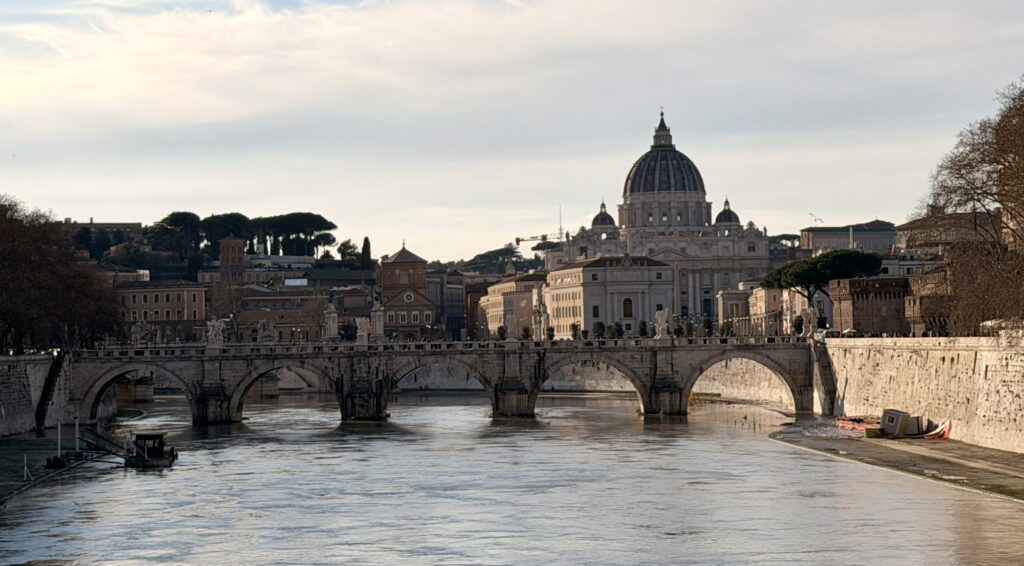
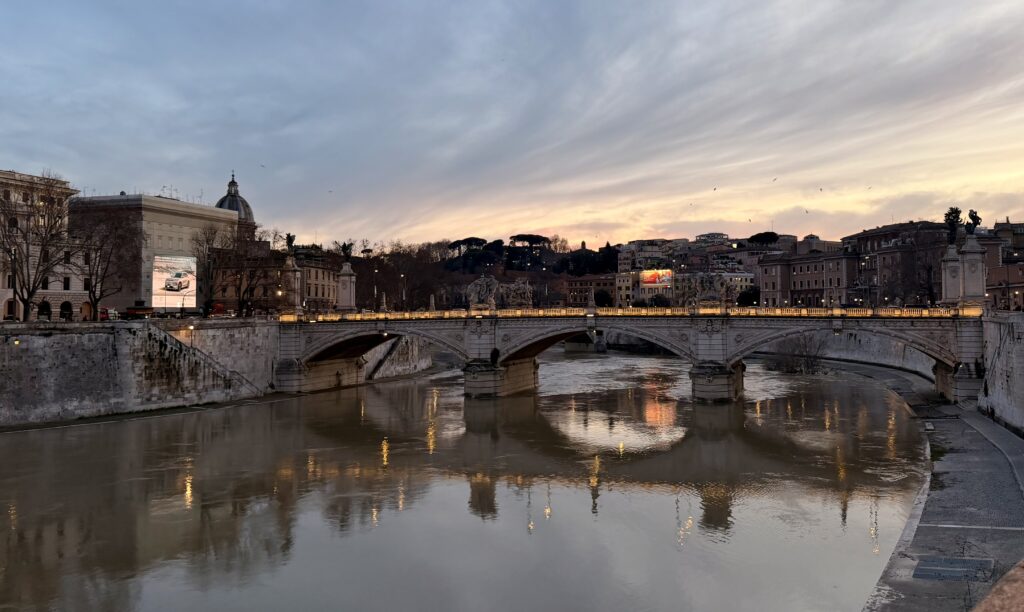
A bit of history about St. Peter himself and the basilica named in his honor. Peter (Simon Peter) – one of Jesus’ apostles and the first Bishop of Rome – was martyred near this site around 65 AD and was buried here. He was crucified upside down because he felt he wasn’t worthy to die on a cross the same way Jesus did (we saw a similar theme with St. Andrew, who was crucified on an X-shaped cross – more to come on that when we get to Scotland).
St. Peter’s Basilica took 120 years to build – from 1506 – 1626. It was built on the site of an earlier 4th century church commissioned by Emperor Constantine I (Constantine the Great) after he converted to Christianity. The old church was built from 319-333 AD then fell into disrepair when the papacy moved to Avignon. Pope Julius II ordered demolition of the old church in 1506 and commissioned a new basilica. The basilica went through several architects. The initial architect was Donato Bramante, who designed it in a Greek cross plan. When he died in 1514 a few others took over the design until 1645, when Michelangelo took over. Michelangelo simplified the design and built the dome (he was 71 years old at the time, having already completed the Sistine Chapel; he insisted on not being paid). Carlo Maderno extended the nave into a Latin Cross and built the facade. When Maderno died in 1629, Gian Lorenzo Bernini took over and completed the interior decoration (including the altar) and designed St. Peter’s Square.
The official St Peter’s website lists all of the architects:
“For the completion of the majestic building, they called upon the work of some of the most famous architects of the Renaissance, such as Fra’ Giovanni Giocondo (1433-1515), Raphael Sanzio (1483-1520), Giuliano da Sangallo (1445-1516), Antonio da Sangallo (1485-1586), Baldassarre Peruzzi (1481-1536), Michelangelo Buonarroti (1475-1564), Jacopo Barozzi da Vignola (1507-1573), Giacomo della Porta (1533-1602) and Carlo Maderno (1556-1629). The latter completed the Basilica by erecting its façade between 1608 and 1612. In the seventeenth century Gian Lorenzo Bernini (1598-1680) was responsible for the grandiose Piazza San Pietro, while important decorations inside the Basilica date from the eighteenth century.” (https://www.basilicasanpietro.va/en/san-pietro/the-basilica)
The church was consecrated in 1626 by Pope Urban VIII.
In order to pay for this grand church, the popes sold “indulgences”. Generally an indulgence requires an act to be forgiven for sins – saying a specific pray a give number of times, going on a pilgrimage, doing good works, etc. In this case it allowed wealthy Europeans to “buy” forgiveness. This kind of corruption ultimately led to the Protestant Reformation.
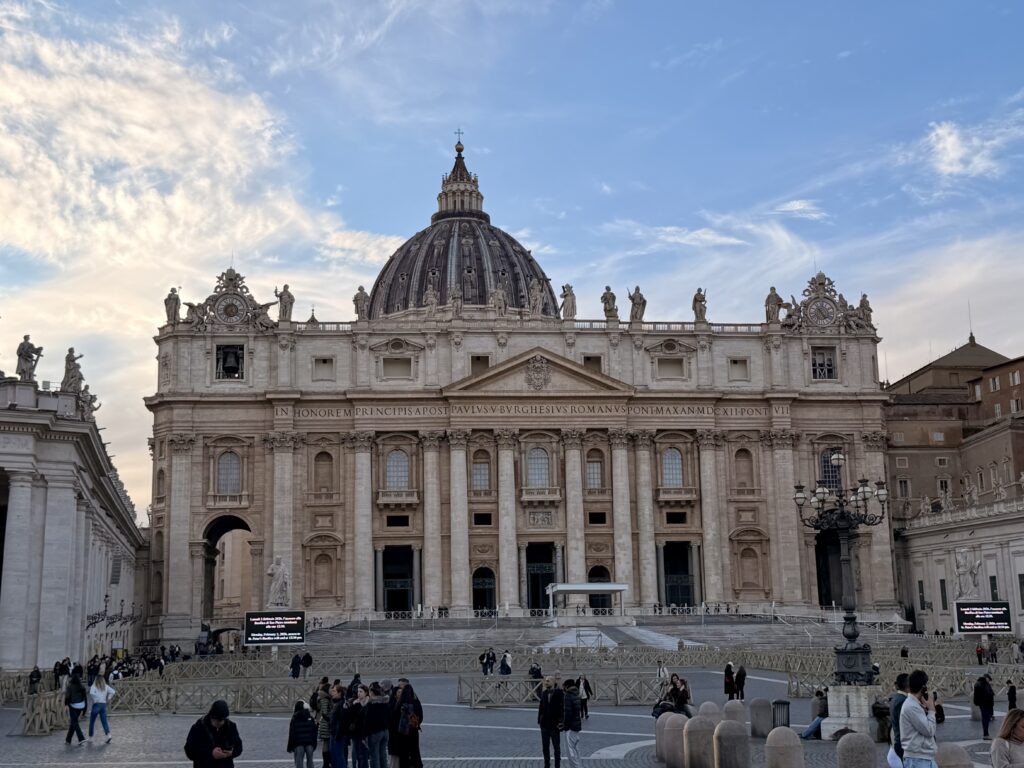
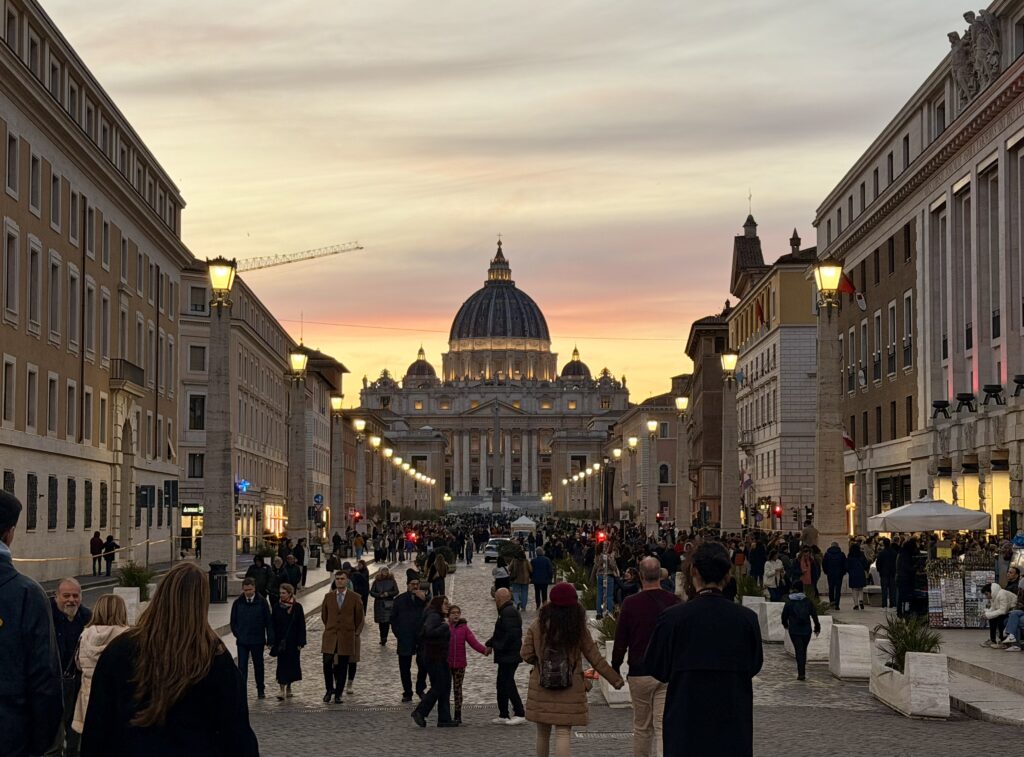
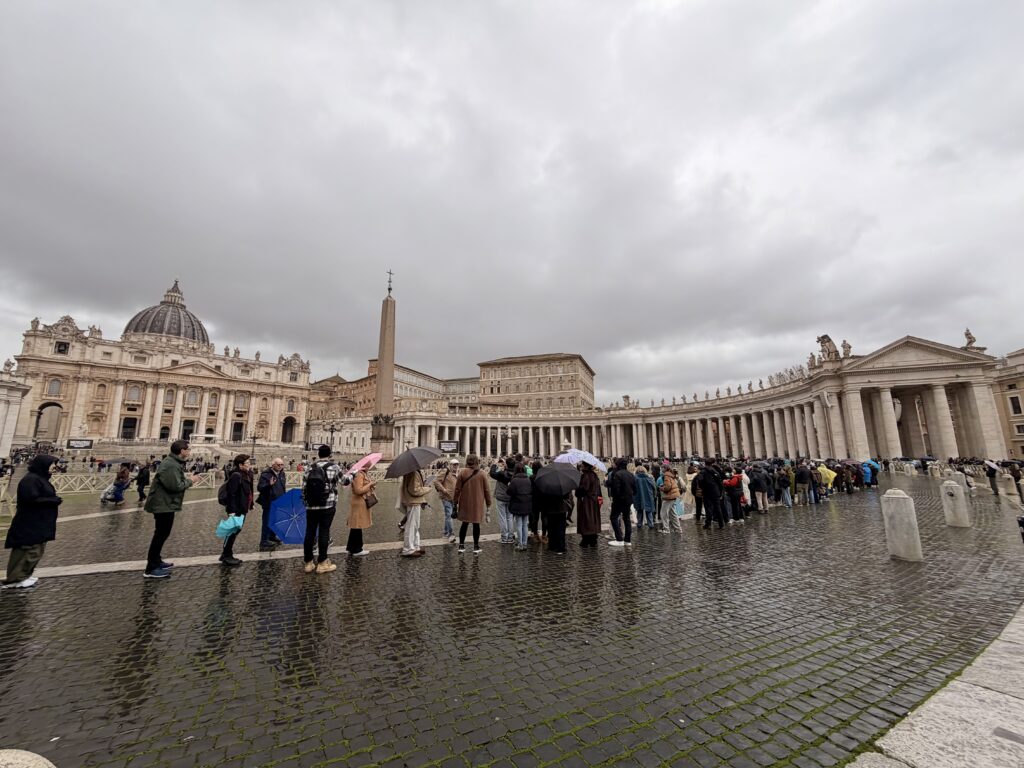
Earlier I mentioned paying for a timed entry to St Peter’s – that was €7 well-spent! The regular line (free entry) was long when we got there but when we left it was even worse! Check out the video to get a better idea of how long the line was. I’m sure it moved fast since it’s just a security check but it was definitely worth the money to skip the line.
We went on a Wednesday and on Wednesday mornings there is a papal audience that you can get tickets for. In the winter they hold it in a smaller auditorium space and the rest of the year it’s St. Peter’s Square – the large square just in front of the basilica (the picture and video of the line below were from mid-day and well after the papal audience was over so I don’t think the line had anything to do with the papal audience). The tickets are free – you just have to email to get on the list but then you have to go either the night before or the morning of to pick up your tickets (and you have to go through that long security line just to pick up the tickets). We watched a video about it and in the peak times, people get there 3 hours early to be able to get a seat. We opted not to do this because we would have missed out on the Vatican Museums in order to do it. But something to keep in mind if you are going to be in Rome on a Wednesday. (http://www.papalaudience.org/tickets).
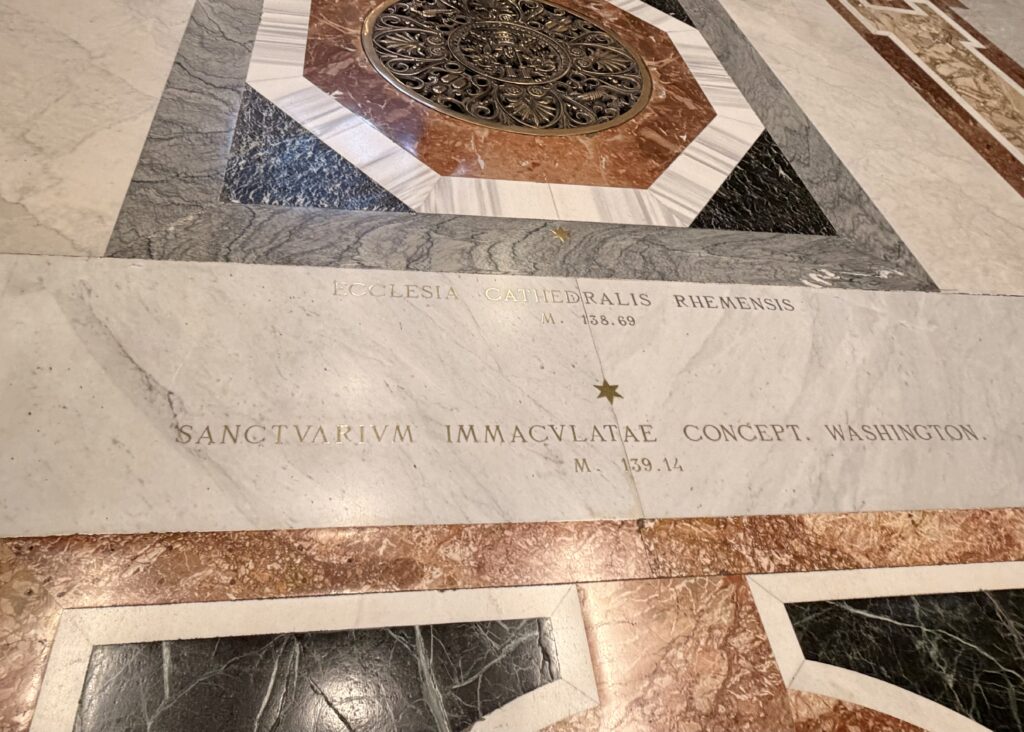
Inside St. Peter’s …… St. Peter’s Basilica is the largest church in the world. Inside the long nave, they have markings on the floor to indicate where other famous churches would fit inside St. Peter’s – the picture in the middle below shows the Basilica of the National Shrine of the Immaculate Conception in Washington DC (in the top 30 largest in the world).
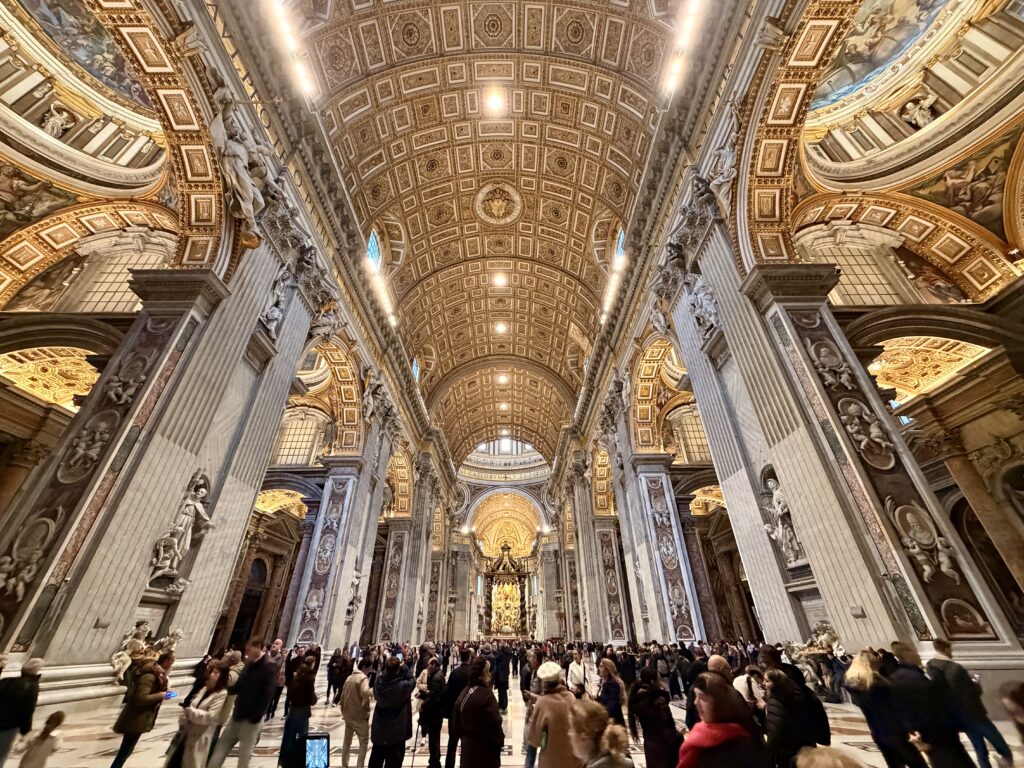
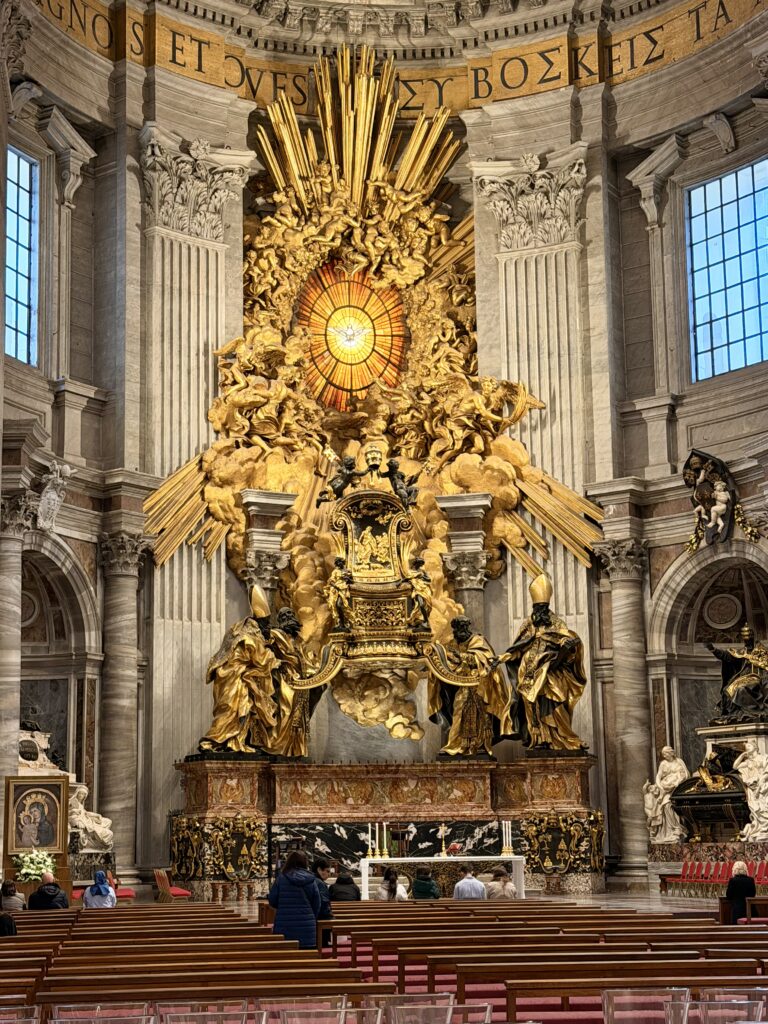
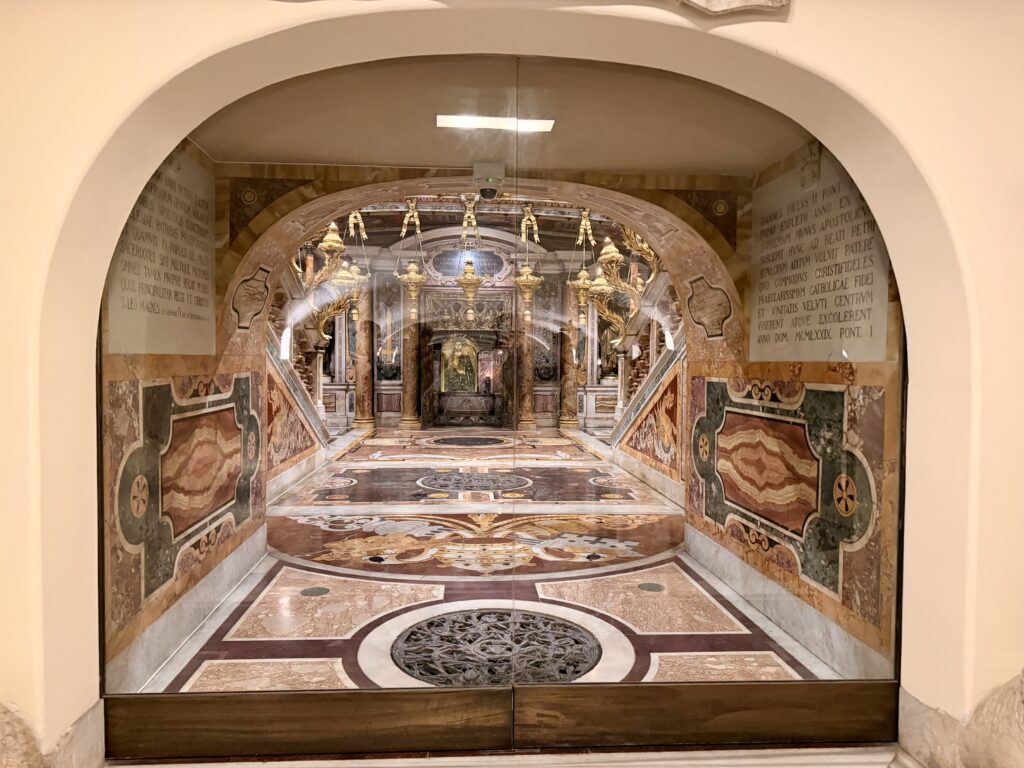
The high altar was consecrated by Clement VIII in 1594. It has a large 95-foot tall bronze canopy (St. Peter’s Baldacchino) that was built by Gian Lorenzo Bernini from 1624-1633. The Confessio is the space in front of the altar (inside the low marble wall) that allows St. Peter’s tomb to be visible (that part was closed off during our visit – you can see part of a red curtain in the 2nd photo – but we were able to see it from the crypt). The altar and its canopy are really impressive to see in person. (the official site has some pictures of St. Peter’s Tomb: https://www.basilicasanpietro.va/en/san-pietro)
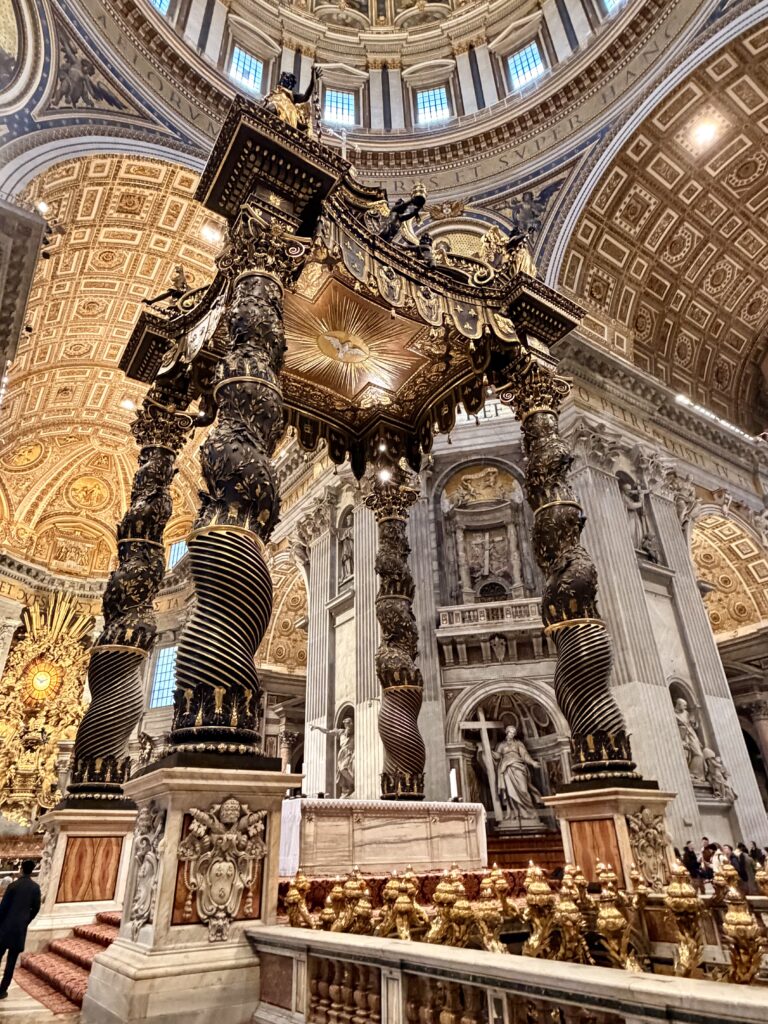
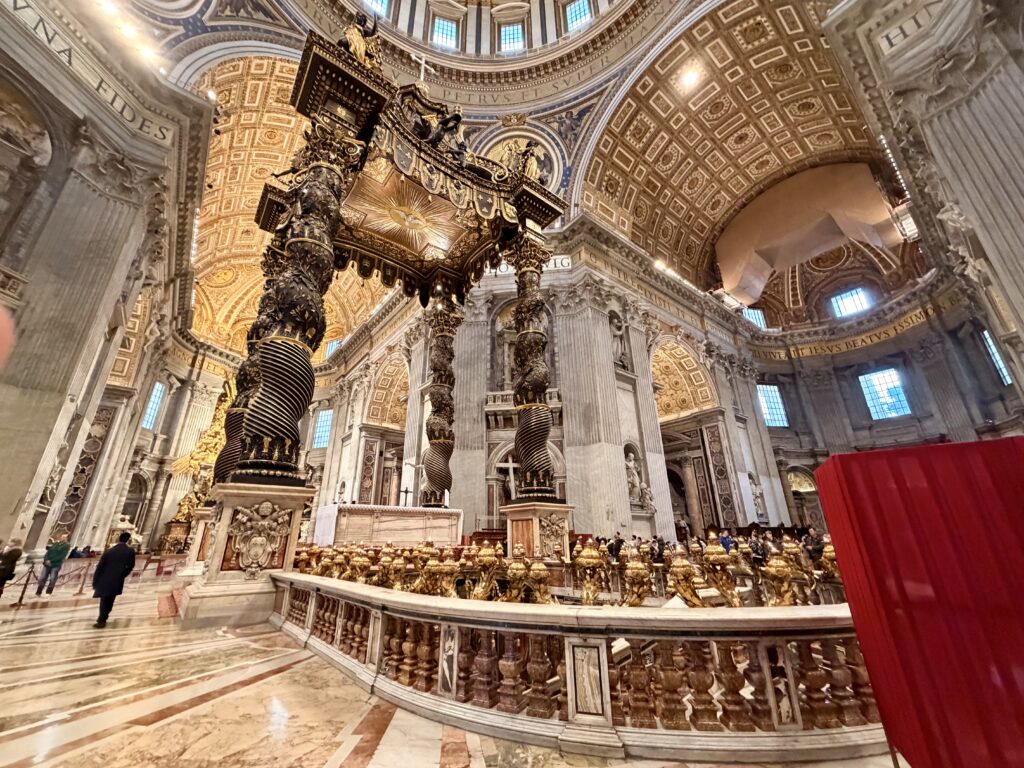
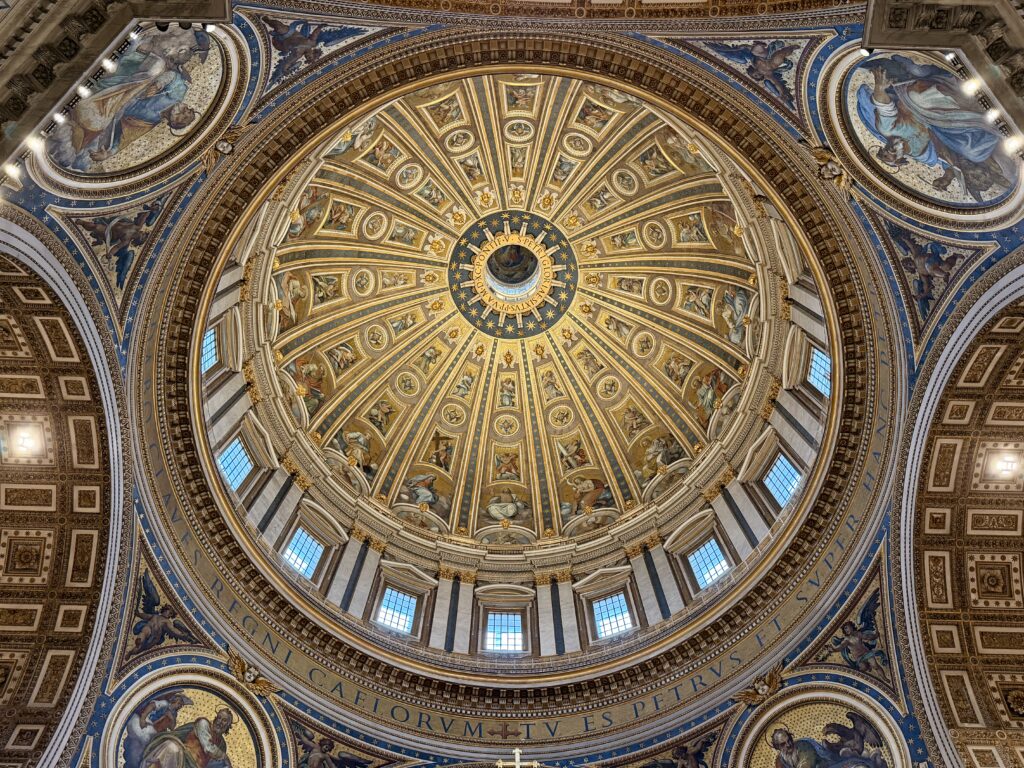
The dome was completed in 1590 and is 117 metres (383 feet) high from the ground to the top of the lantern (and 133 meters/436 feet from the ground to the top of the cross atop the dome). It’s the tallest dome in the world.
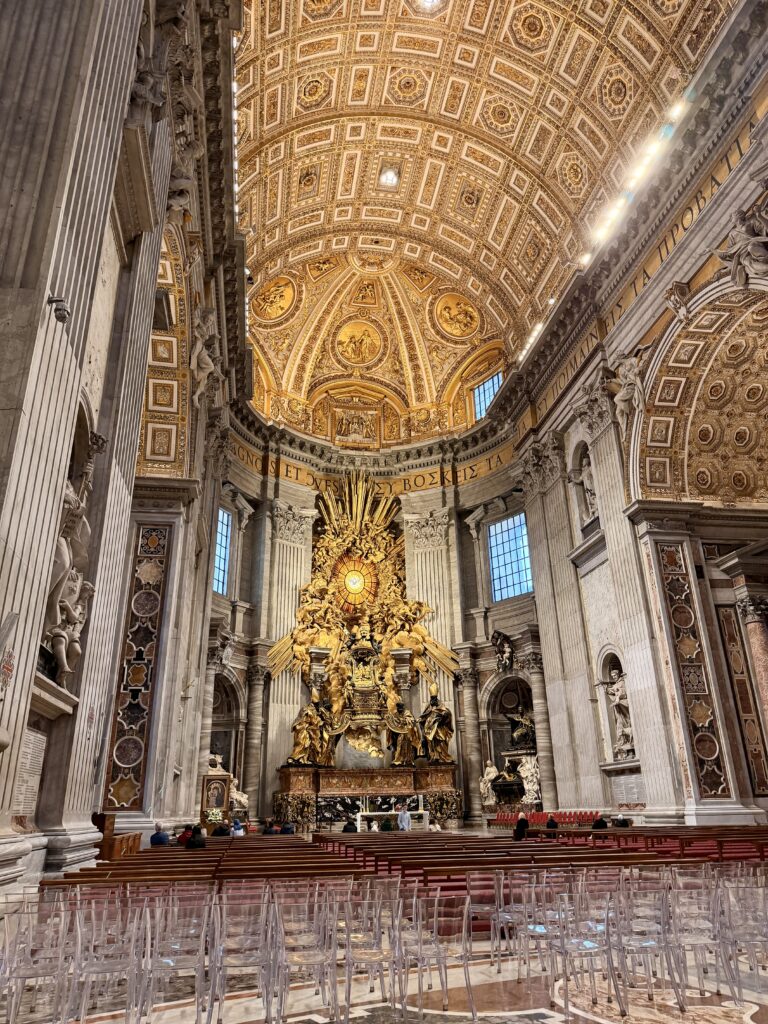
Behind the Papal Altar is the Cathedra Sancti Petri Apostoli (Chair of St. Peter) “an ancient wooden throne, symbol of the Petrine primacy and the Pope’s magisterium”. Bernini built this bronze monument over 10 years (completed in 1666) to protect that ancient throne. It stands almost 15 meters (49 feet) tall and weighs 74 tons! (https://www.basilicasanpietro.va/en/san-pietro/the-cathedra-of-saint-peter)
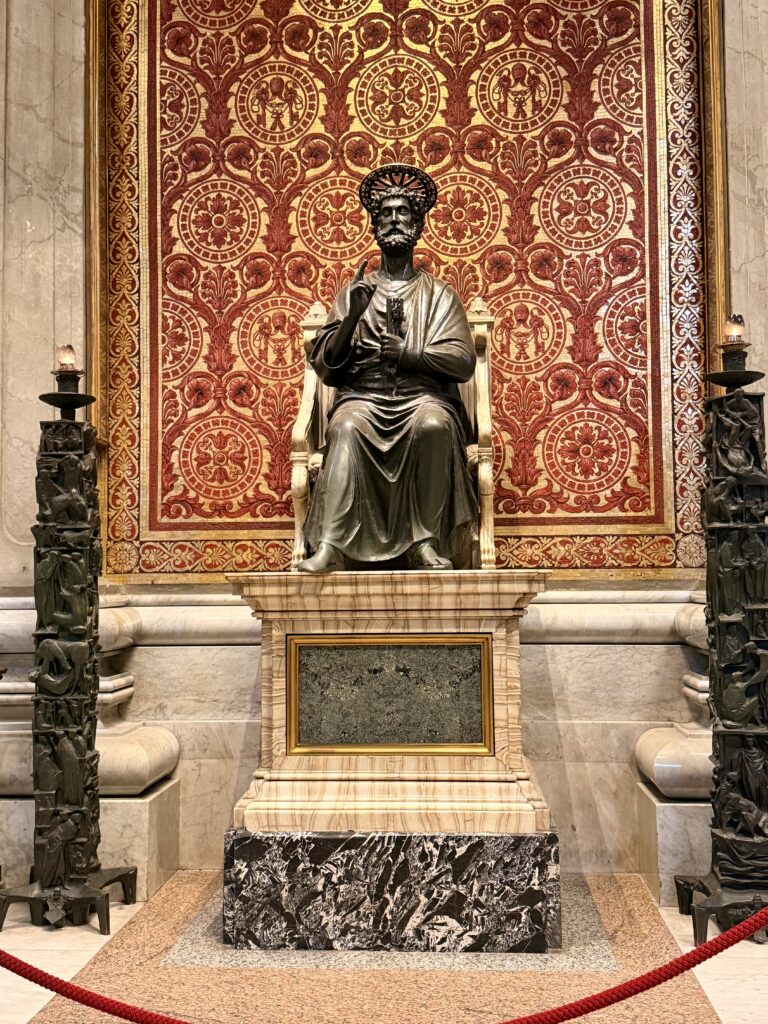
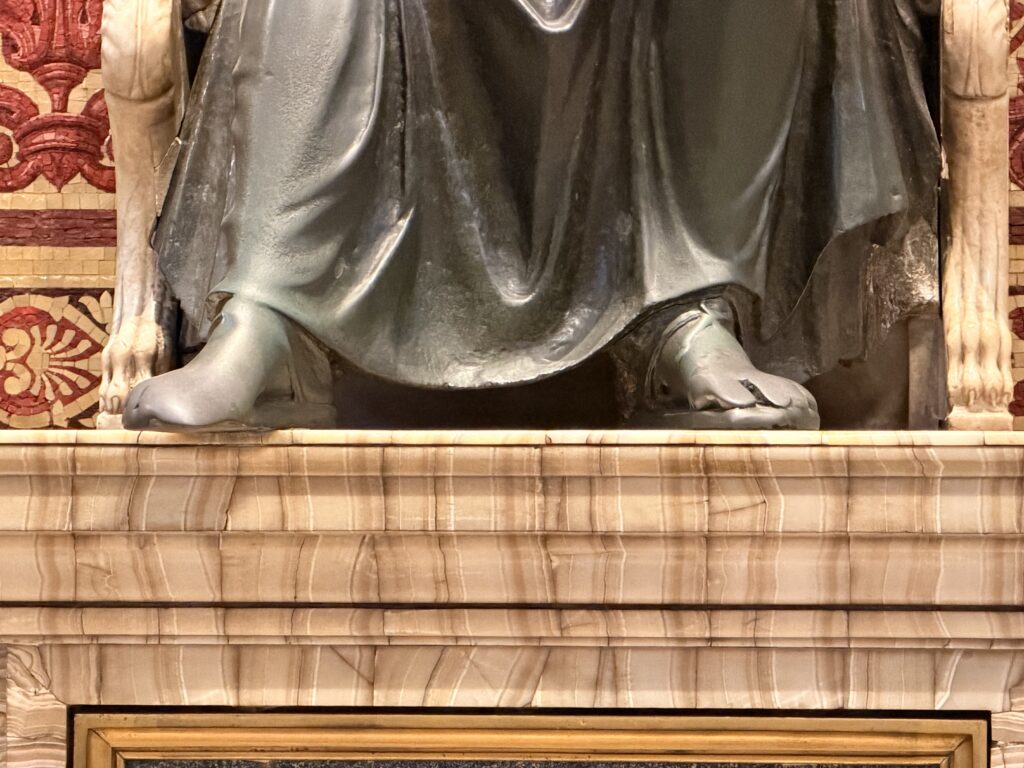
There’s a statue of St. Peter inside the nave. It’s now roped off so you can’t get close but it used to be a tradition to rub his foot for good luck. You can see below that his feet are rubbed smooth so I can see why they have roped it off.
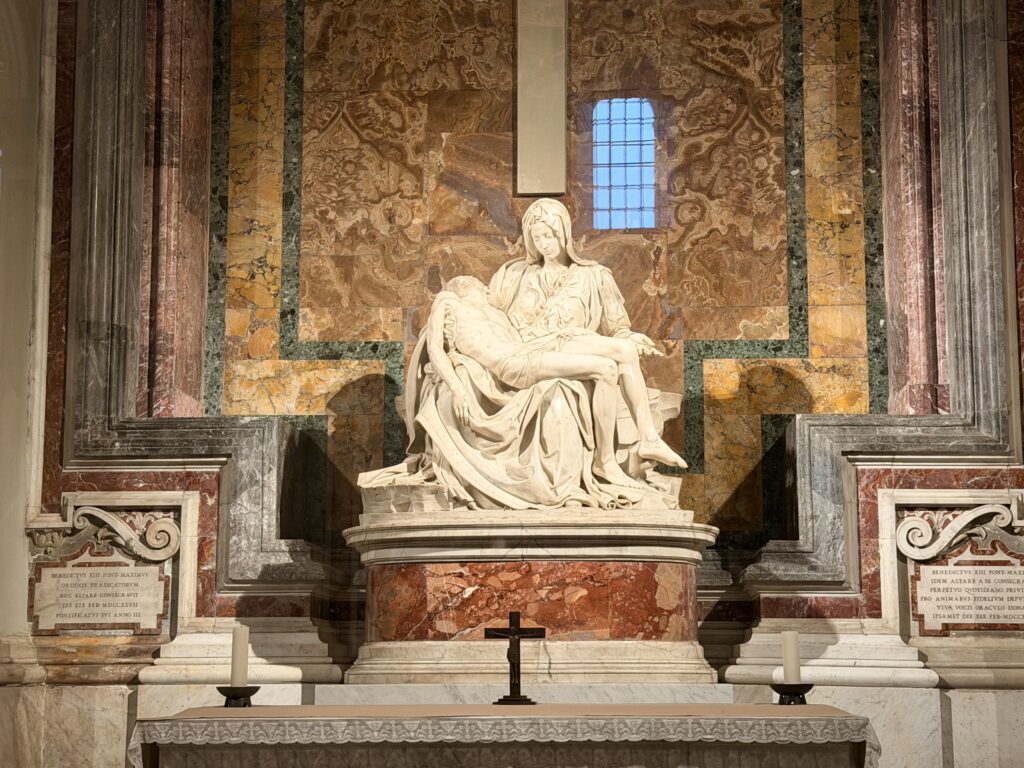
One of Michaelangelo’s most famous sculptures, the Pietà (Madonna della Pietà, or Our Lady of Pity) was created from 1498-1499 and is housed inside St. Peter’s Basilica. It captures the moment that Jesus was taken down from the cross and handed to his mother, Mary.
The Crypt
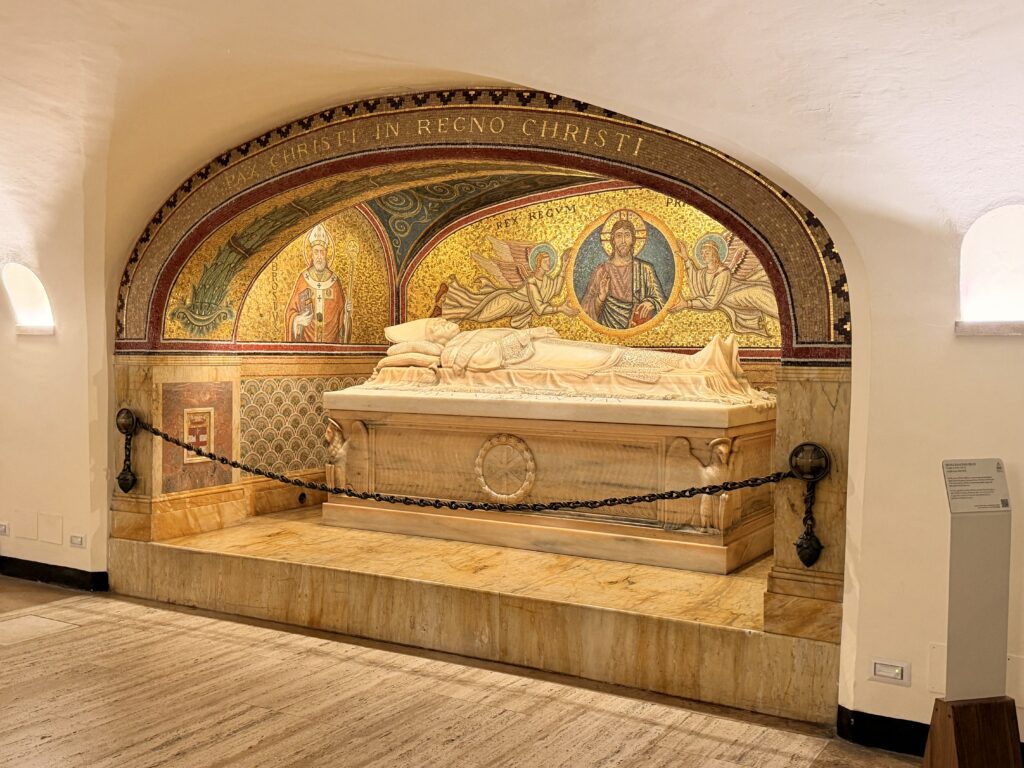
Most popes are buried in the crypt below the basilica. There are a couple of particularly popular popes (St. John Paul II and John XII) who have their tombs upstairs inside the basilica itself. This picture shows the ornate tomb of Pope Pius XI (he was Pope from 1922-1939).
From the crypt we were also able to get a glimpse of St. Peter’s tomb.
The Vatican Museums
The Vatican Museums are a huge collection of art that started around the 15th century and expanded over time. The collection is housed in the papal palaces, which includes multiple museums and galleries. We spent about 3 hours here and could have easily spent more time. (Official site: https://www.museivaticani.va/content/museivaticani/en/musei-del-papa/storia.html; this site has some more background info: https://www.britannica.com/topic/Vatican-Museums-and-Galleries)
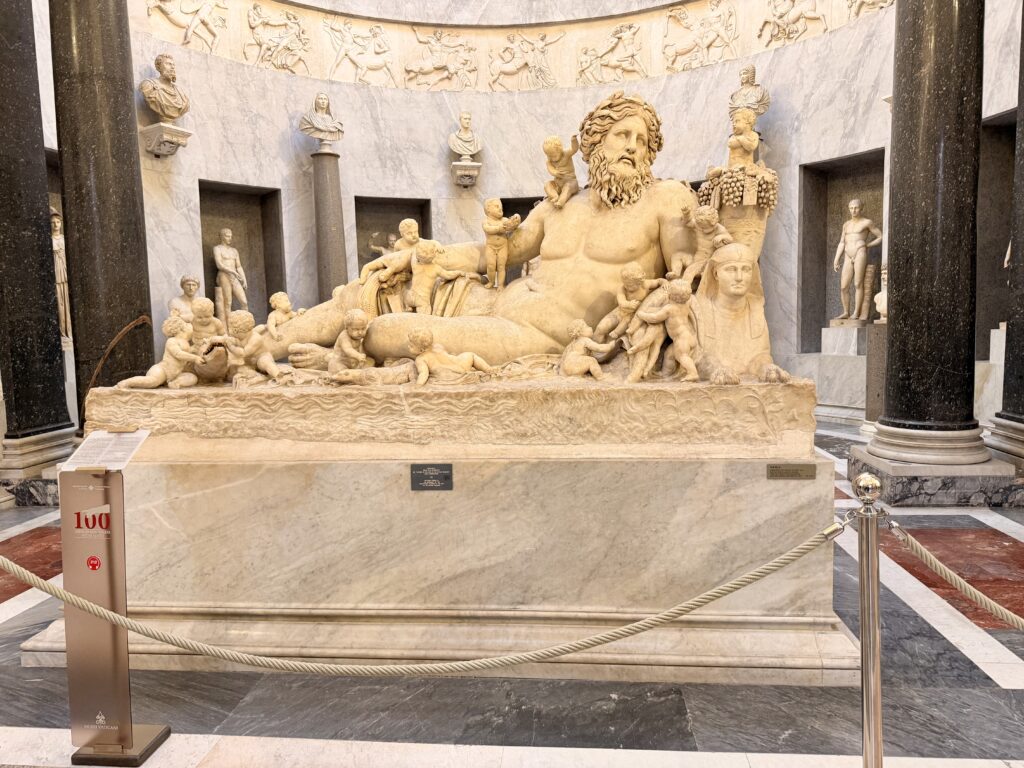
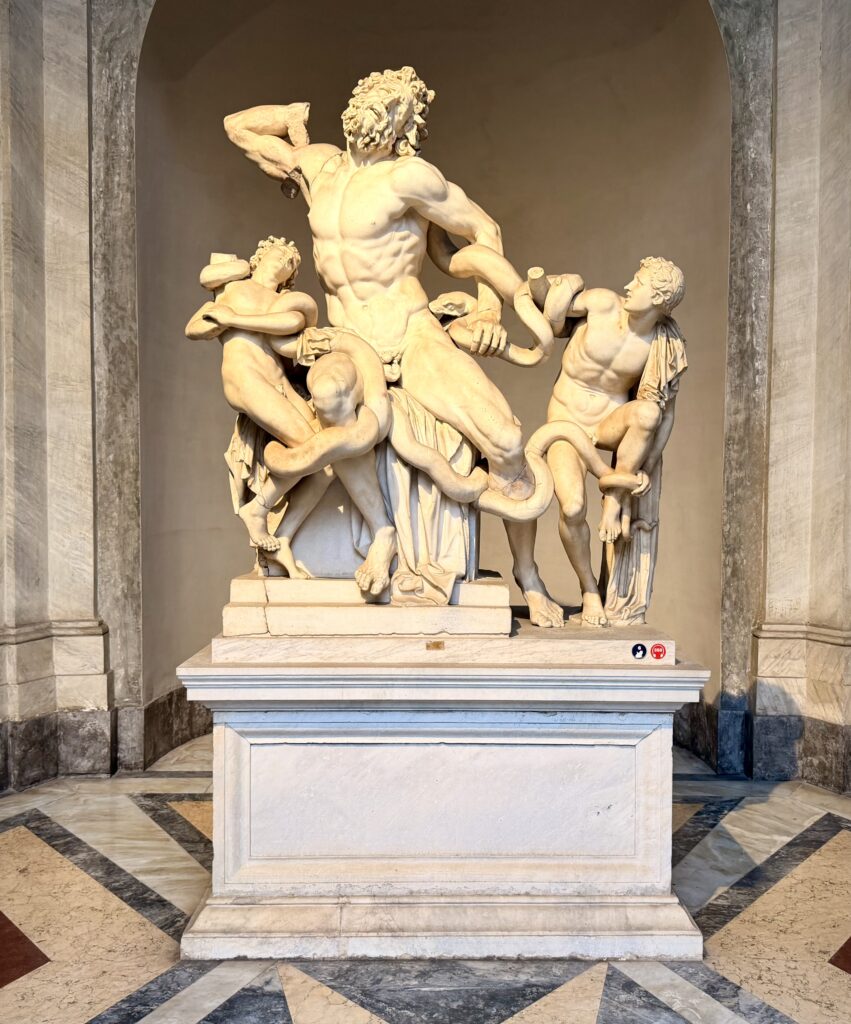
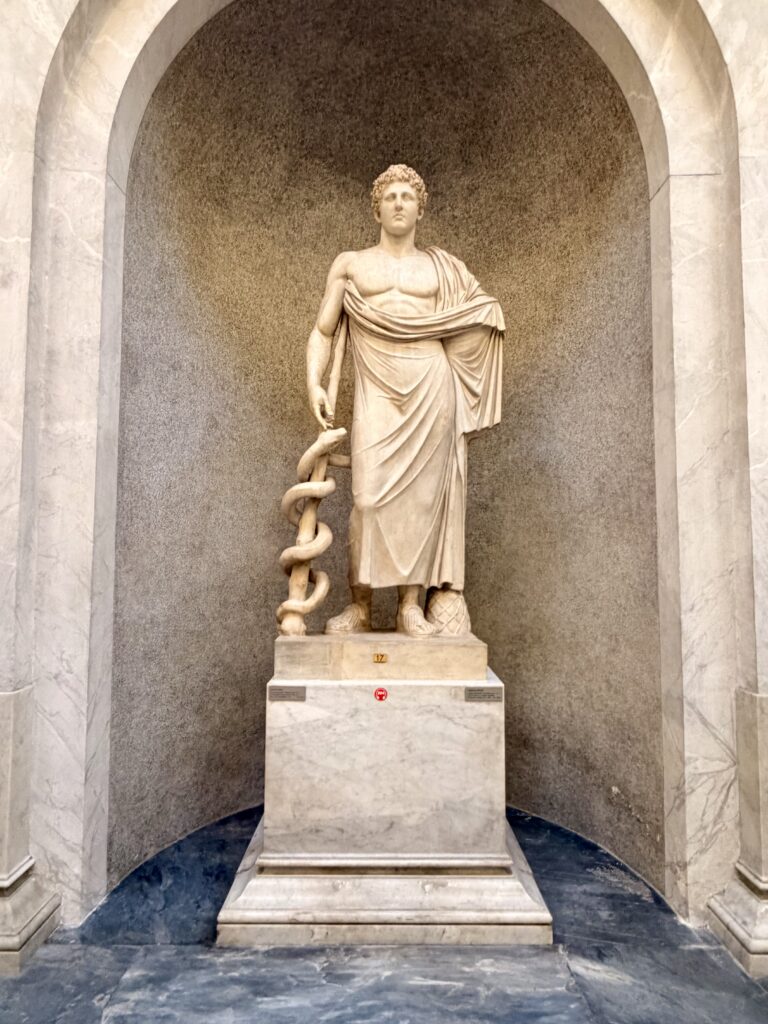
A few marble pieces of note were Nile, Lacoön, and Aesculapius.
Nile: This sculpture was discovered in Rome in 1513 and dates back to the 1st century. The river is shown as an old man stretched out on his side with a cornucopia of fruit in his left arm and ears of wheat in his right hand. The sphinx (along with some other exotic animals) represents Egypt. The 16 children allude to the 16 cubits of water by which the Nile rises for its annual flood season (a cubit is roughly 20 inches; it’s an ancient unit of length – the distance from the elbow to the tip of the middle finger). (https://www.museivaticani.va/content/museivaticani/en/collezioni/musei/braccio-nuovo/Nilo.html)
The Lacoön sculpture was discovered in Rome in 1506. The exact age of the sculpture isn’t known but it is thought to be a sculpture described by Pliny the Elder, who lived from 23-ish AD – 79 AD. There has been a lot of debate about the age of the statue but it is thought to date to around 40-30 BC.
Lacoön is a Trojan priest from Greek and Roman mythology who argued against bringing the wooden horse (left outside the gates by the Greeks) into Troy. He, along with his sons, was killed by sea serpents sent by the gods Athena and Poseidon (who sided with the Greeks) as punishment.
Some pieces were missing when the sculpture was discovered. In particular, the right arm of Lacoöon. During restoration, the artists had his arm extending out trying to free himself from the serpents. Then in 1905, the original arm was discovered in an antique shop in Rome by scholar Ludwig Pollak. The fragment (with the right arm bent trying to ward off the serpent’s fatal bite), was reattached in 1958.
The sculpture is the first work of art in the Vatican Museums (acquired by Pope Julius II, who purchased the work in 1506, shortly after its discovery).
Aesculapius – this was a 2nd century AD Roman interpretation of the 4th century BC Greek original. I mostly thought it was cool because Aesculapius is the Greek god of healing and medicine.
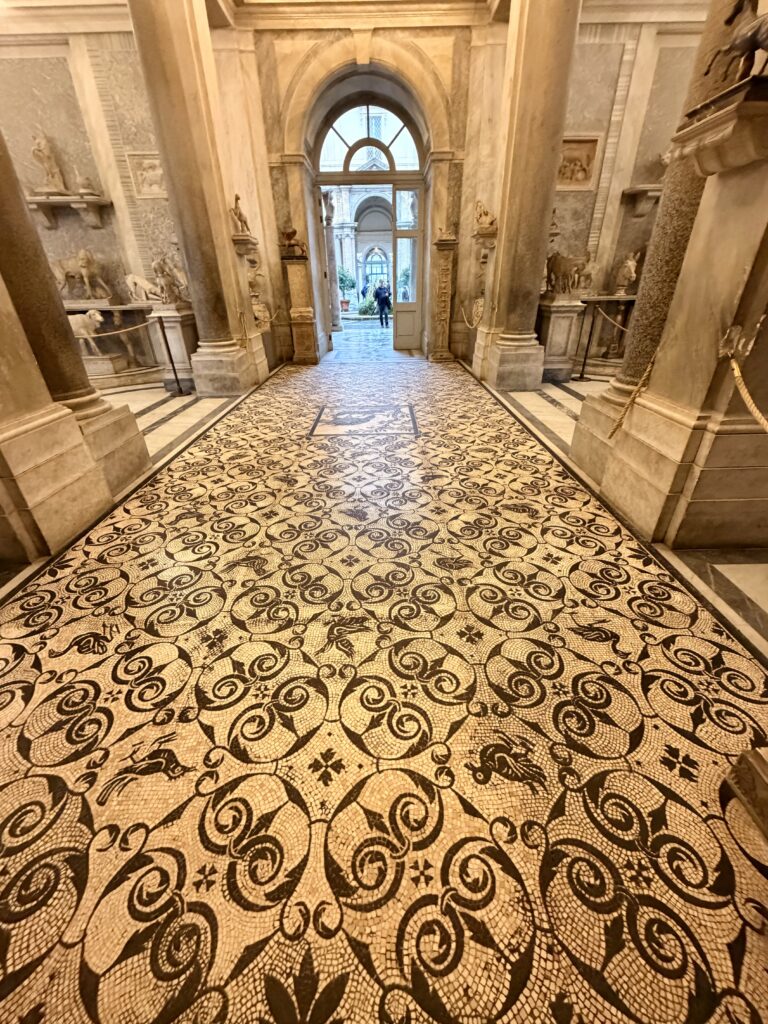
In addition to some amazing works of art, the building itself is beautiful. Many of the rooms had decorative mosaic tile floors like this one.
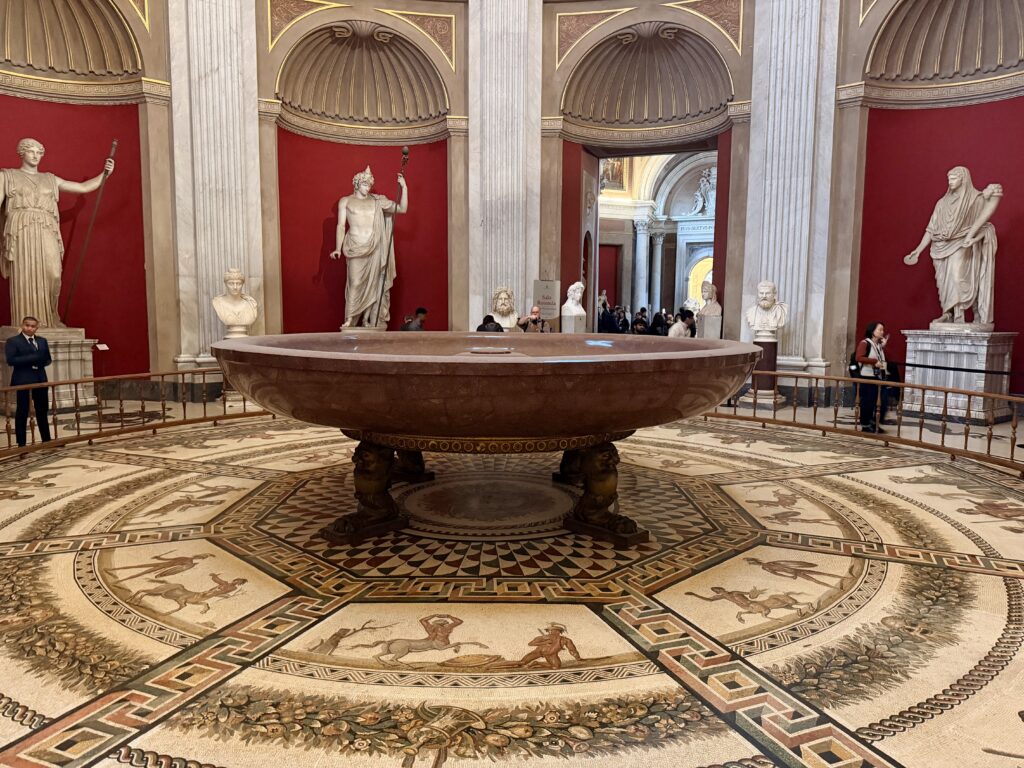
The Sala Rotunda (Round Hall) houses a large basin. It is 15 feet across and carved from a single block of stone – when it was moved to the Vatican in the 18th century, the room had to be built around it. It is made from rare Imperial porphyry (this porphyry is only found in a single mine in Egypt – Mons Porphyrites). The size of this basin almost causes you to miss the beautiful mosaic floor, which is over 1700 years old and depicts various battle scenes.
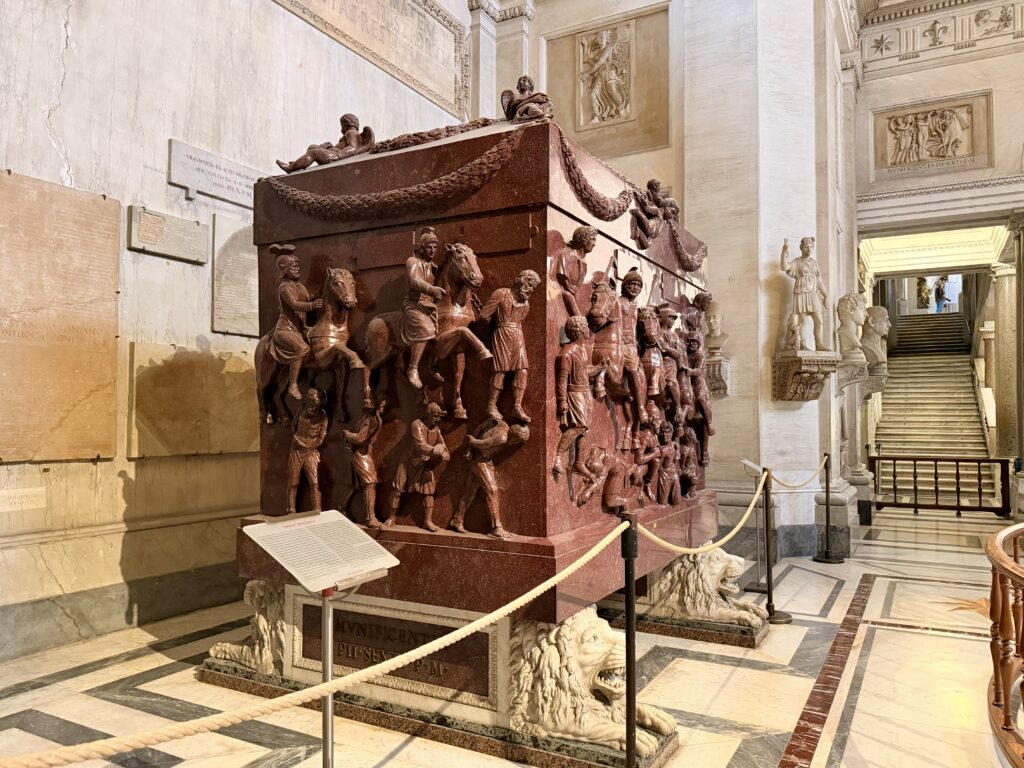
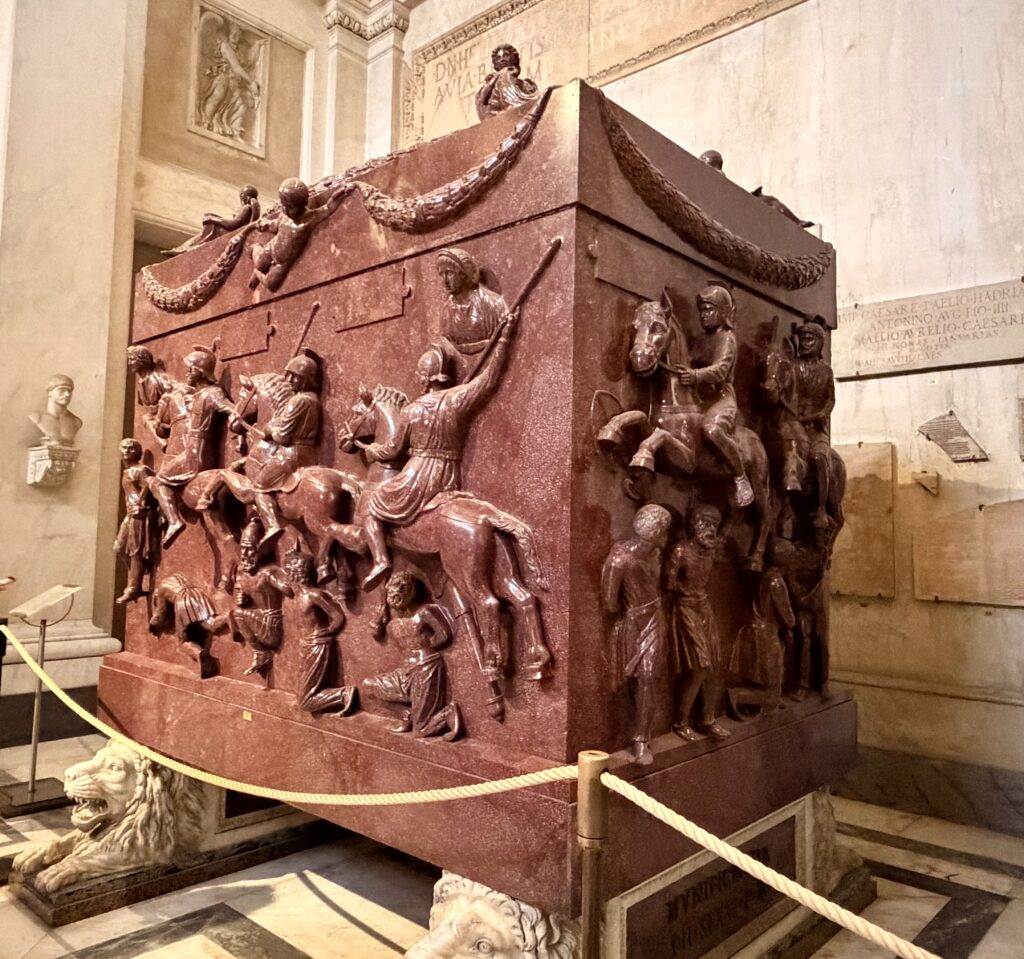
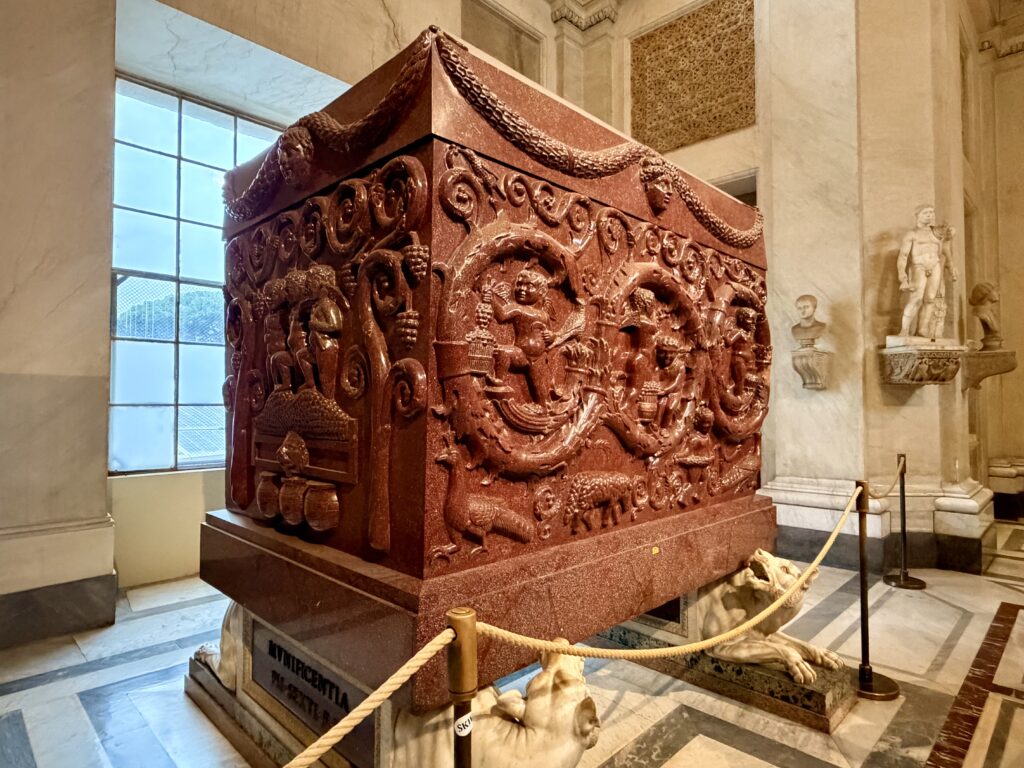
There are also 2 sarcophagi made from the same Imperial porphyry – the Sarcophagus of St Helena (mother of Constantine the Great) and the Sarcophagus of Constantia (one of the daughters of Emperor Constantine the Great).
Sarcophagus of St Helena: Helena, the mother of Constantine the Great, died around 335 AD and was buried just outside of Rome in the Imperial mausoleum at Tor Pignattara. This sarcophagus was brought to the Vatican in 1777 and restored and mounted on 4 lions. It is carved with military scenes which led scholars to believe it was originally intended for a male member of the Imperial family (most likely Constantine himself). (https://www.museivaticani.va/content/museivaticani/en/collezioni/musei/museo-pio-clementino/sala-a-croce-greca/sarcofago-di-s–elena.html)
Sarcophagus of Constantia: This sarcophagus was made to hold the remains of one of Emperor Constantine the Great’s daughters (likely Constantia who died in 354 AD). She was buried in a mausoleum alongside the Basilica of St. Agnes Outside the Walls. Between 1467 and 1471 the sarcophagus was moved to Piazza San Marco in Rome (near the Victor Emmanuel II monument). In 1790, it was taken into the Vatican Museums on a cart dragged by 40 oxen. (https://www.museivaticani.va/content/museivaticani/en/collezioni/musei/museo-pio-clementino/sala-a-croce-greca/sarcofago-di-costanza.html)
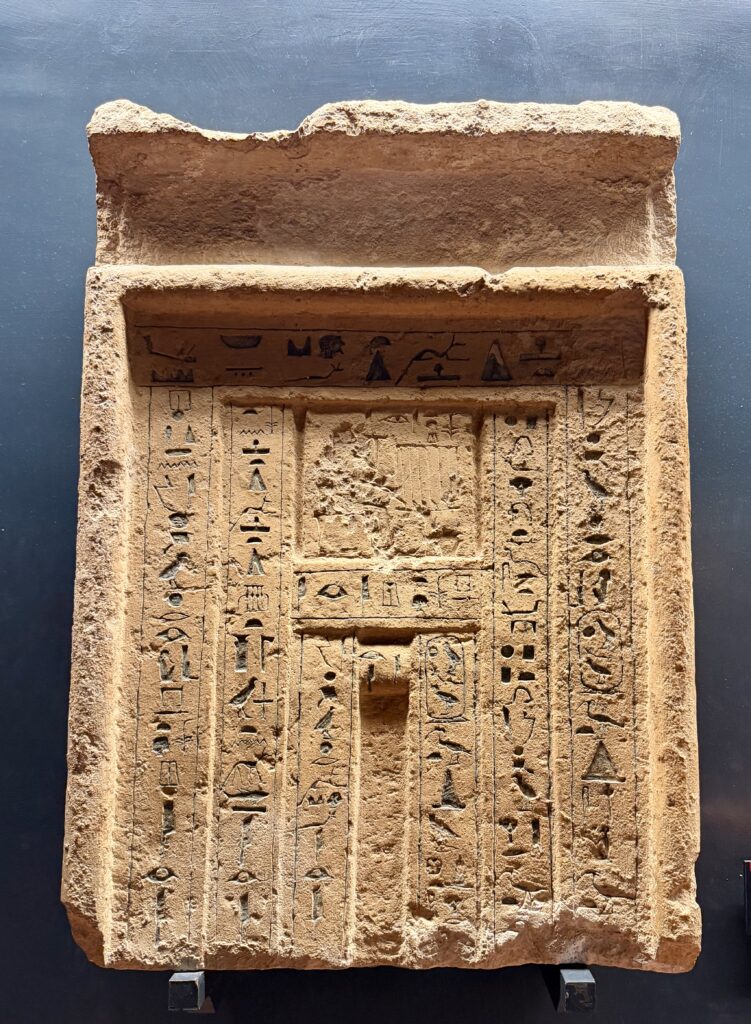
The Gregorian Egyptian Museum, founded on the initiative of Pope Gregory XVI in 1839, consists of 9 rooms that house Egyptian artifacts. The oldest pieces we saw in the museums were in this section. (https://www.museivaticani.va/content/museivaticani/en/collezioni/musei/museo-gregoriano-egizio.html)
The Stele of Iry is a funerary stele (grave marker) from 2323-2134 BC.
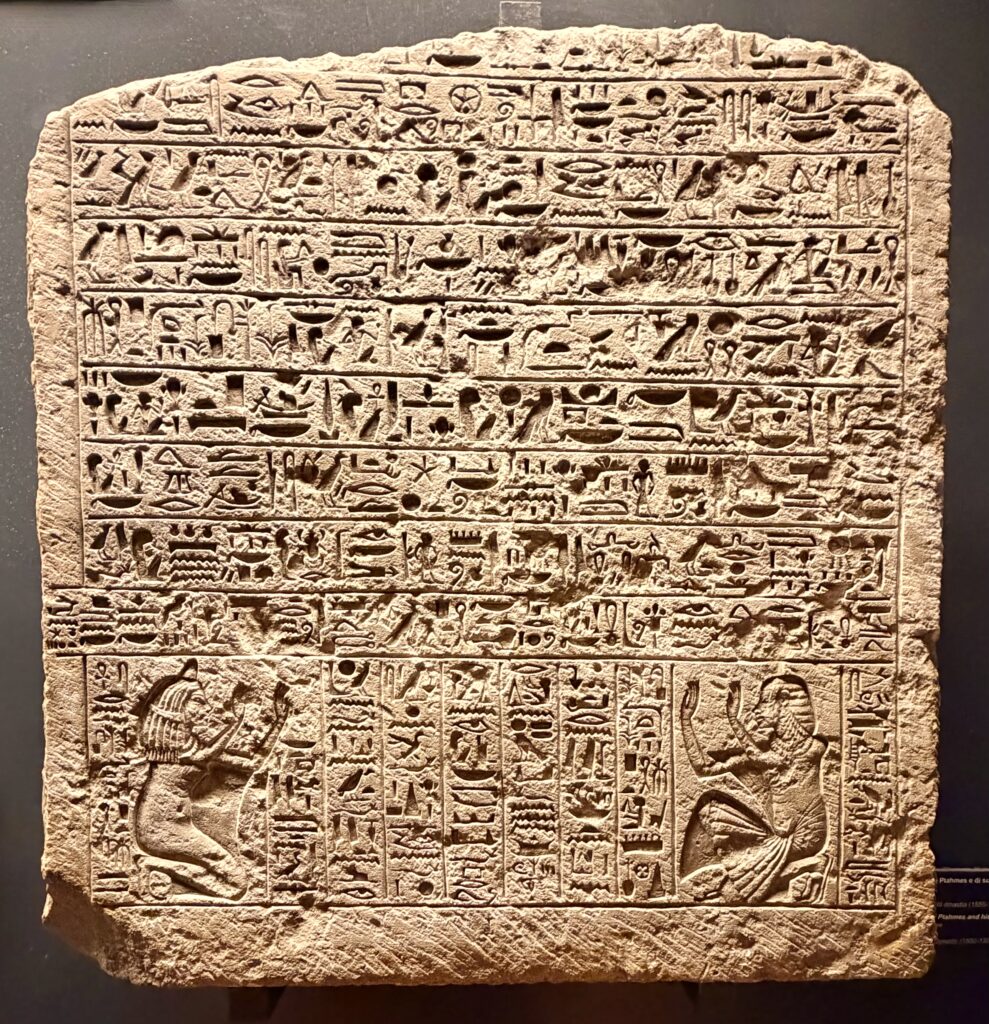
The Stele of Ptahmes and his mother Ruy is a limestone funerary monument dating to 1550-1307 BC.
The transition from hunter-gatherer to farming civilizations occurred initially in an area called the Fertile Crescent – a region in the Middle East surrounding the Tigris and Euphrates Rivers (the area previously Mesopotamia) and the part of the Nile near the Mediterranean Sea – so basically parts of present day southern Iraq, Syria, Lebanon, Jordan, Israel, and northern Egypt.
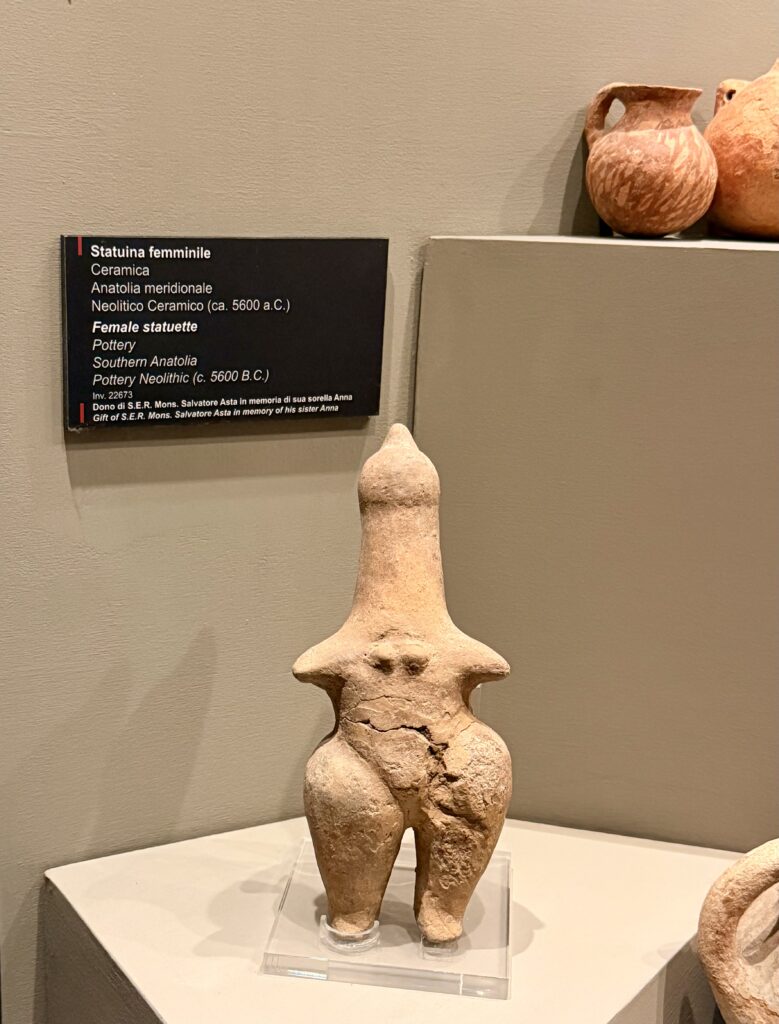
Pottery was introduced here in daily life as early as 7000 BC. The pottery below spans the period from 7000-3500 BC!
I thought the “female statuette” pottery (from 5600 BC!) was pretty funny.
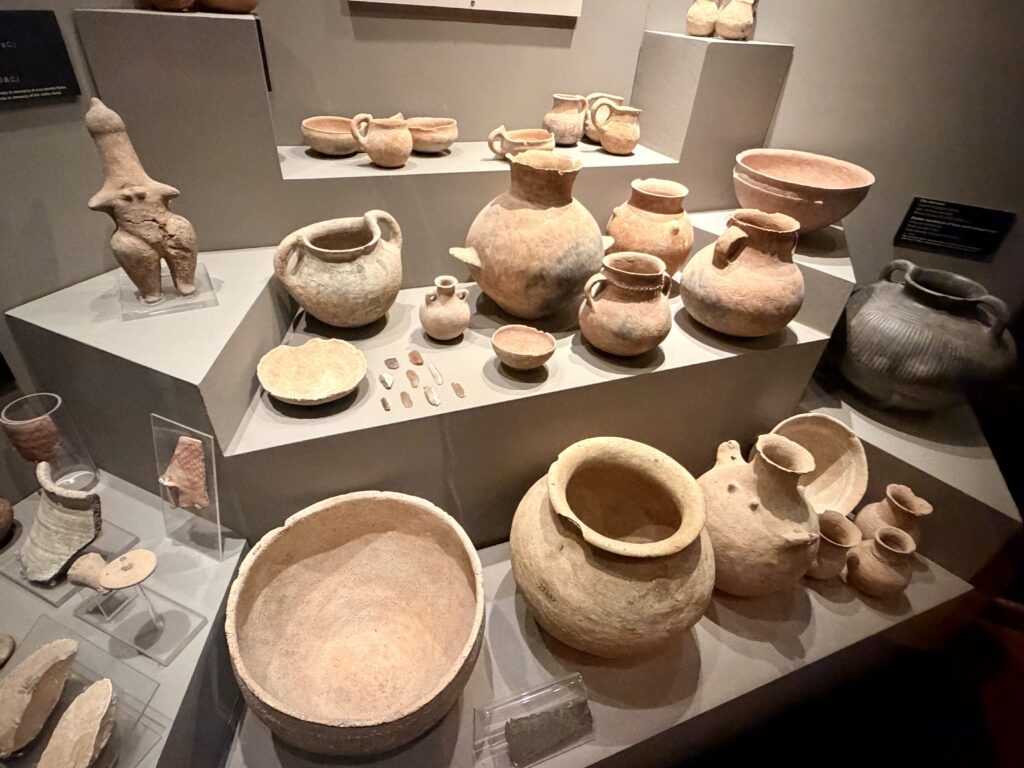
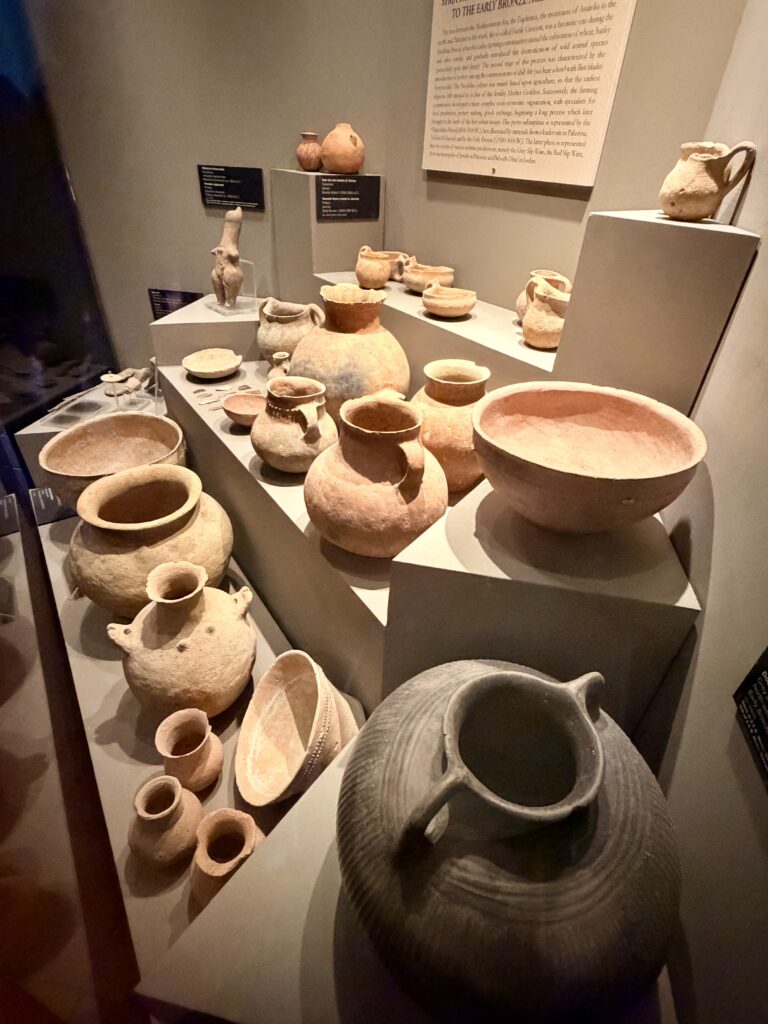
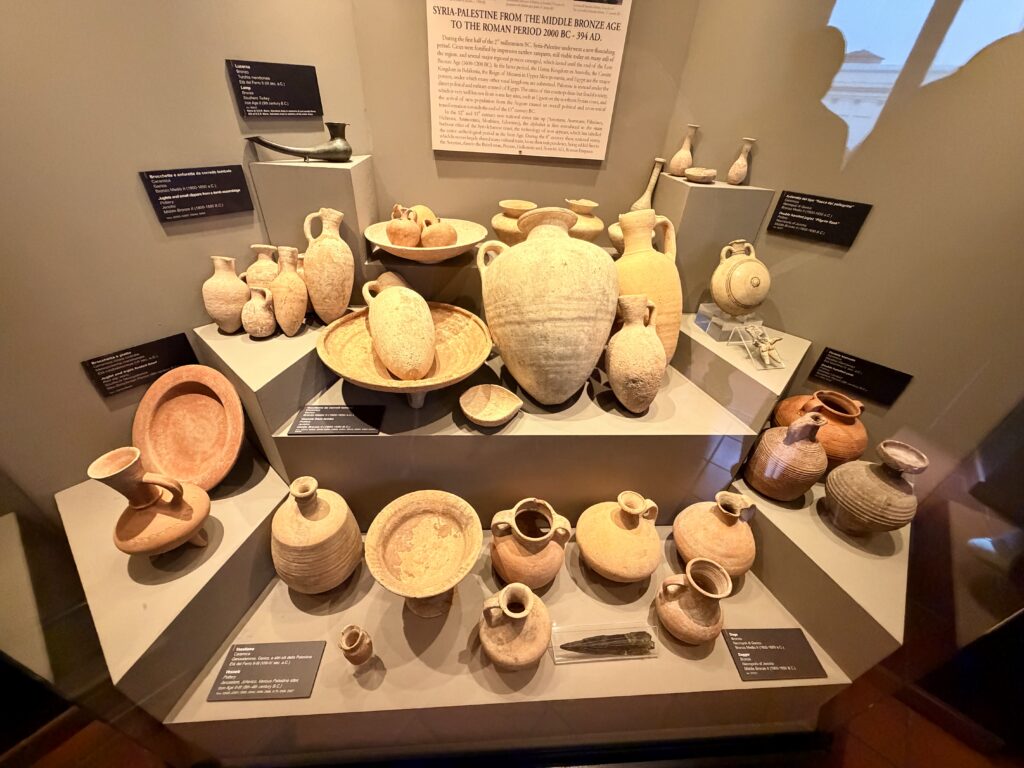
The pottery in this picture was newer – 1600 up through the 9th century BC (encompassing parts of the Bronze Age to the Roman period).
The last stop on the tour of the Vatican Museums is the Sistine Chapel. This room is a highlight of the tour but you have to go through all of the other rooms first – it’s a one-way tour through the museum and this is at the end (then you have to go outside and walk alllll the way around to get to the entrance to St. Peter’s Basilica (about a 15 minutes walk). There is a door from the chapel straight into the basilica that apparently some tour groups get to go through. Since we were not on one of those tours, we had to walk around the outside (in the rain). We got our steps in that day!
We spent close to 30 minutes inside the Sistine Chapel alone. I almost wished I could lay on the floor to see the ceiling because it hurts your neck to stare up in wonder for so long!
Michelangelo painted the ceiling from 1508-1512 standing up on scaffolding (not laying on his back as you’ve probably heard). I can’t imagine what his neck felt like after that! The ceiling depicts scenes from the Book of Genesis and it’s really incredible to see.
The Last Judgement was painted by Michaelangelo from 1536-1541 on the back wall of the chapel. It is currently undergoing restoration so it was covered in scaffolding and we weren’t able to see it.
You are not allowed to take pictures or video in the Sistine Chapel but they have a cool virtual tour on their website. (https://www.museivaticani.va/content/museivaticani/en/collezioni/musei/cappella-sistina.html). (Virtual Tour https://www.museivaticani.va/content/museivaticani/en/collezioni/musei/cappella-sistina/tour-virtuale.html).
Colosseum
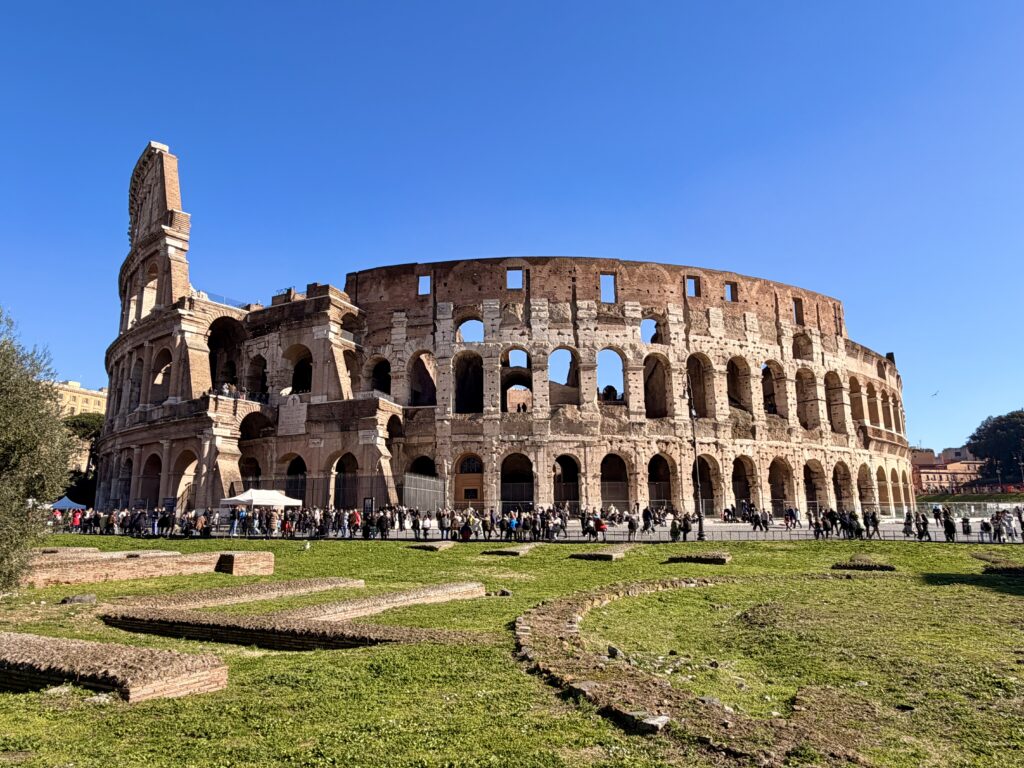
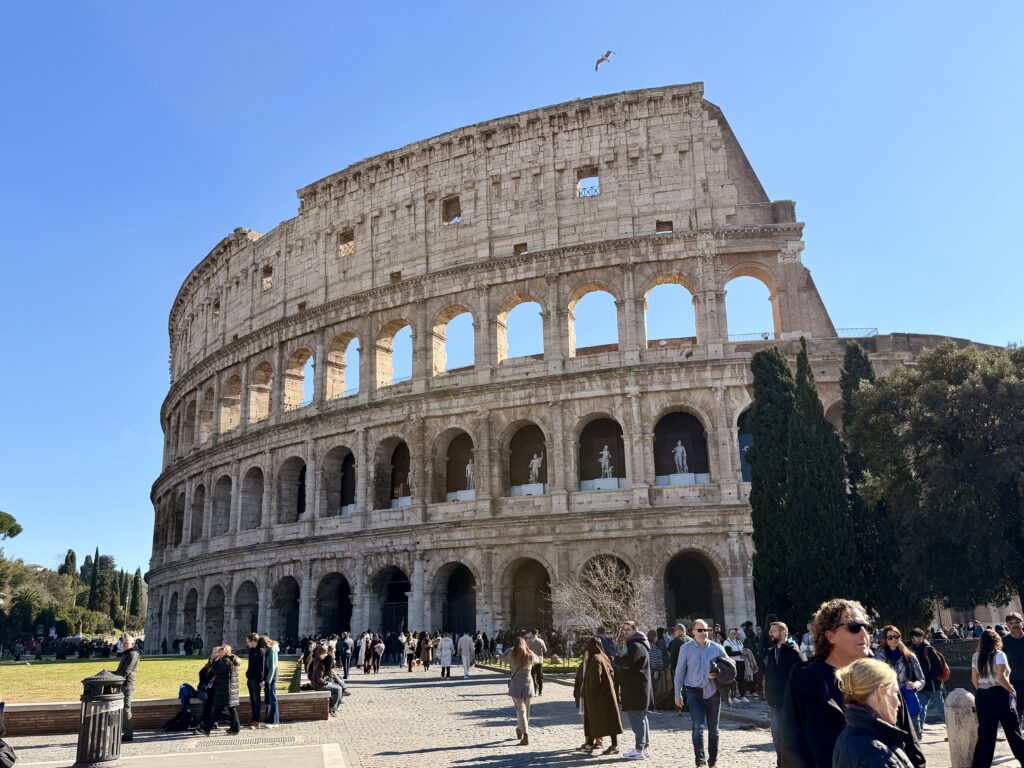
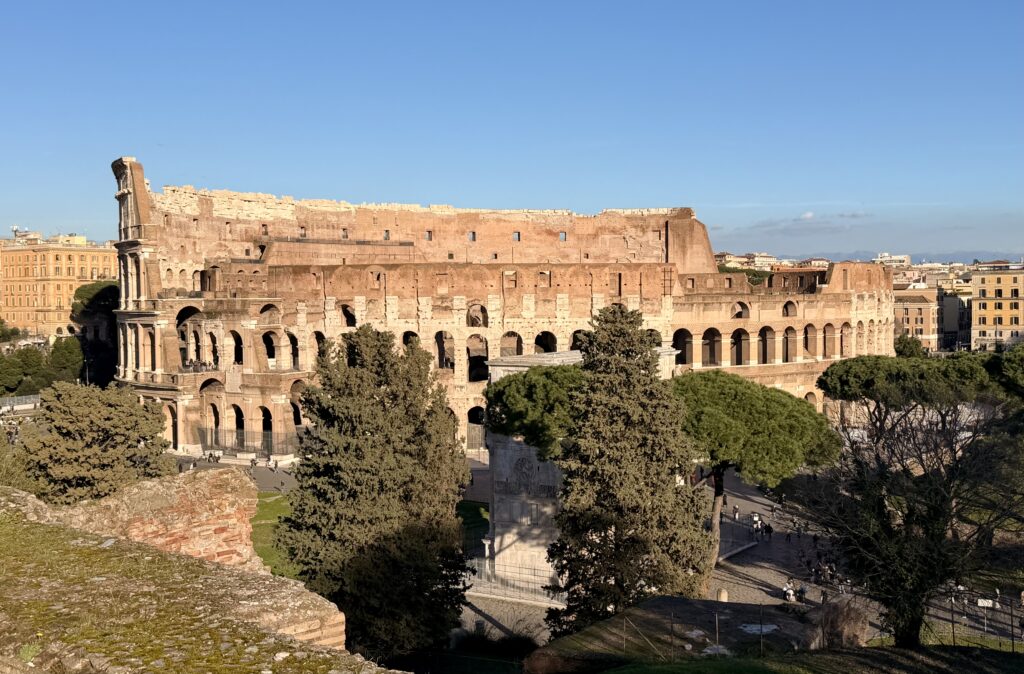
The Colosseum in Rome needs no introduction. Its actual name is the Flavian Amphitheater (it was built at the behest of emperors of the Flavian Dynasty in the 1st century AD). It’s probably one of the most recognized monuments and if you think of one picture of Rome, it’s probably the Colosseum. Construction started in 72 AD and was completed in 80 AD. It’s the largest ancient amphitheater ever built (and the largest standing amphitheater in the world). The gladiatorial games were abolished in 438 AD and after that the amphitheater started a slow and steady decline. As with so many other ancient structures that now exist as ruins, it became a quarry for building materials for other structures. In fact, stones from the Colosseum were used in the construction of St. Peter’s Basilica. (https://colosseo.it/en/area/the-colosseum/)
As I mentioned earlier, you buy a combo ticket that includes the Colosseum, the Roman Forum, and Palantine Hill for €18.00 (https://colosseo.it/en/tickets/24h-colosseum-roman-forum-and-palatine/). Whether you want to go into the other sights or not, the ticket is the same. The ticket is good for 24 hours from entry (so if you start in the afternoon, you could come back the next morning). You have to pick an entry time for the Colosseum then the other 2 sights don’t require a timed entry. So we went to the Colosseum first with a 10:15 AM entry slot. Then the Forum after that, then Palantine Hill. We did have a bit of an adventure getting there – we decided to walk but didn’t realize the road was closed (even for pedestrians) around the shortest route past the Victor Emmanuel II monument. So we had to go around. Thankfully we had left with plenty of time – instead of being 20+ minutes early, we got there right on time.
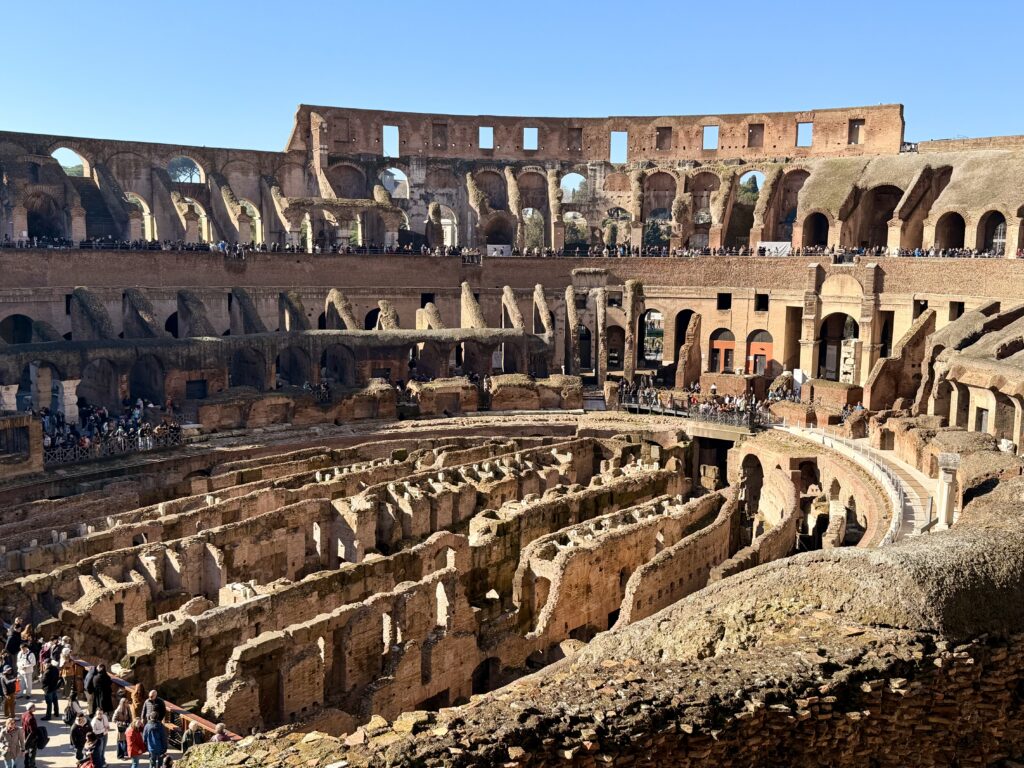
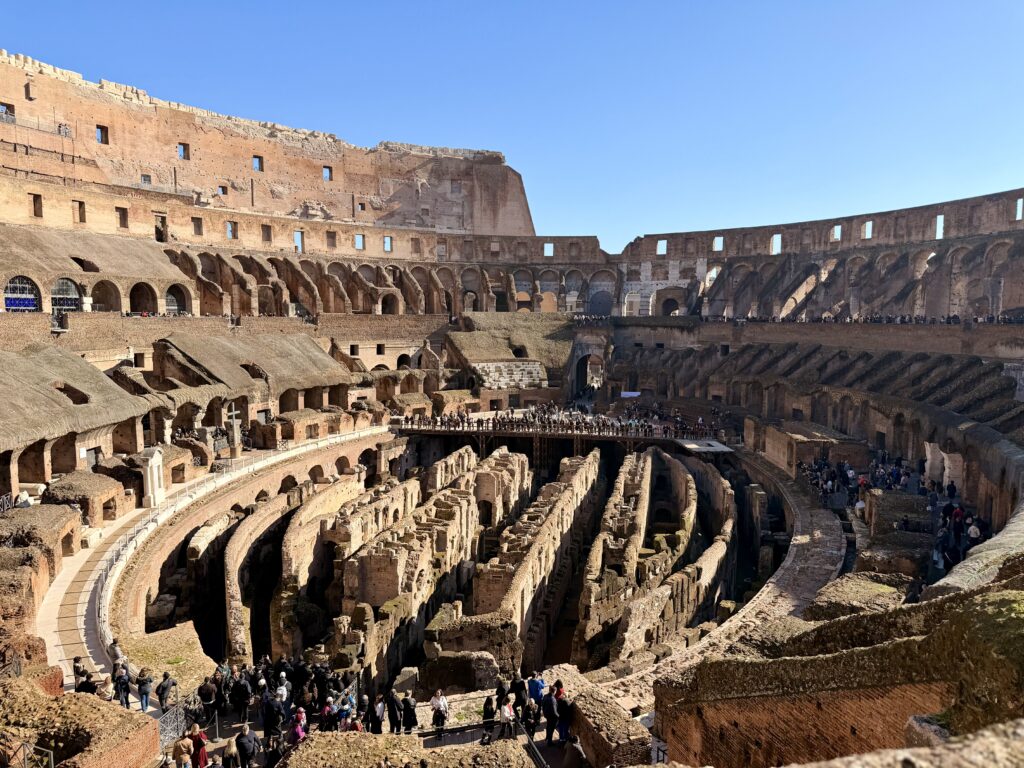
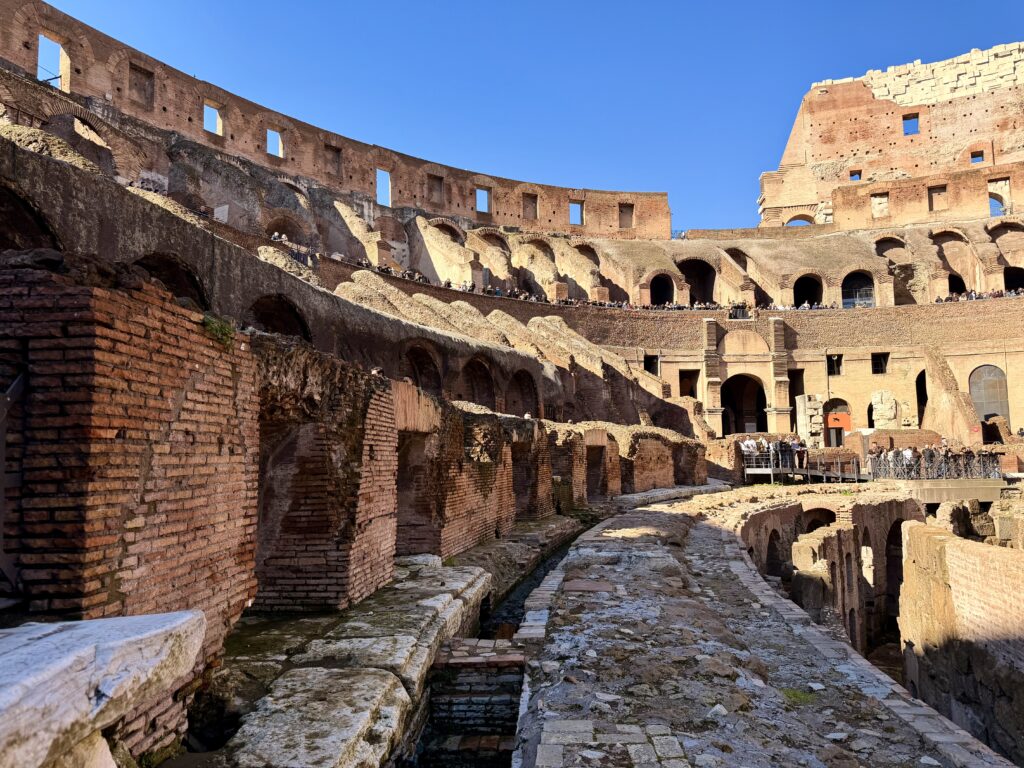
If you can picture the Colosseum in its heyday, there was a floor above the now-exposed hallways. The above photo shows a reconstructed partial floor that you can walk on to get a better look. Then you can see various levels of seating – just like in a modern arena, the lowest level ones were the fanciest/most expensive. There are also special tours that take you into these underground spaces but we just did the regular self-guided tour.
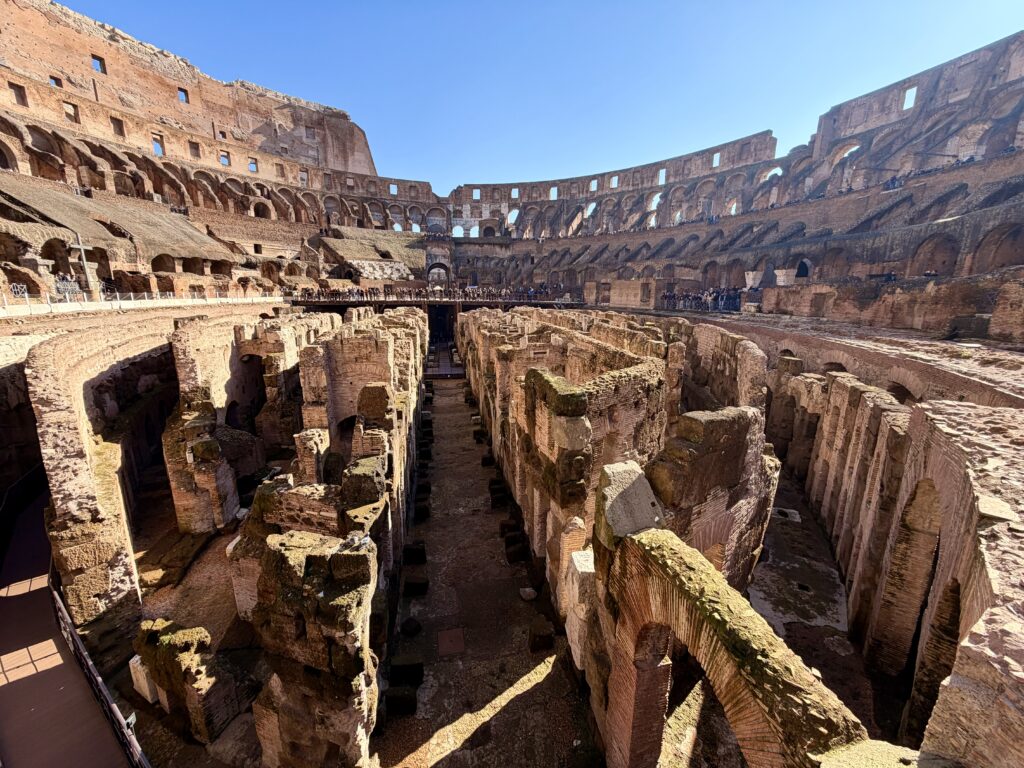
It’s really impressive to see from the outside too. Hard to imagine this was built over 2000 years ago and so much of it is still standing!
The Roman Forum
The Roman Forum was the center of Roman life, holding government buildings and public events starting from the 8th century BC through the 7th century AD. (https://colosseo.it/en/area/the-roman-forum/). Rubble from the Forum (as well as the Colosseum) was scavenged and some of it was used to build St. Peter’s Basilica. In the 19th century, excavation and restoration began.
For each of the specific sights in the Forum, I included a link to the official website with more information about each one.
You first get a glimpse of the Forum from the Colosseum. The Temple of Venus and Roma – built in Emperor Hadrian’s time, it is the largest sacred building built by the Romans. It was started in 121 AD and completed in 141 AD. (https://colosseo.it/en/marvels/temple-of-venus-and-roma/)
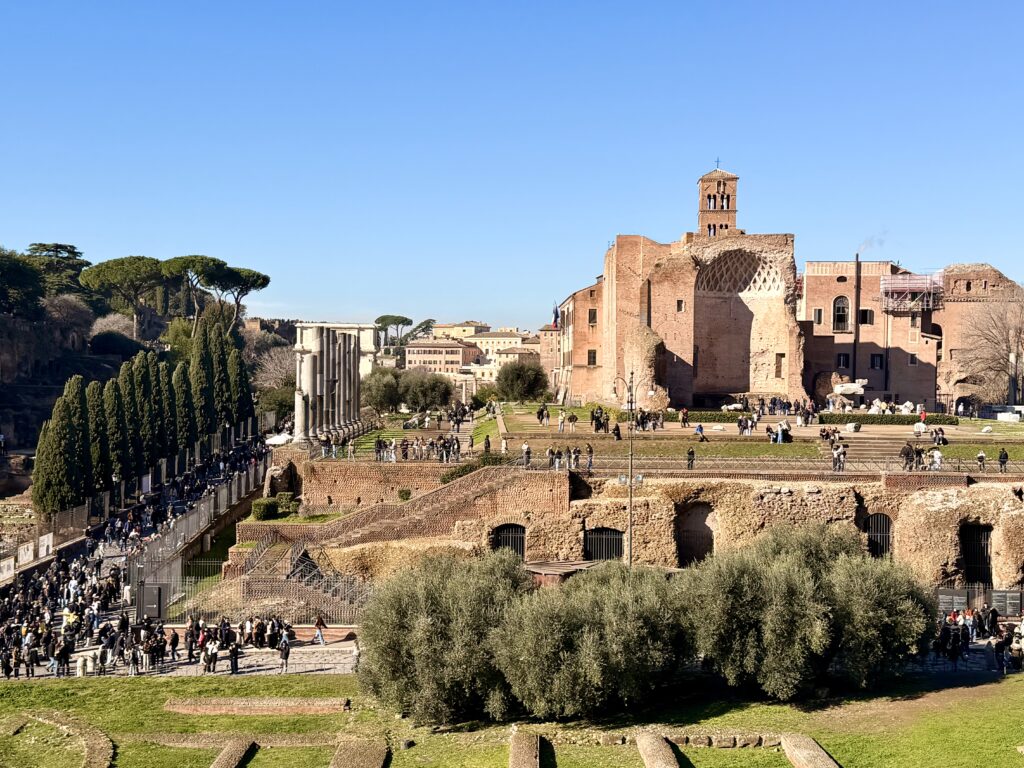
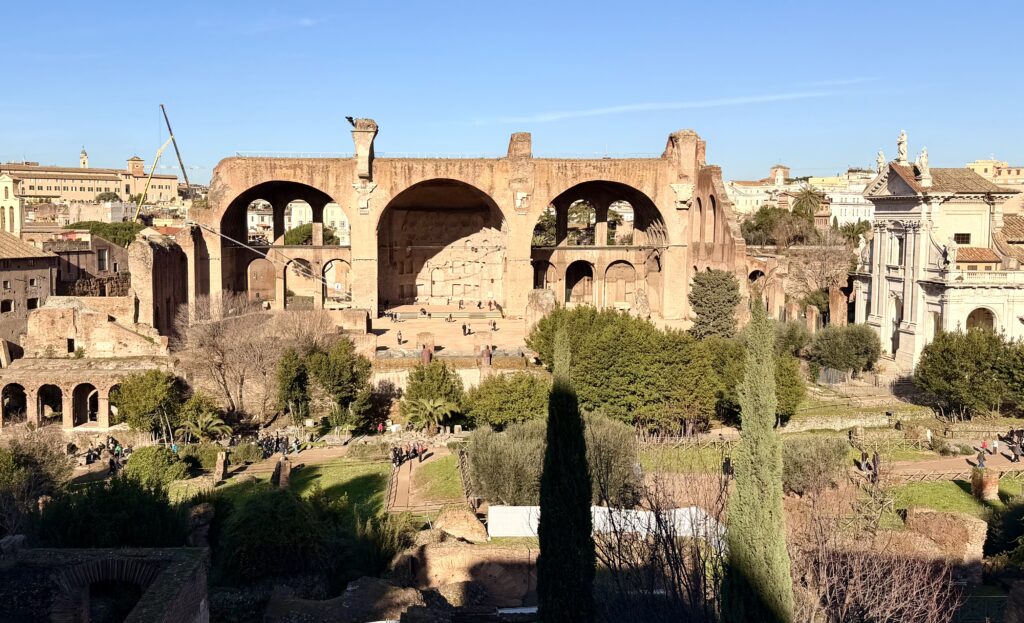
The Basilica of Maxentius (or of Constantine) was huge – around 6000 square meters (about 64,000 square feet!). Construction was started with Maxentius (306-312 AD) and finished by Constantine (306-337 AD). (https://colosseo.it/en/marvels/basilica-of-maxentius/)
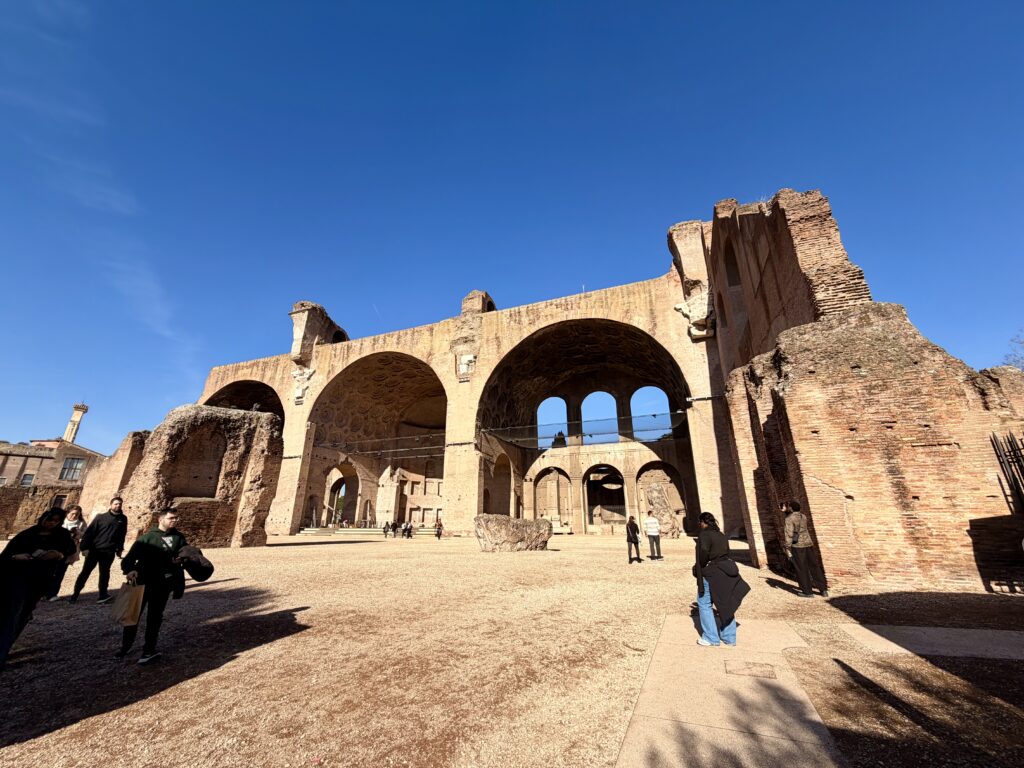
It was large enough that it was tough to get a good picture of it from ground level – it was much easier to capture from up on Palantine Hill.
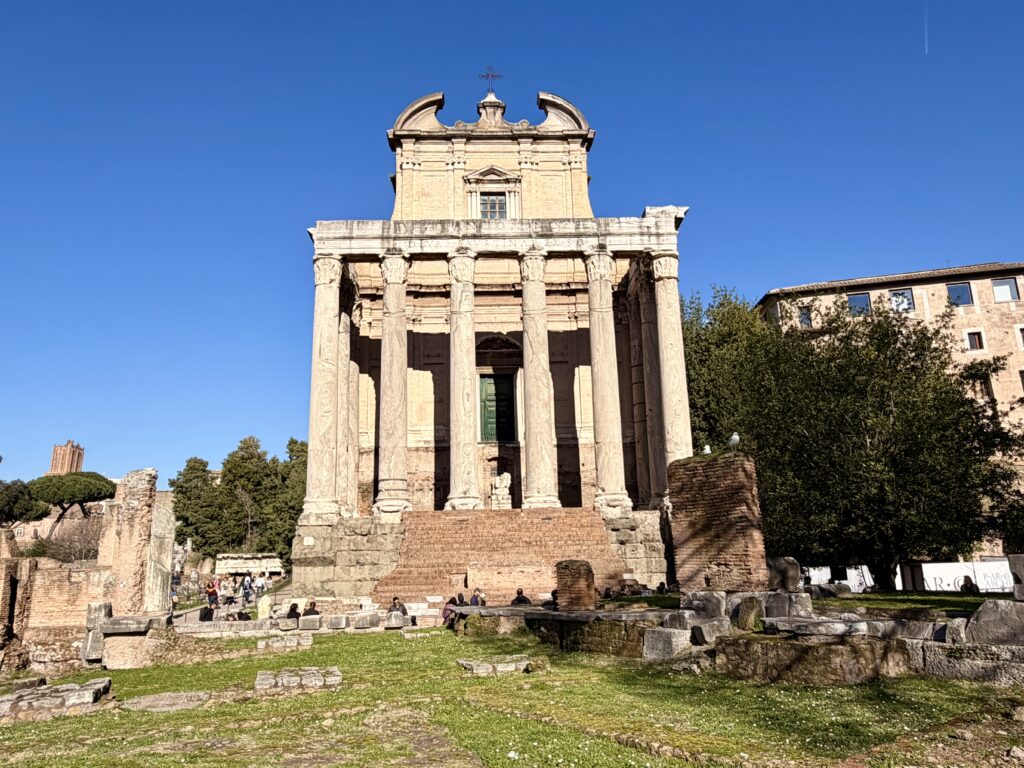
The Temple of Antoninus and Faustina was dedicated by the Senate to Faustina (the wife of Emperor Antoninus Pius) after she died in 140 AD. Then when Emperor Antoninus Pius died in 161 AD, the Senate decided the temple should be dedicated to both of them. The facade has 6 marble columns that are 17 meters (56 feet) high. (https://colosseo.it/en/marvels/temple-of-antoninus-and-faustina/)
This was a temple dedicated to the goddess Vesta – and linked to the cult of Vesta, an ancient cult dating back to the 7th century BD and banned by the end of the 4th century AD. The interior of the temple housed “a sacred fire that was never to be extinguished, a symbol of the eternity of Rome and its destiny as a universal empire”. The temple and flame were watched over by the Vestal Virgins, with one stationed there at all times. (https://colosseo.it/en/marvels/temple-of-vesta-and-vestal-house-atrium-vestae/)
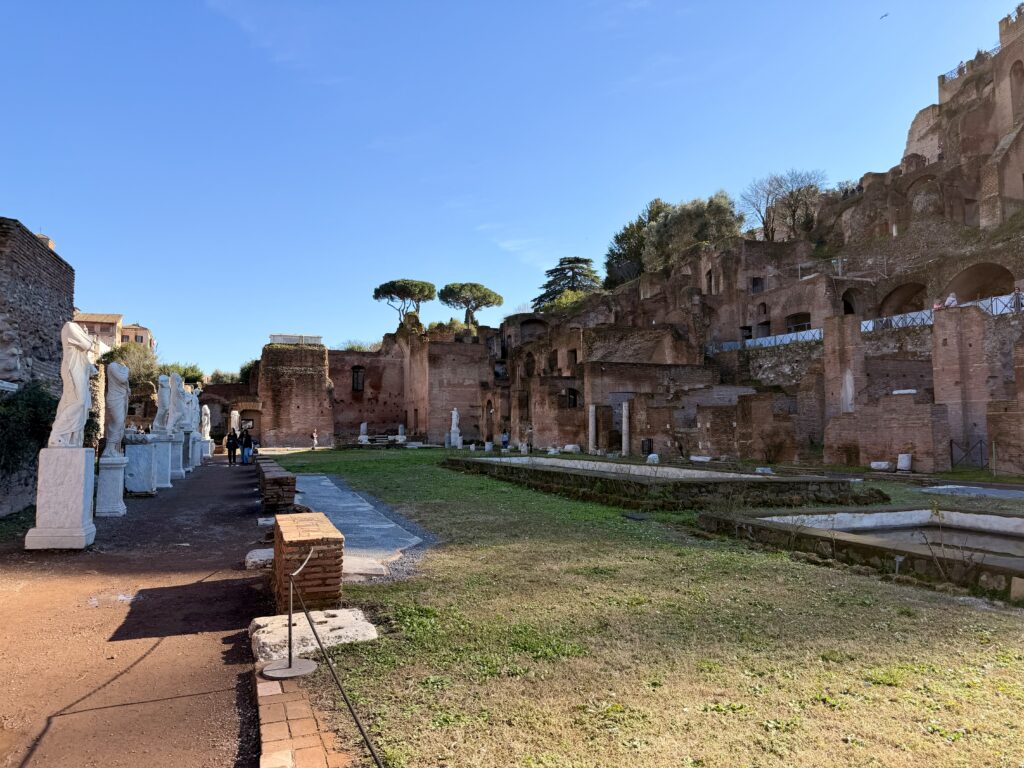
The Vestal Virgins were a priestly order of young aristocratic girls – they were the only female priesthood in Rome. They were chosen by the Pontifex Maximus (the highest ranking priest in Ancient Rome) between the ages of 6 and 10 years (before puberty). Their service lasted for 30 years and they had to take a vow of chastity during that time. They kept the fire in the temple burning – if the fire went out, they were punished with whipping. If they broke their vow of chastity, they were buried alive! And if their partner was known, he was publicly beaten to death. Yikes!
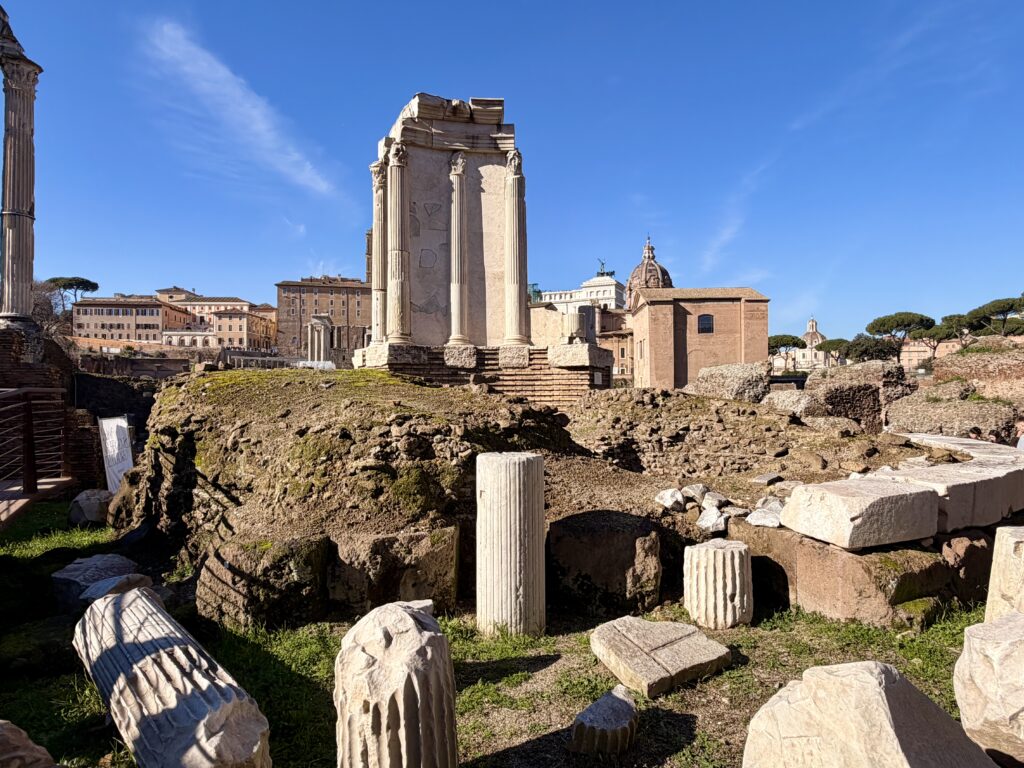
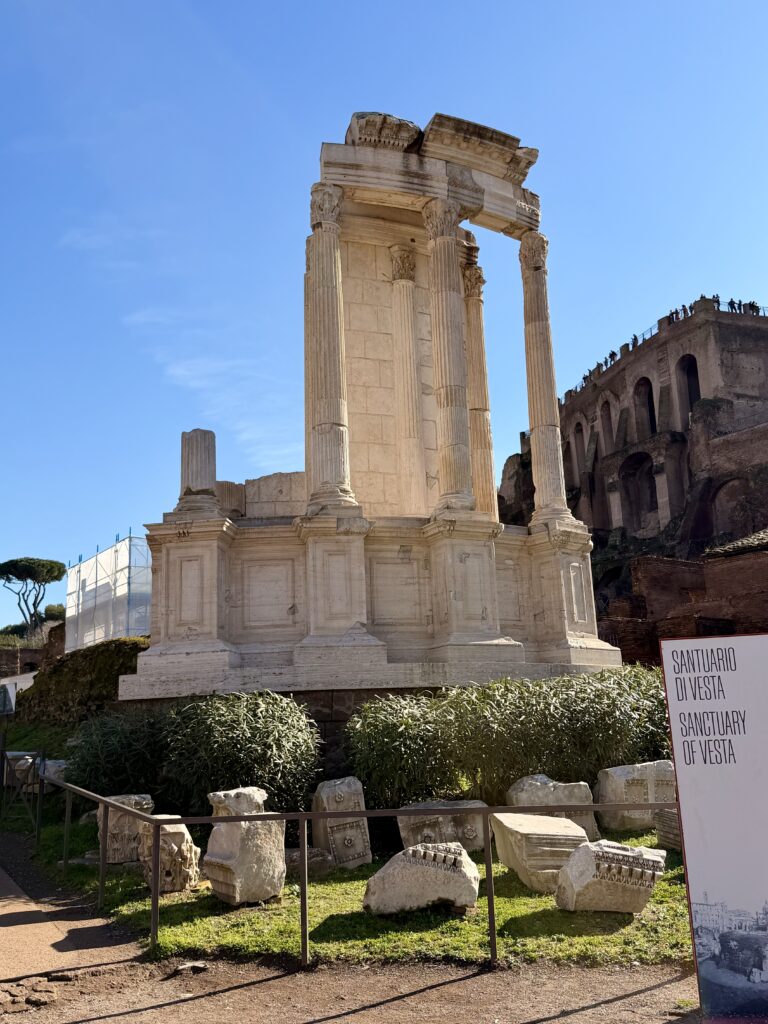
The House of the Vestal Virgins sits right next to the temple.
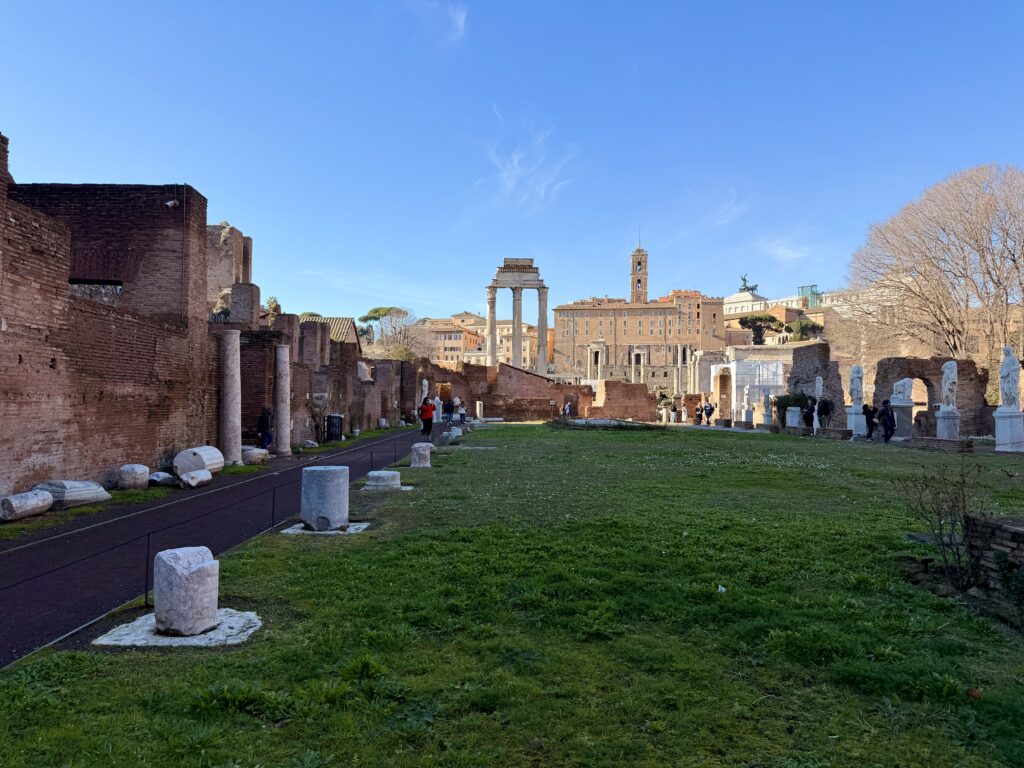
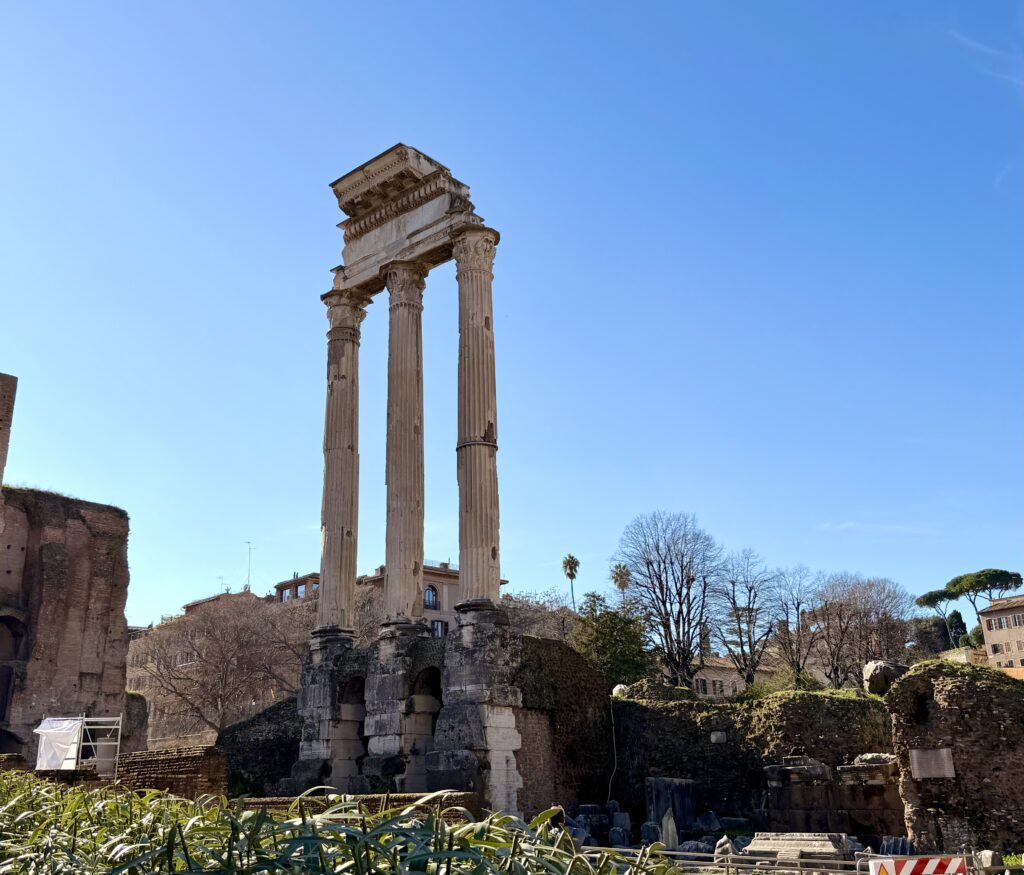
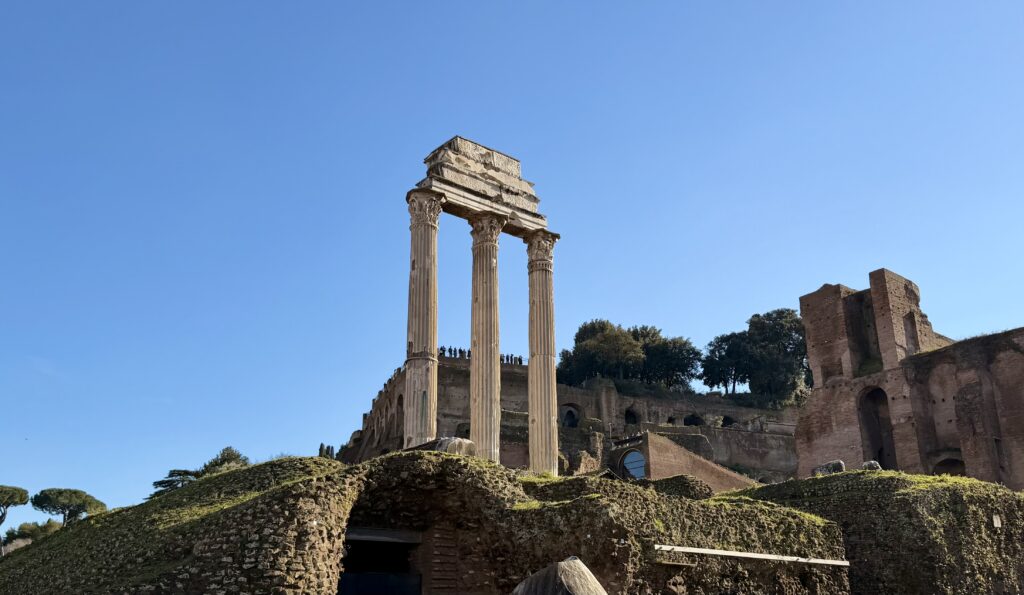
The Temple of the Dioscuri (Temple of Castor and Pollux) was built in 484 BC as gratitude for victory at the Battle of Lake Regillus in 499 BC. Castor and Pollux were the Dioscuri – the “twin” (Gemini) sons of Leda (but with 2 fathers – Zeus and Tyndareus – King of Sparta). They miraculously appeared on this site on the day of the battle, watering their horses.
These 3 Corinthian columns on a podium are among the few in the Roman Forum that have remained standing.
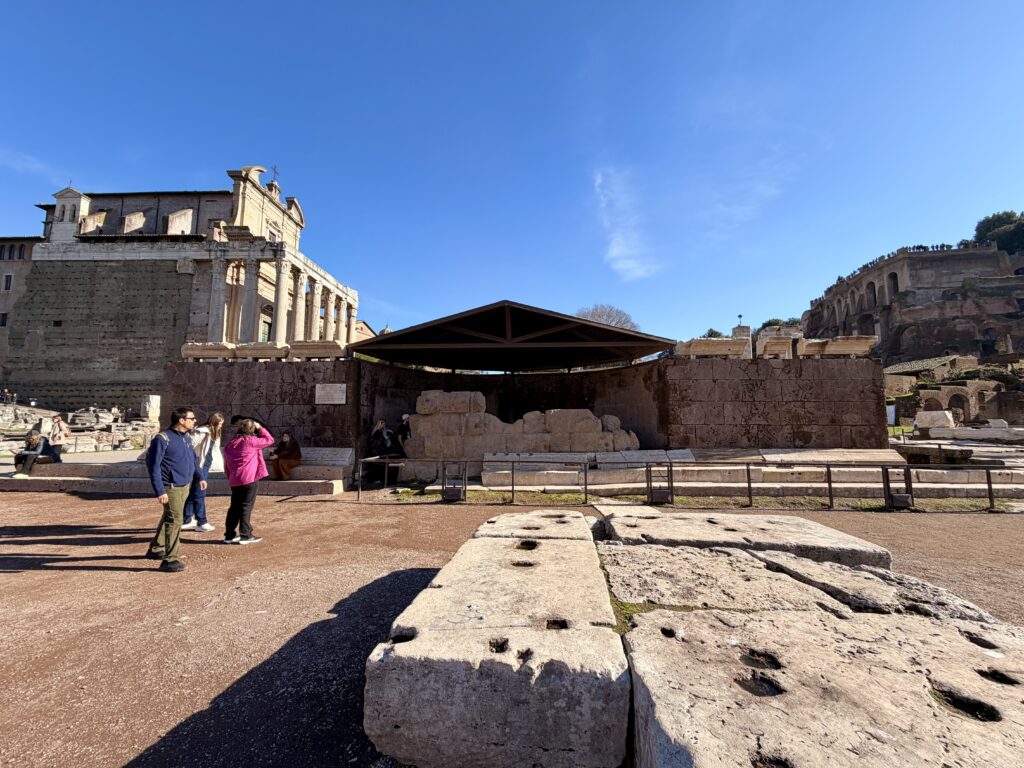
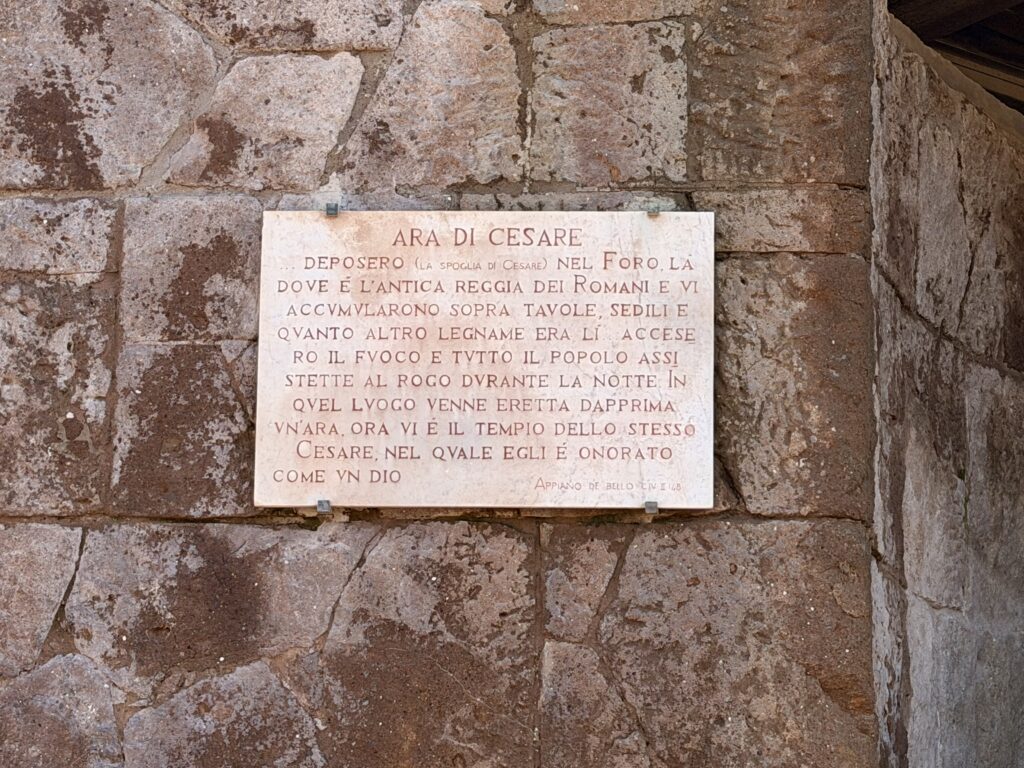
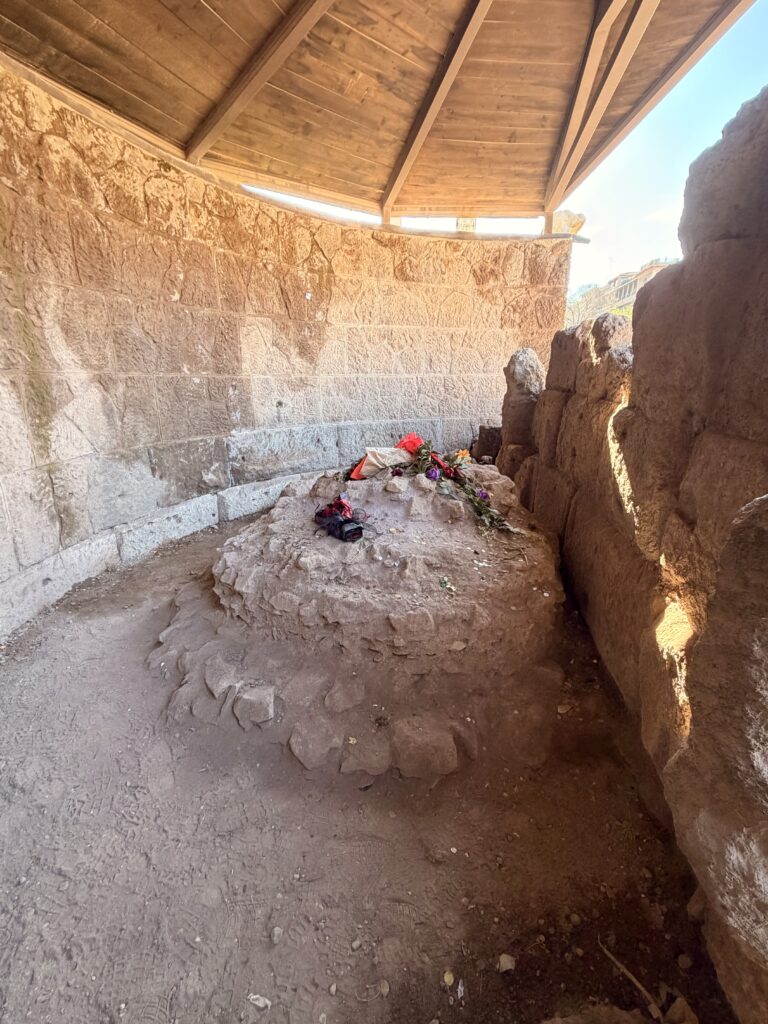
Right on the Forum Square, you can find the remains of the Temple of Caesar. He was murdered by Cassius and Brutus and their supporters on 15 March 44 BC (beware the Ides of March!). Caesar was then cremated and this temple was built on the site of his cremation. It was completed in 29 BC. If you remember, he was murdered on the steps of the Senate … more on that later.
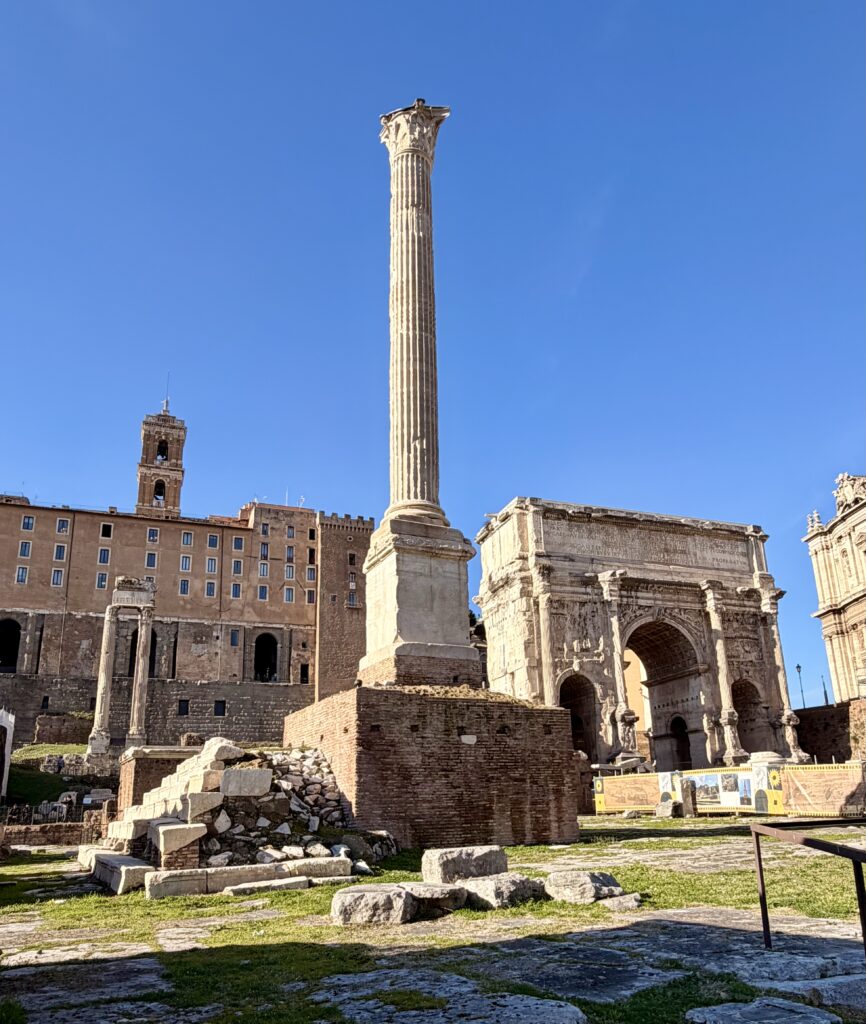
The Column of Phocas stands at over 13 meters (44 feet) high and was dedicated in honor of the Eastern Roman Emperor Phocas in 608 AD. It was the last architectural addition made to the Roman Forum, after over 1,300 years of construction.
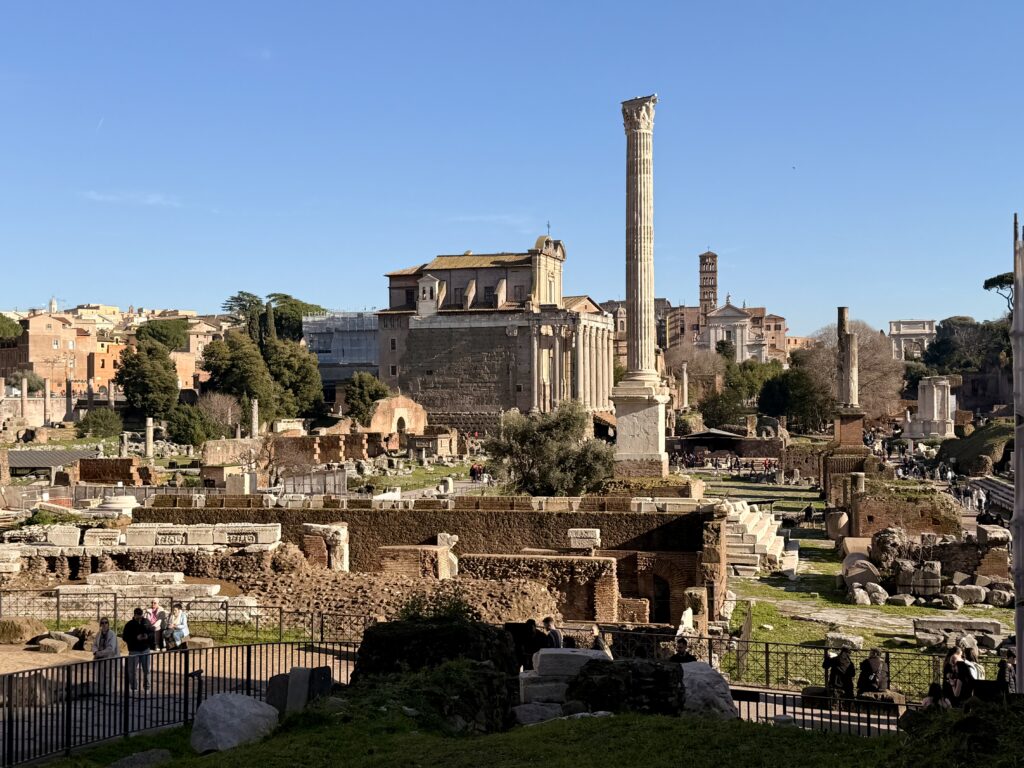
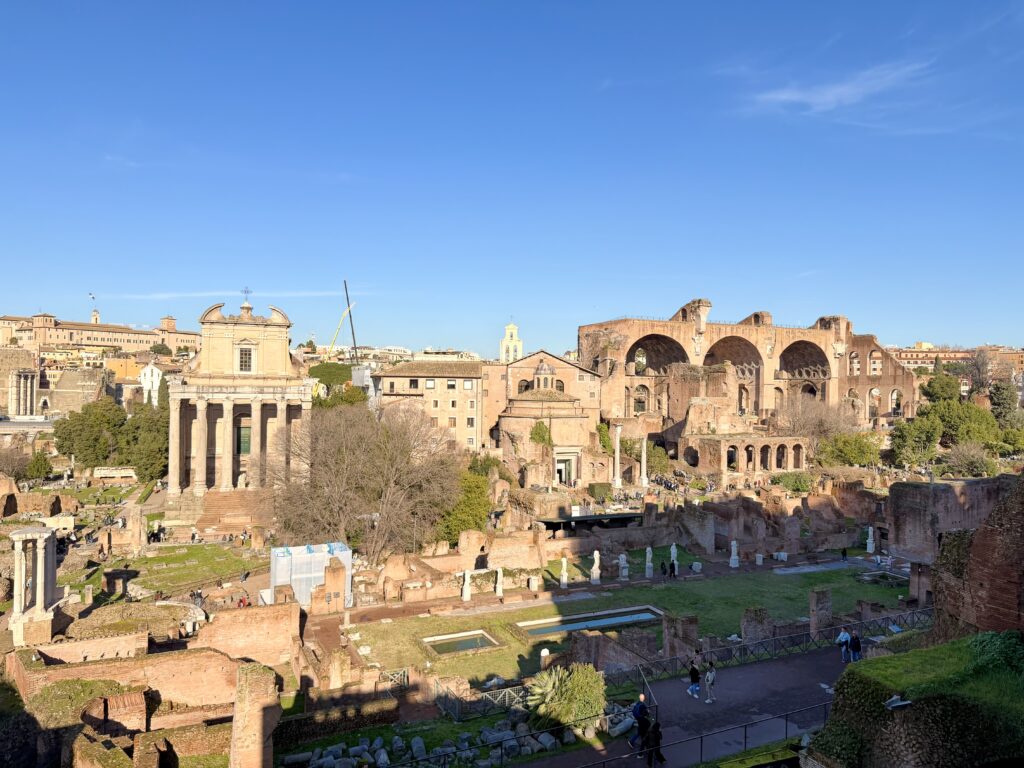
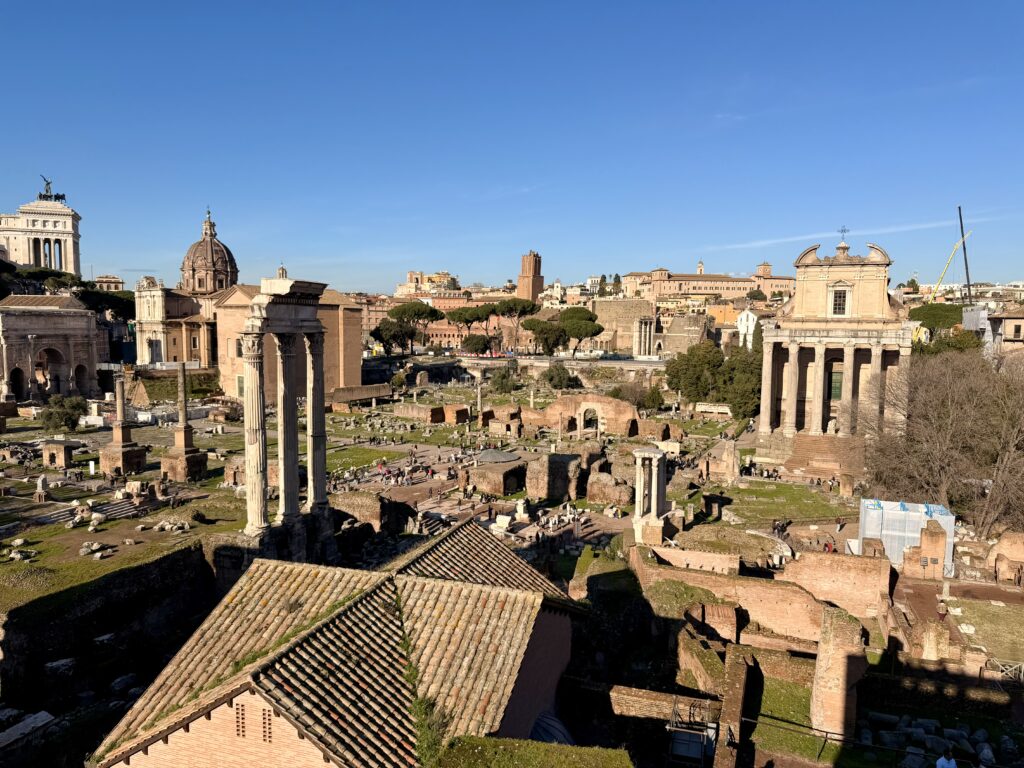
It’s crazy to see the Forum from up high and realize how the area is just littered with remains of ancient buildings.
Palantine Hill
Palantine Hill is contiguous with the Roman Forum (you can move between them without having to go through a ticket stall or security). It contains remnants of Iron Age settlements in Rome. Between the 2nd and 1st centuries BC, it was the residential district for Roman aristocracy (including Emperor Augustus). (https://colosseo.it/en/area/the-palatine/)
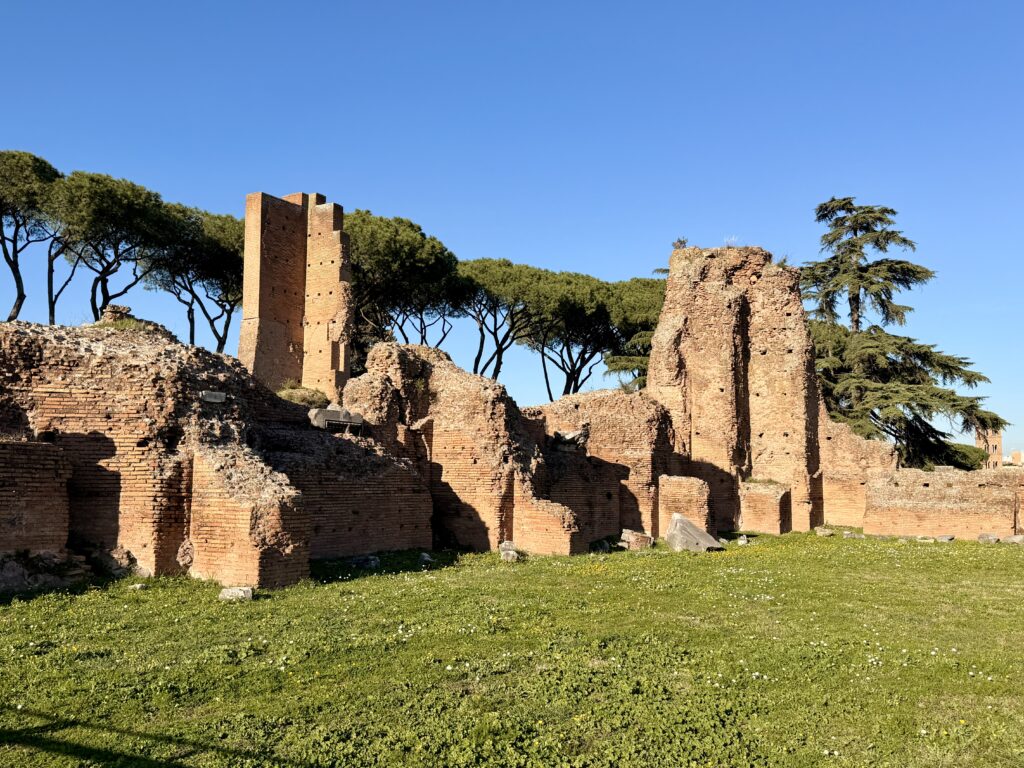
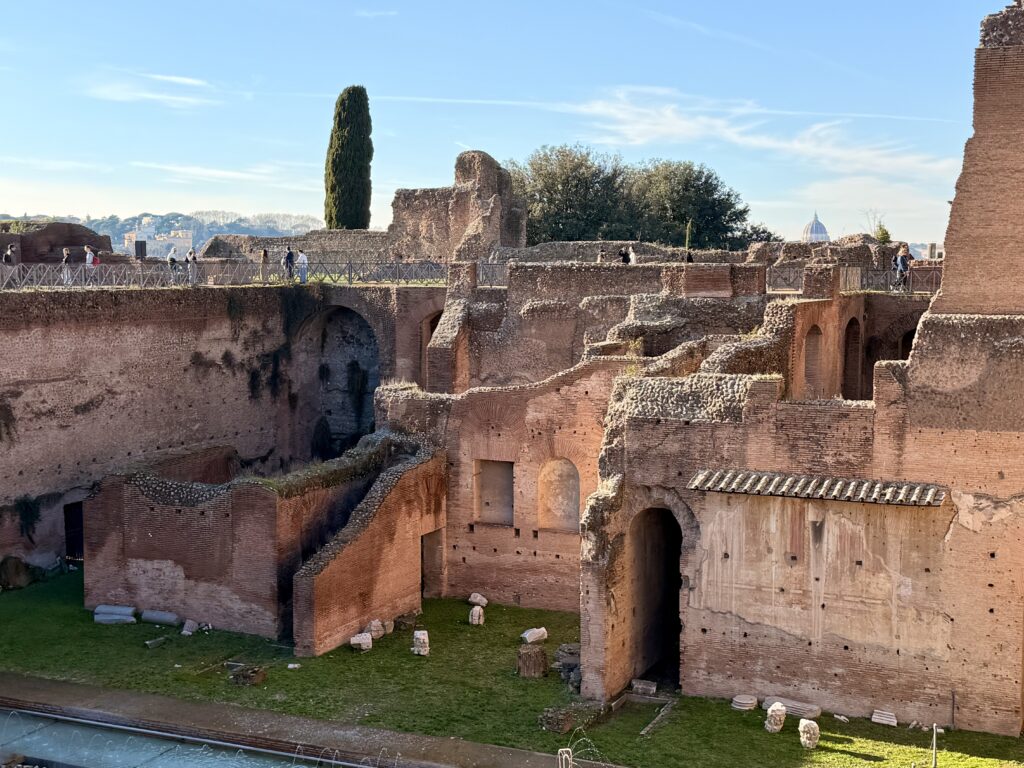
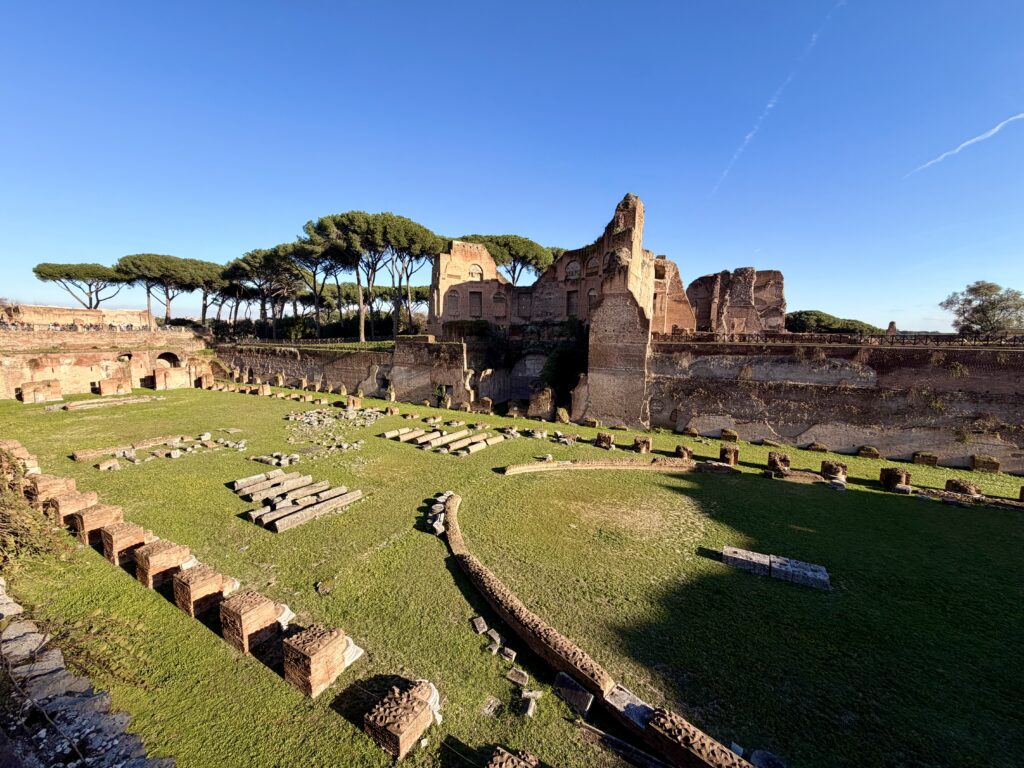
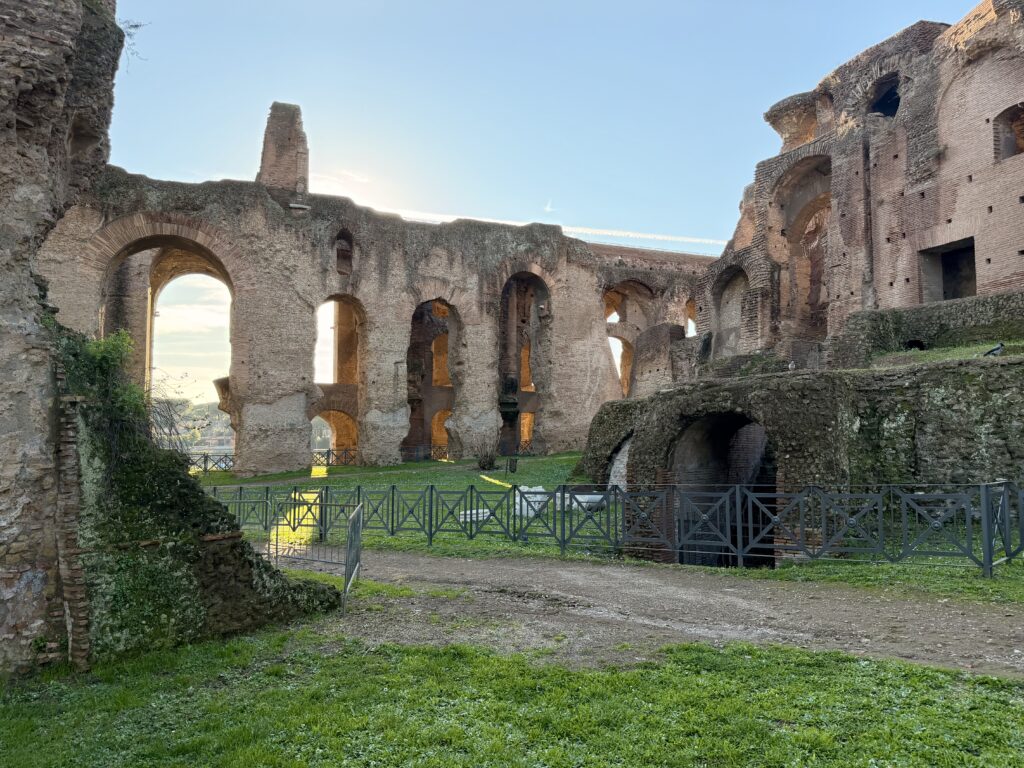
As the name suggests, it’s up on a hill and overlooks the Roman Forum, providing great views of the Forum as well as the Colosseum.
Pantheon
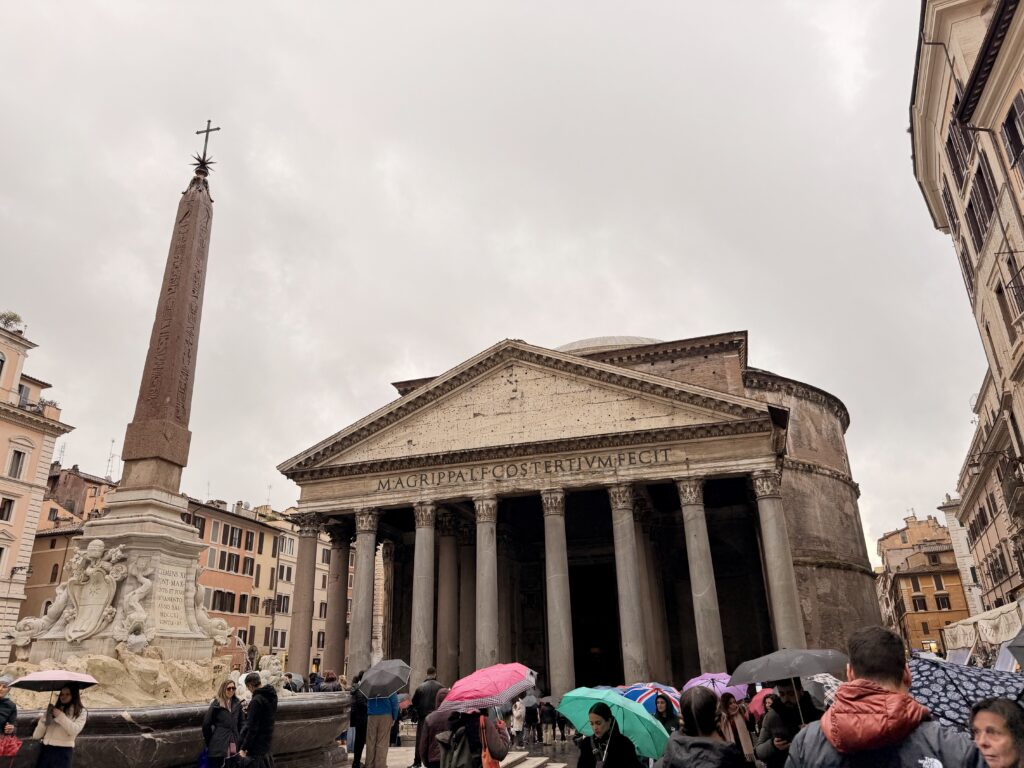
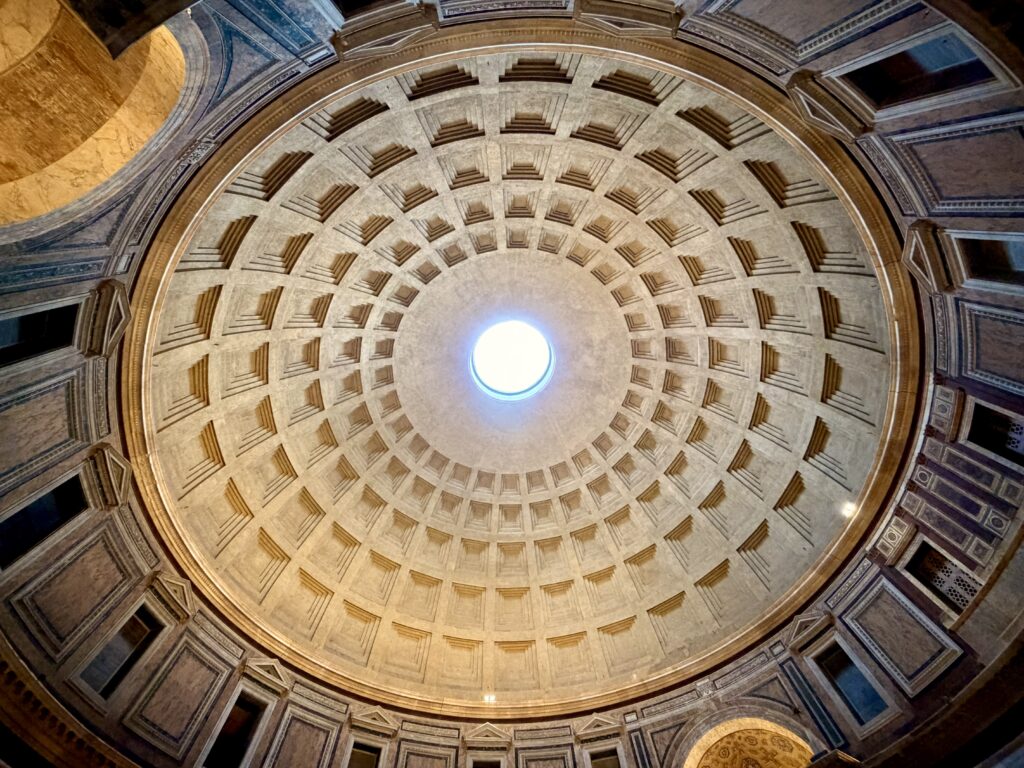
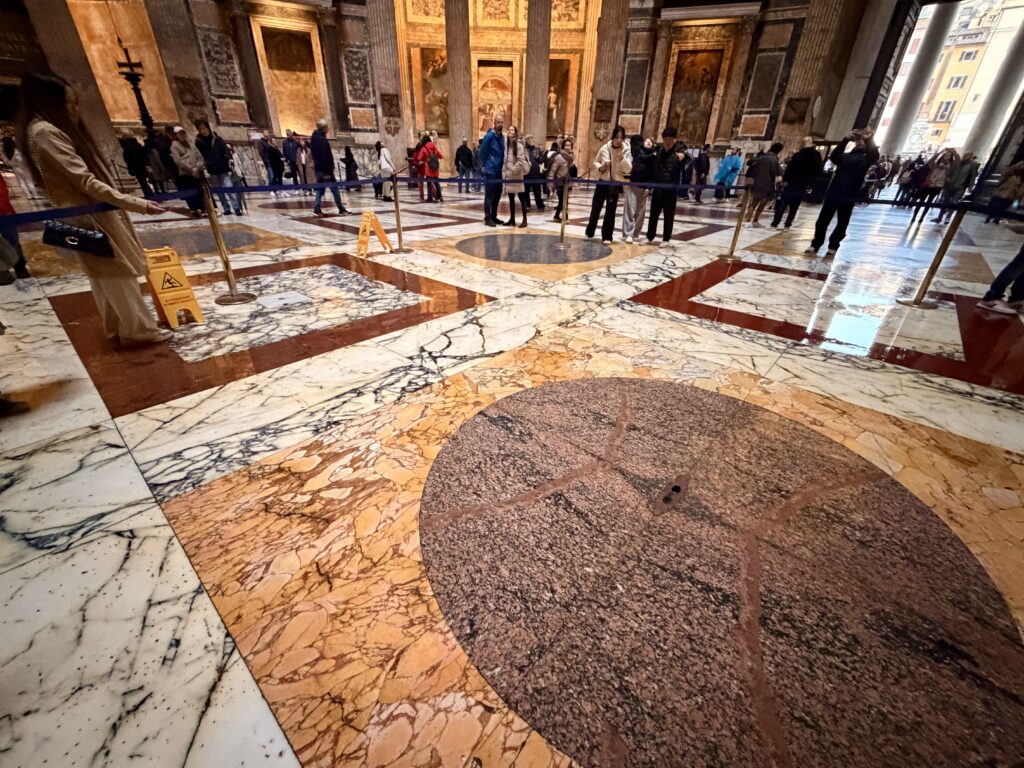
The Pantheon was built in Emperor Hadrian’s time (118-125 AD) on the site of an older temple that burned down. It’s a temple to all of the gods (pan = all, theon = gods). It the best preserved ancient building in Rome because it was used as a church starting in the 7th century. A circular wall that is over 6 meters (20 feet) thick supports the largest unreinforced dome ever built. (https://direzionemuseiroma.cultura.gov.it/en/pantheon/)
The first day we passed by was the 1st Sunday of the month – the line was super long! We went back on our last day there and it was much easier to get in. It costs €5 to enter – you can pre-book a timed entry ticket online but we just walked up and didn’t have to wait long (I’m sure that’s a different story in the summer and certainly was not the case on the 1st Sunday).
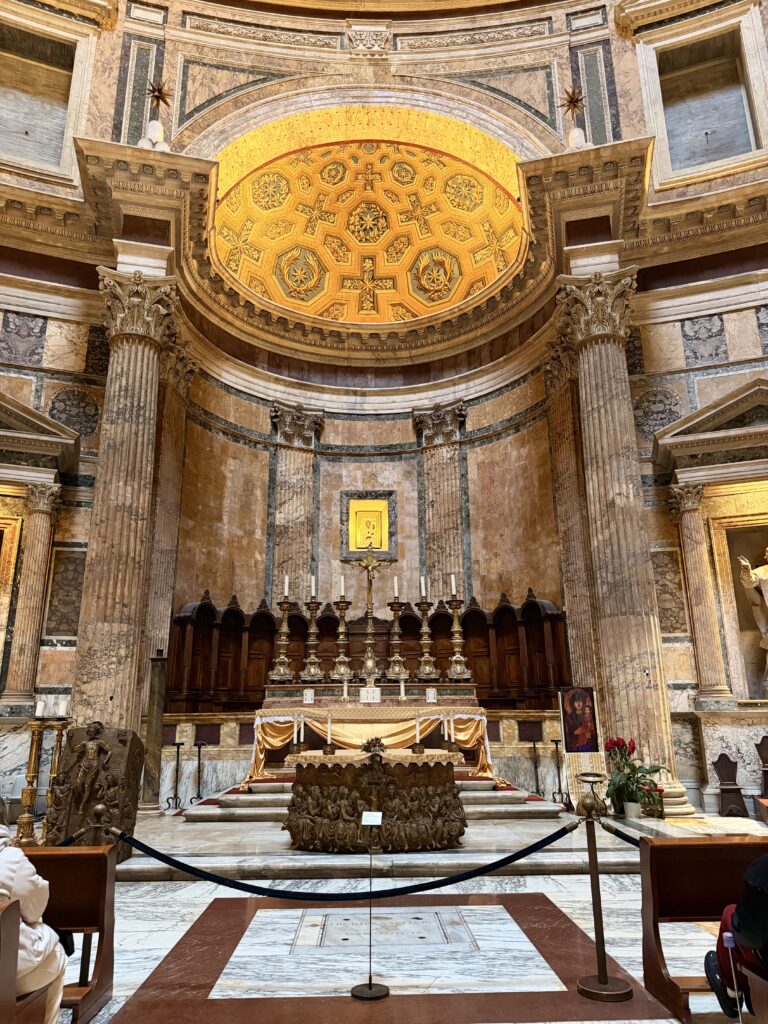
The dome is open at the top (the oculus) so it was pretty neat to see it on a rainy day. It just rains right inside of the Pantheon.
It also holds the tombs of several important people from Roman and Italian history. Vittorio Emanuel II was the first King of Italy and is buried here, as are his son and daughter-in-law. The Renaissance painter, Raphael, is also buried here.
Other Sights
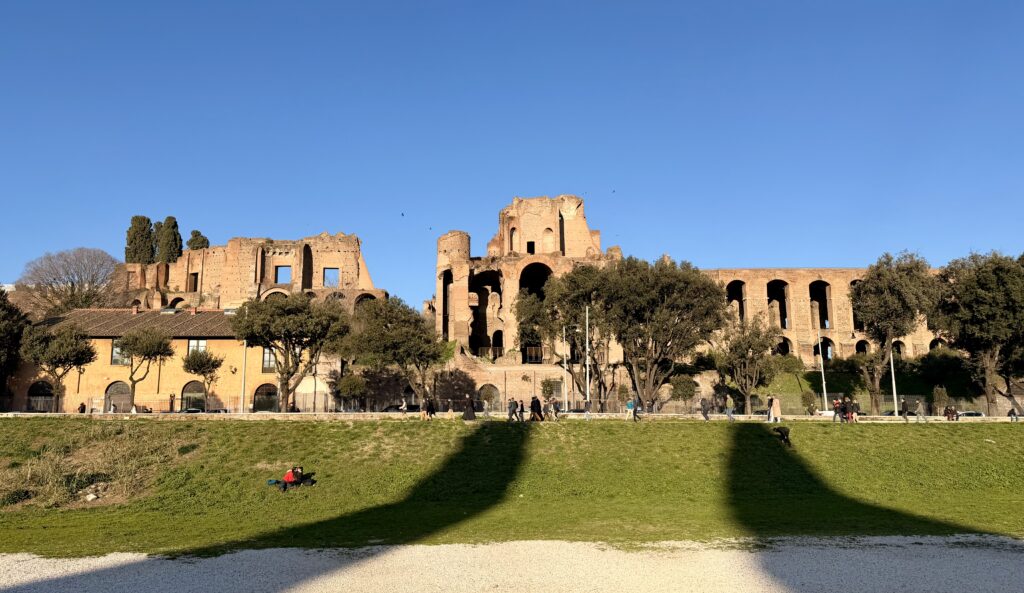
Circus Maximus was the largest building for public entertainment in antiquity (over 2000 feet long and almost 400 feet wide, holding over 150,000 spectators). It was an ancient chariot-racing stadium and sits in a valley between the Palantine and Aventine hills. It’s now a public park and we walked through it as we left the Forum/Palantine Hill (https://www.turismoroma.it/en/places/circus-maximus)
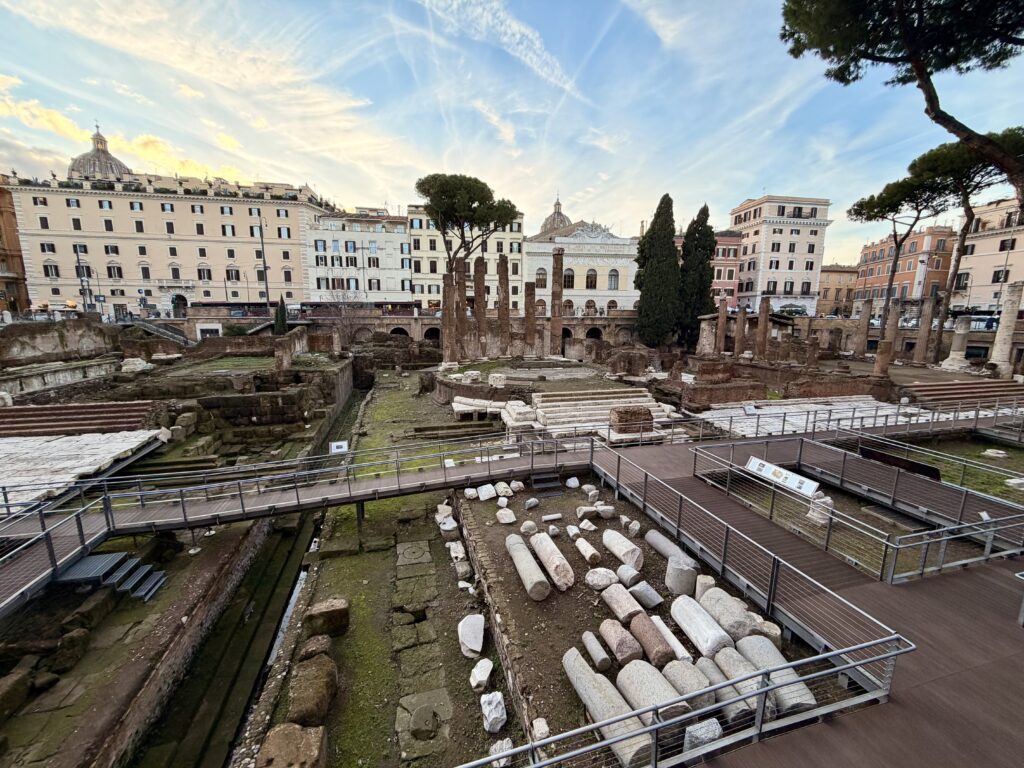
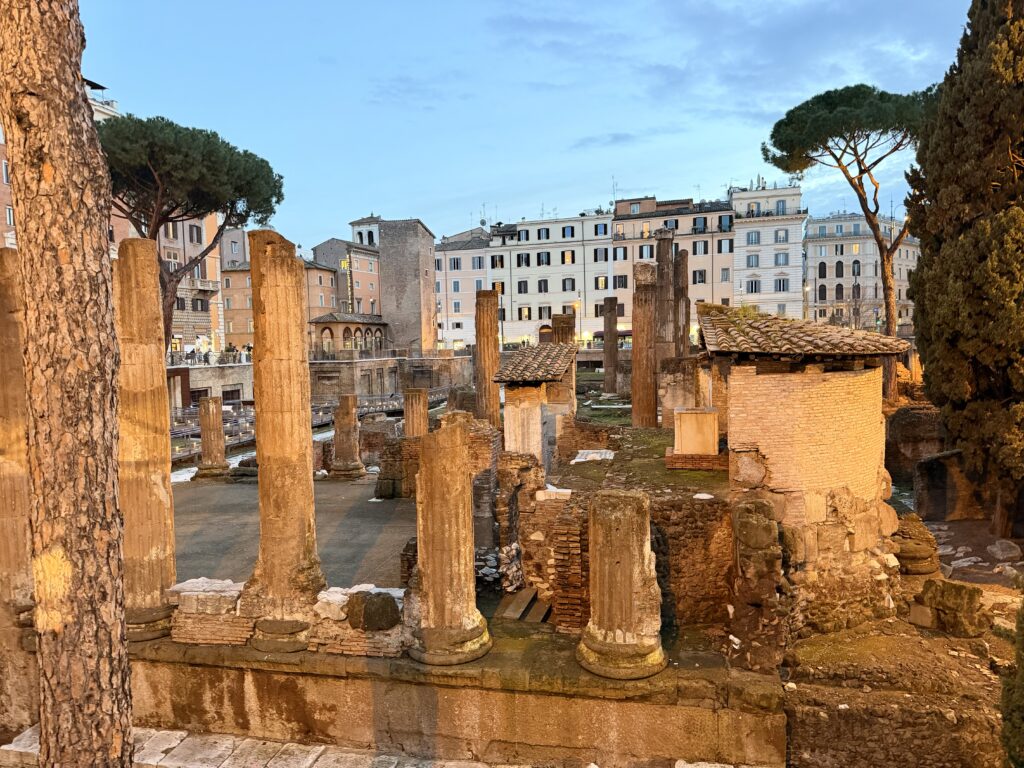
Largo di Torre Argentina (“silver tower square”) contains remains of Pomey’s Theater (among other things). It’s famous as the site of Julius Caesar’s assassination – the theater was serving as the Senate at the time.
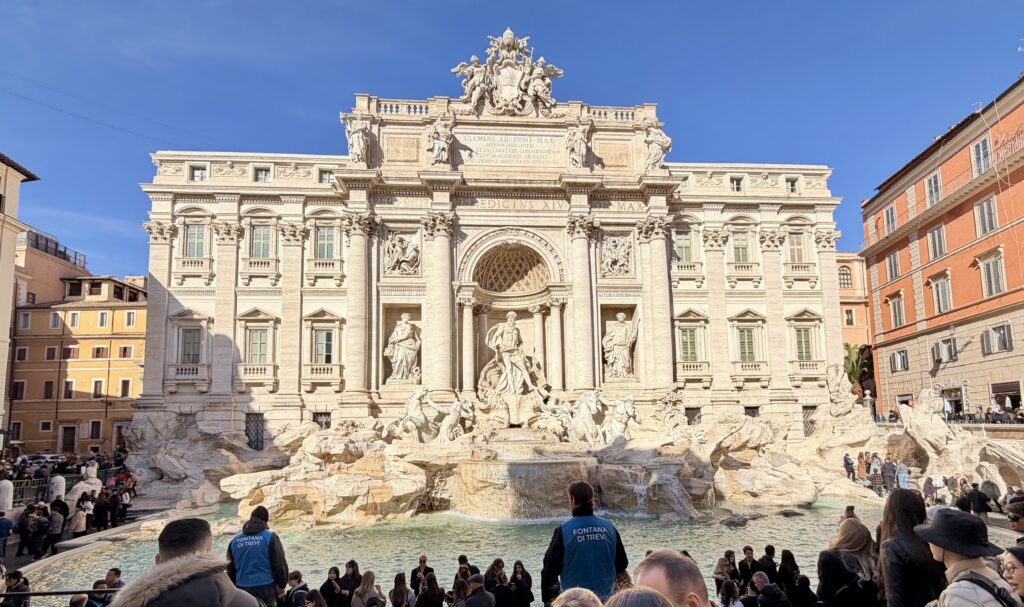
The Trevi Fountain is the most famous Roman fountain, dating to the 18th century (basically brand new by Roman standards!). It is the end of the Virgo aqueduct (the only ancient aqueduct in continuous use). According to legend, if you throw a coin over your left shoulder, you will definitely return to Rome one day. Even in January it was packed! You also now have to pay a couple of Euro to go down close to the fountain and the line was quite long (although they limit how many people are down there at a time so I’m sure the experience while you are down there is better than it had been before they started limiting it). We just passed by – Chris caught a video that captures how crowded it was. (https://www.turismoroma.it/en/places/trevi-fountain)
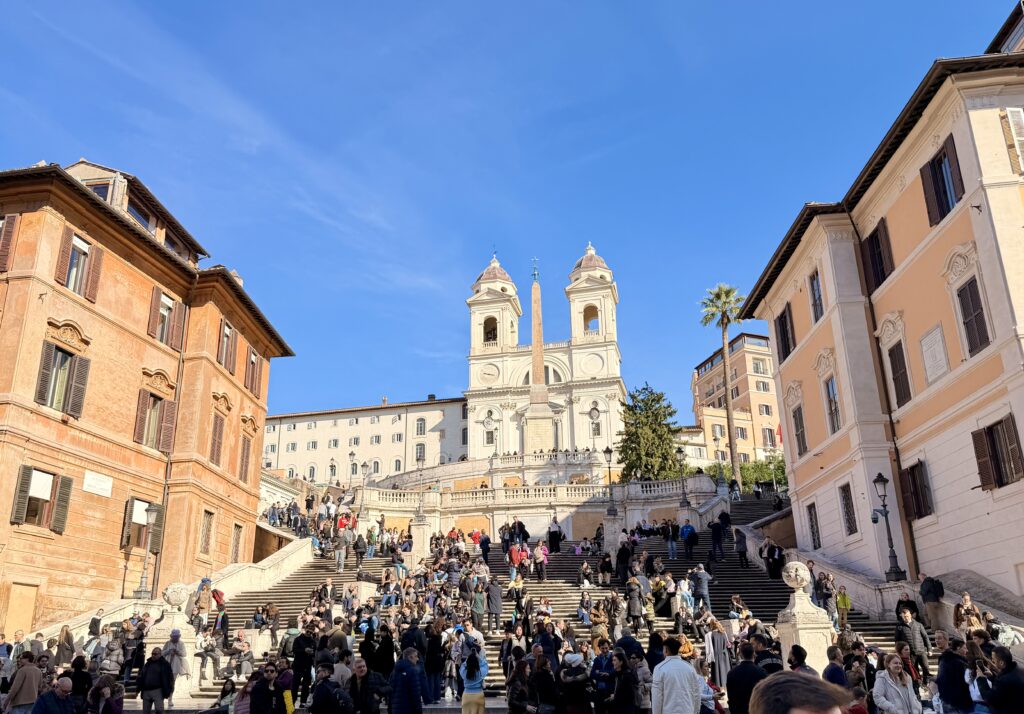
The Spanish Steps were built in the 18th century and are next to the Piazza di Spangna (named for the proximity of the Spanish Embassy). They feature in several movies – my favorite is Roman Holiday (Audrey Hepburn and Gregory Peck, 1953). There is a fine of €250 for sitting on the steps and up to €400 if you damage or dirty the steps – which includes staining it from eating while you are sitting there! (https://www.cnn.com/travel/article/spanish-steps-rome-sitting-fine). I can’t imagine what the fine was for the man who drove his car down the steps in 2025! (https://www.bbc.com/news/videos/c70rw09z6z2o)
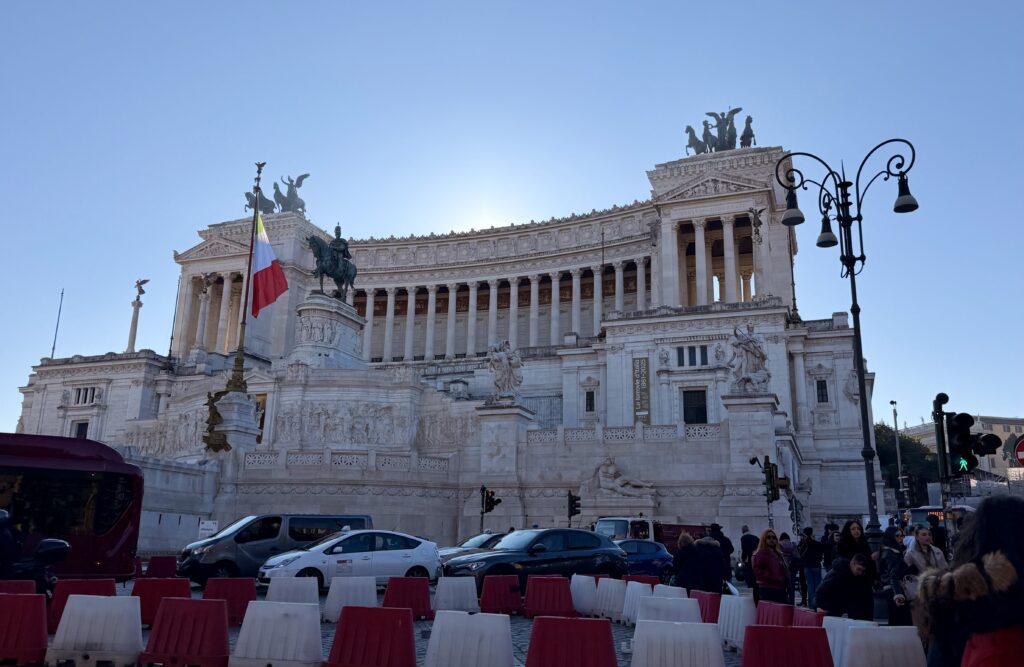
The Monument to Vittorio Emmanuel II (the first King of Italy) was conceived in 1878, after he passed away. The monument was inaugurated in 1911 for the 50th anniversary of Italian unification. It is also now the site of the Tomb of the Unknown Soldier, added after WWI. (https://www.turismoroma.it/en/places/monument-vittorio-emanuele-ii-vittoriano)
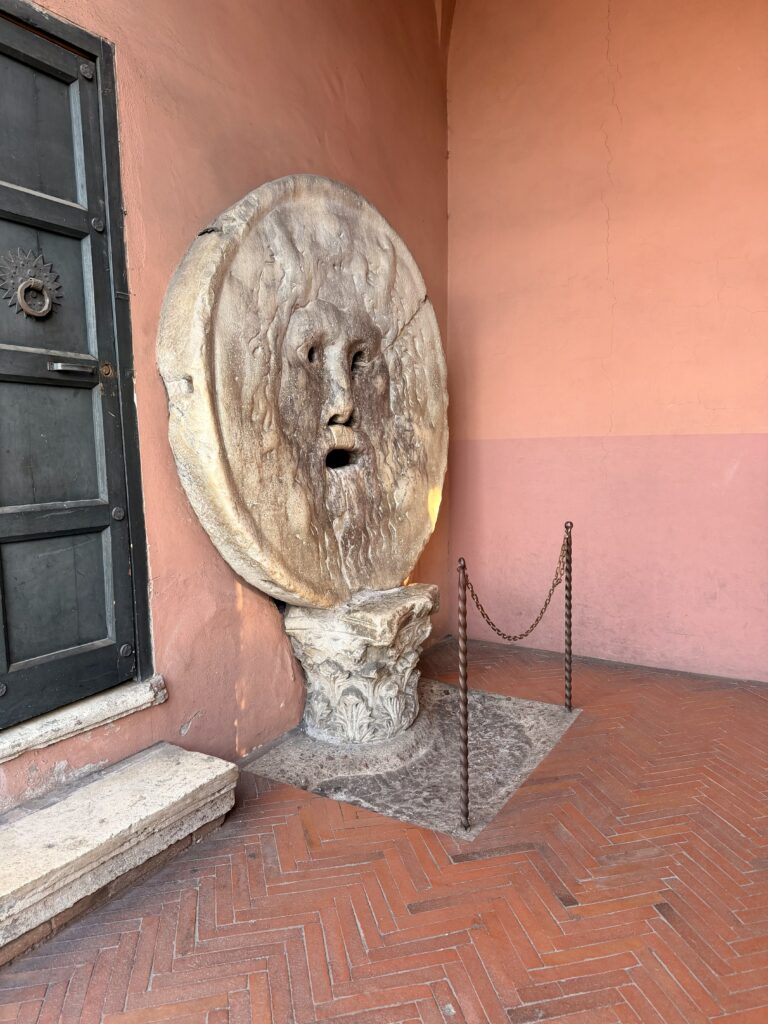
Another classic made famous in Roman Holiday is the Mouth of Truth (Bocca della Verità). According to legend, it will bite off the hand of a liar who places their hand in its mouth.
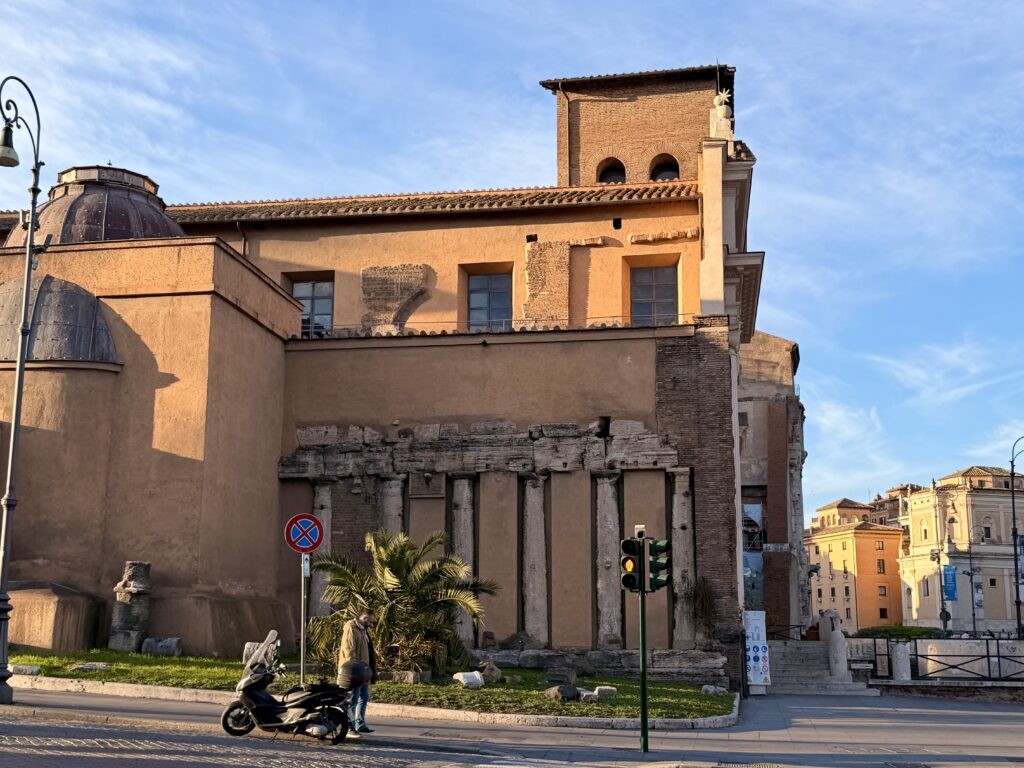
One really cool thing about Rome was that there was so much history everywhere you turned. We came across this church, Basilica of San Nicola in Cancere, which incorporated columns from a 3rd century BC temple right into its walls. We just happened to see it when we were walking back from the Colosseum/Forum.
Until next time Rome!