During a recent trip to Barcelona for a conference, we had a chance to explore several of Antoni Gaudí’s works. We saw a lot of other things too but will focus on Gaudí’s works in this post. There are several – we had a chance to see Casa Botlló, Casa Milà (La Pedrera), La Sagrada Familia, and Park Güell. Each of these sites could be a post in their own rights so these are highlights with links to more detailed info.
If you are not familiar with Antoni Gaudí, you’re not alone! I first visited Barcelona in December 2011 when I was stationed in England. It was a nice break from the cold England winter and a cheap flight on Easy Jet. But I didn’t even look at a travel guide until I was on the plane heading to Barcelona (those were the days! didn’t need all of these timed entries back then!). Once I got there are started exploring, I realized how cool the Modernisme, and more specifically Gaudí, architecture was. One of my favorite elements is the lack of sharp corners. Everything is rounded off. By the way – ever notice that all of your Apple products also don’t have sharp corners? They are all rounded off!. Another favorite element to me was the broken ceramic tiles – this allowed the tiles to cover rounded surfaces. You’ll see this theme a lot in Casa Batlló and Park Güell in particular (we didn’t go to Palau Güell on this visit but the same tile-work is used on the rooftop chimneys there).
First up is Casa Botlló. This is actually my favorite between the 2 houses we visits (Casa Batlló and Casa Milà/La Pedrera). It’s more colorful inside and out. They’re both cool for different reasons but I liked this one better.
We happened to walk by Casa Batlló one night after dinner and it was pretty cool seeing it all lit up. You can actually visit at night – it’s lit up inside and outside. I’ve linked the official ticket webpages for each of these sites at the bottom – I noticed that all of these had tour options from 3rd party vendors and all of those were more expensive than buying directly from the official site.
We visited 3 Gaudí sites in one day. We started with Casa Batlló then Casa Milà (La Pedrera), which are an easy walk form each other. Then headed over to La Sagrada Familia. We did Park Güell the following morning.
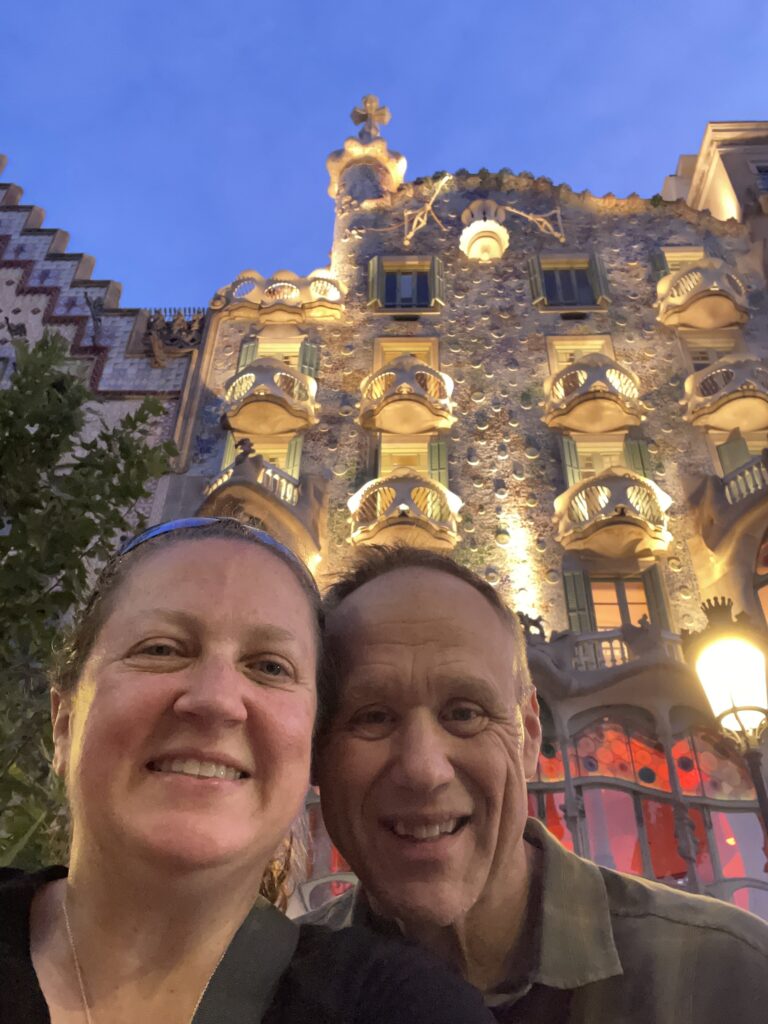
Casa Batlló history: This is actually a renovation of an existing building. The original building was built in 1877 (at a time when Barcelona didn’t have electric lighting). Josep Batlló i Casanovas bought the building in 1903 and commissioned Gaudí. Batlló originally wanted him to demolish the building and start from scratch but Gaudí convinced him to renovate instead. Gaudí renovated it from 1904-1906. The official website has a more detailed history of the building here: https://www.casabatllo.es/en/antoni-gaudi/casa-batllo/history/.
Casa Batlló is in an area of Barcelona called the Eixample (which translated to “expansion” in Catalan). The Eixample was a planned expansion of a very overcrowded Barcelona in the 1850s. They had previously been limited by old city walls. So if you see an aerial view of Barcelona, you’ll notice blunted corners of buildings and every intersection being an octagon. This was done to allow more light into the spaces and it’s really cool to see all of the activity that happens in these intersections (in the area by our rental apartment, we noticed a lot of people hanging out there at picnic tables or chairs, or cafes). Because it was an expansion of a very over-crowded city, it was planned on a larger scale (rather than piecemeal expansion). So in those arial views you’ll notice it looks the same all around outside of the old city.
Casa Botlló also sits on Passeig de Gracia on what is called the Block of Discord. There are 3 Modernista houses on this street – Casa Batlló by Antoni Gaudí, Casa Amatller by Josep Puig i Cadafalch, and Casa Lleó Morera by Lluís Domènech i Montaner – the last of which is not open to the public (Gaudí is the only one I could successfully pronounce!).
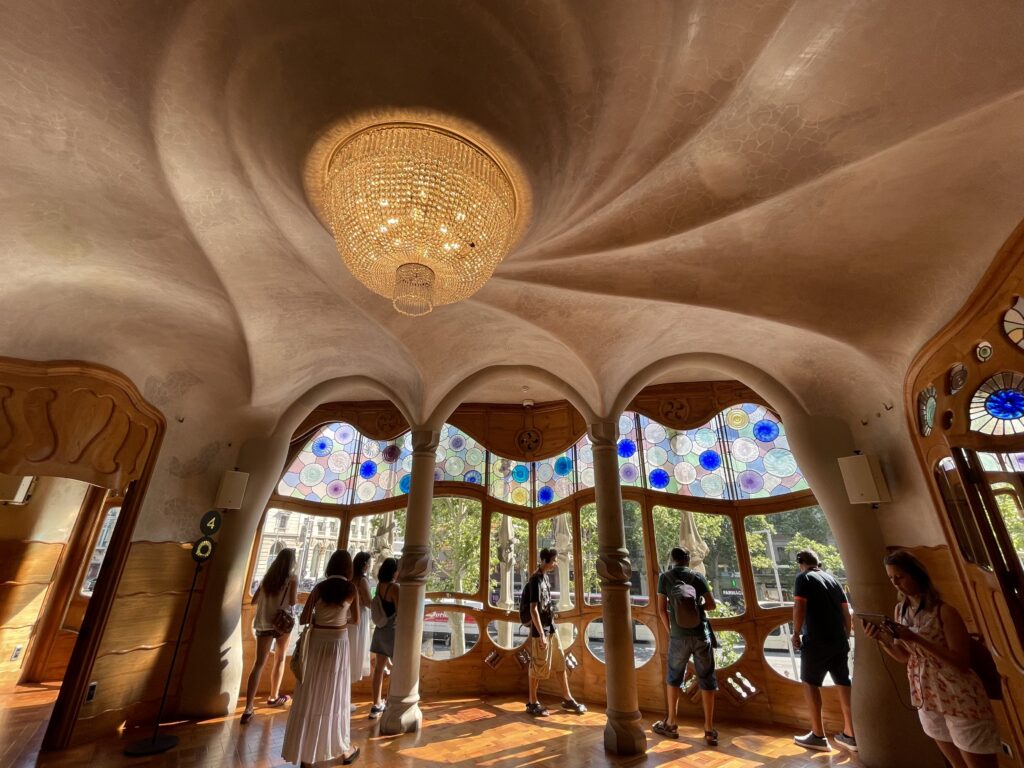
I loved this ceiling – it looks like a swirl of ocean. Also take note in the picture how everything is rounded. I really loved the glass at the top of these windows (featured on several interior doors as well.
I thought the interior of this house was really beautiful but the rooftop is a highlight as well.
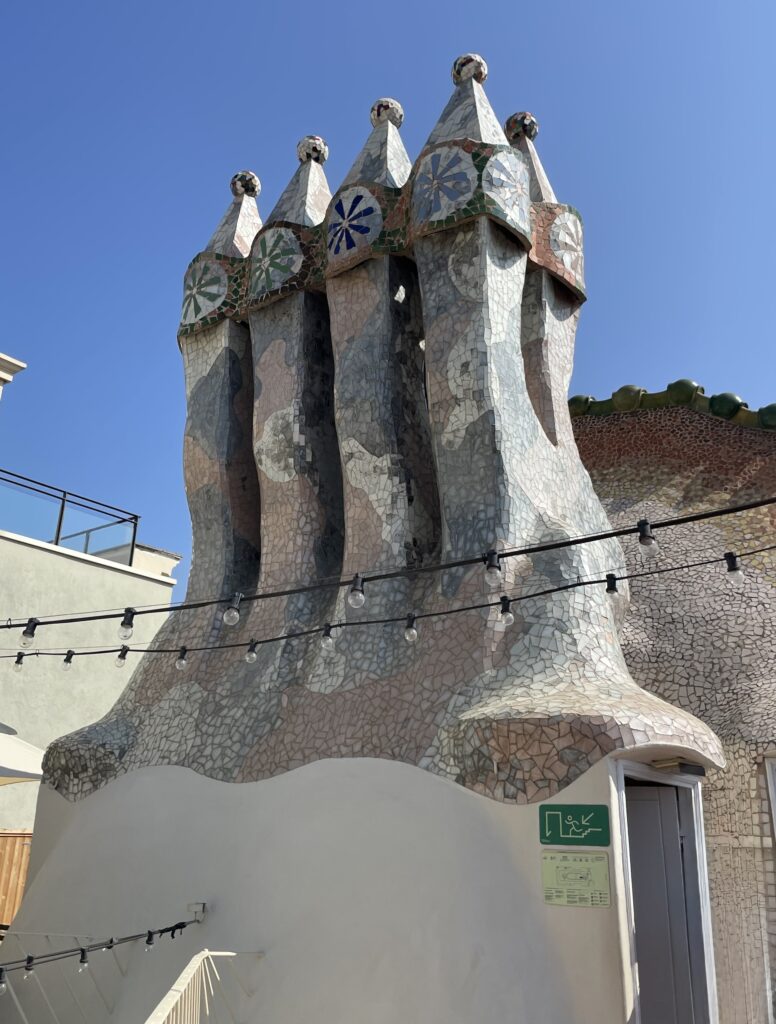
These are actually chimneys – Gaudí took mundane things like chimneys and made even those into works of art. You’ll see this in Casa Milà as well but I think these ceramic tiled ones are particularly cool (you’d see iconic chimneys on Palau Güell as well).
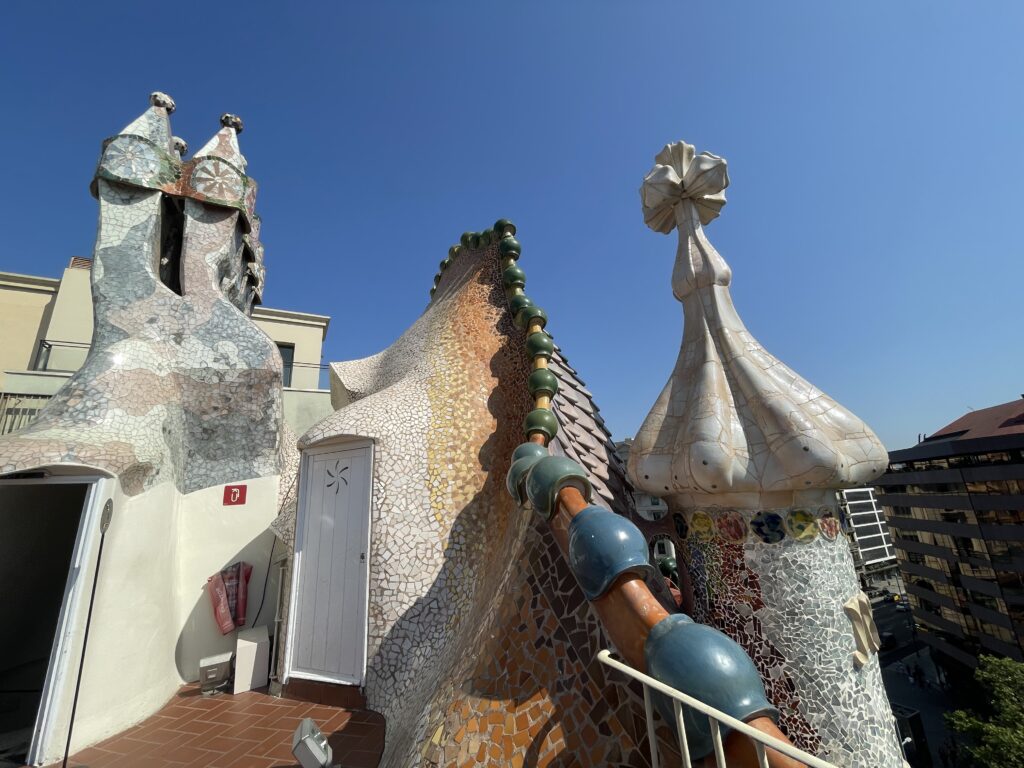
The Casa Botlló website has some really great info about the history as well as the unique aspects of Gaudí’s work on their site so for more info you can look here: https://www.casabatllo.es/en/news/5-symbolic-elements-of-casa-batllos-facade and here: https://www.casabatllo.es/en/antoni-gaudi/casa-batllo/facade/. This picture above is the dragon’s back (also seen from the front facade), alluding to Catalan lore about St. George (Jordi) – the patron saint of Catalonia – slaying the dragon to save the princess.
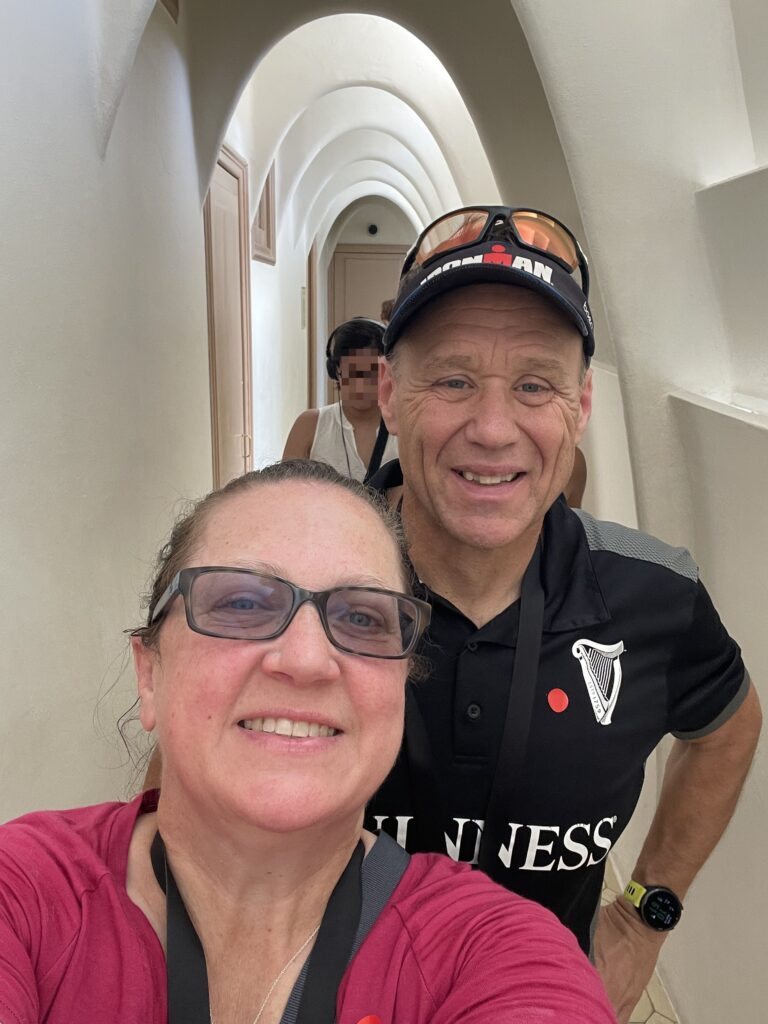
This is inside the attic as you’re headed up to the rooftop – in both this house and Casa Milá you can see how this space is structurally important but also not left behind in the art of the building either. https://www.casabatllo.es/en/antoni-gaudi/casa-batllo/inside
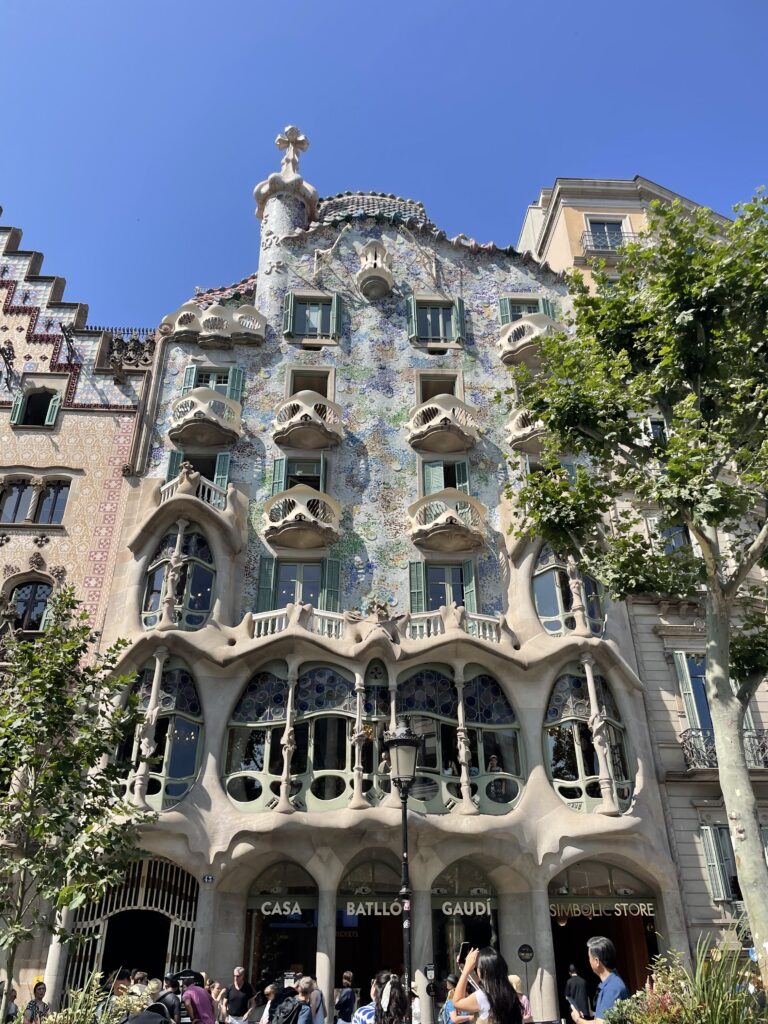
Do you see skulls and bones (the victims of the dragon!)? Mardi Gras masks? The shape of a bat in the front main window? Like all works of art, it’s up for interpretation.
I really loved Casa Botlló but Casa Milà is pretty cool in its own right. To me the inside wasn’t quite as impressive as Casa Botlló (although still cool to see) so I focused on the facade and rooftop here.
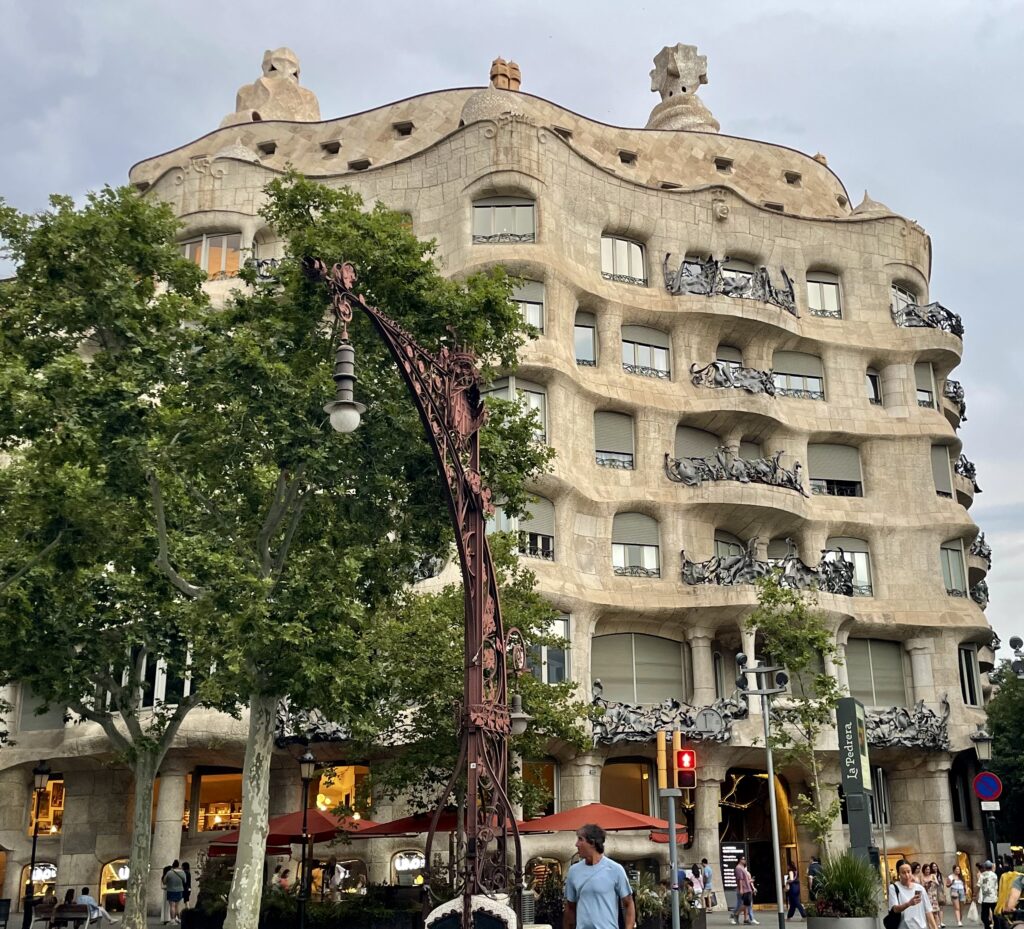
Casa Milà is also called La Pedrera (meaning The Quarry). It was Gaudí’s last major commission (from 1906-1910) before he turned all of his attention to La Sagara Familia. My pictures of the facade will never do it justice – there’s a great arial picture on the official site that shows a much better picture of the expanse of the facade (https://www.lapedrera.com/). This building was purchased by the Milà family in 1905 and they commissioned Gaudí for the renovation. A big difference in the interior here is that they lived on the main floor and had rental apartments on other floors (these were fancy expensive apartments!).
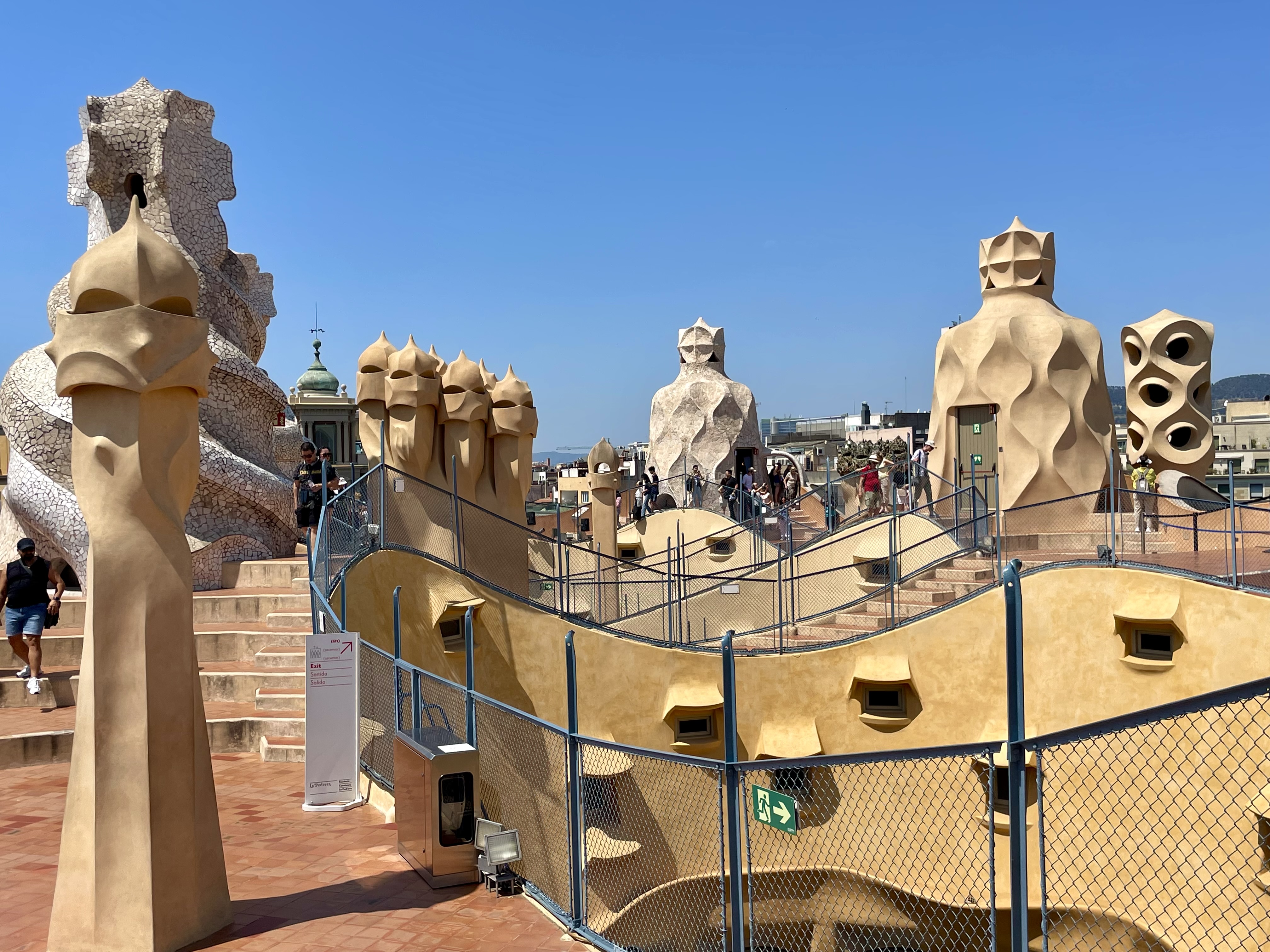
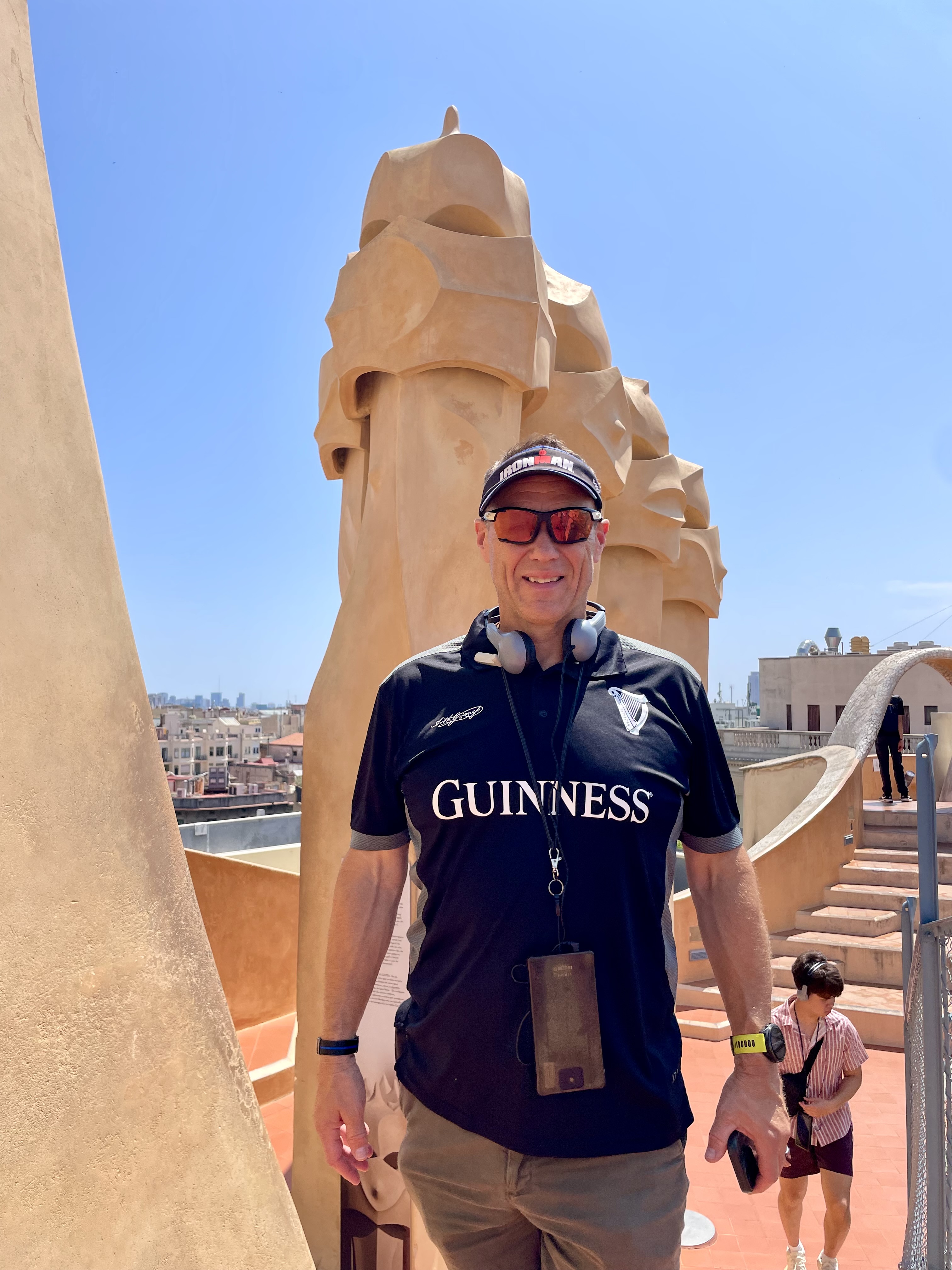
In my opinion, the coolest part of La Pedrera is the rooftop. All of these “guardians” and other structures are functional. They are chimneys, ventilation towers, and staircases. For more detail about the rooftop, their website has good info https://www.lapedrera.com/.
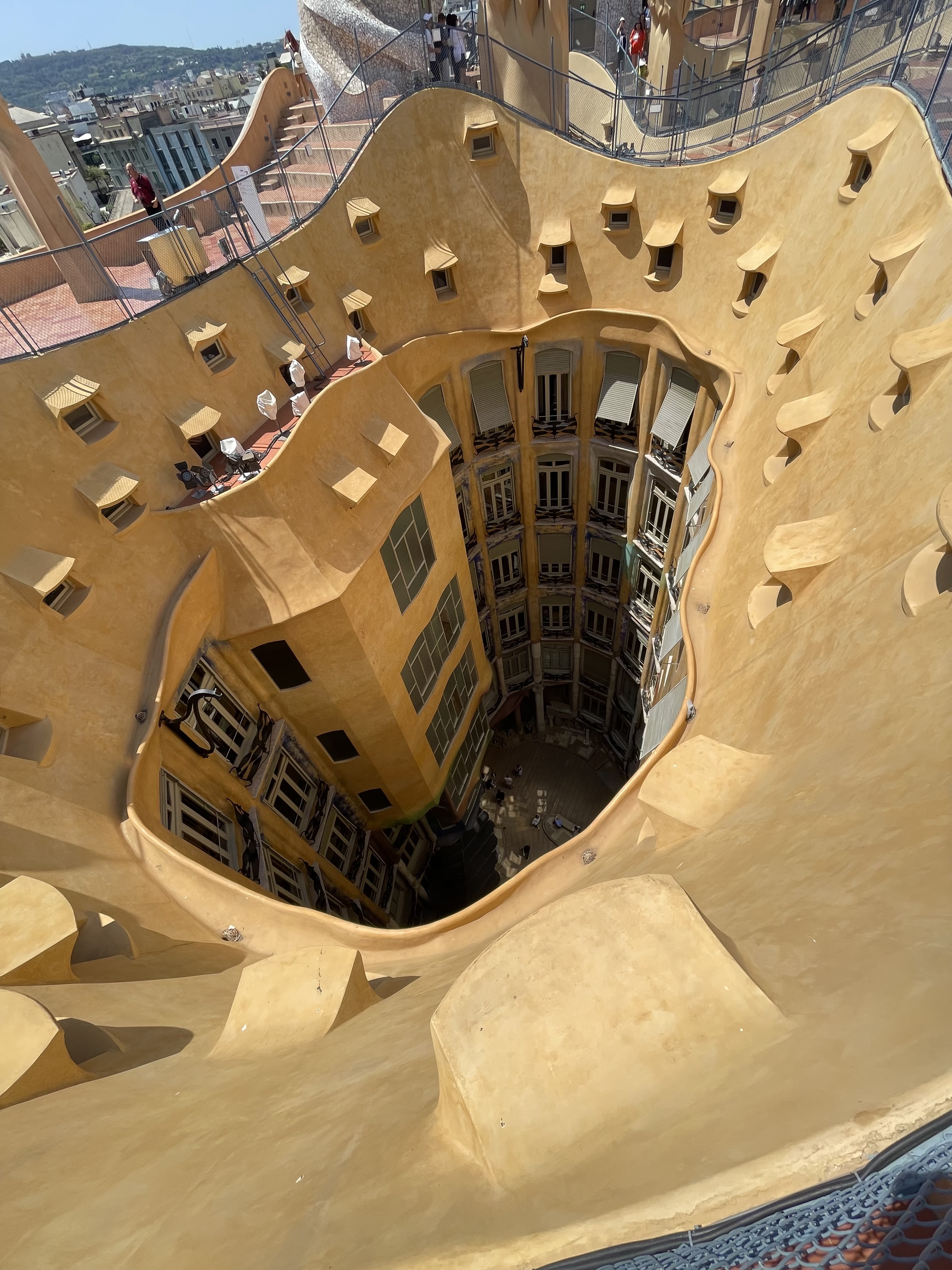
This is a cool view from the rooftop of the courtyard of the building.
Moving onto La Sagrada Familia…..
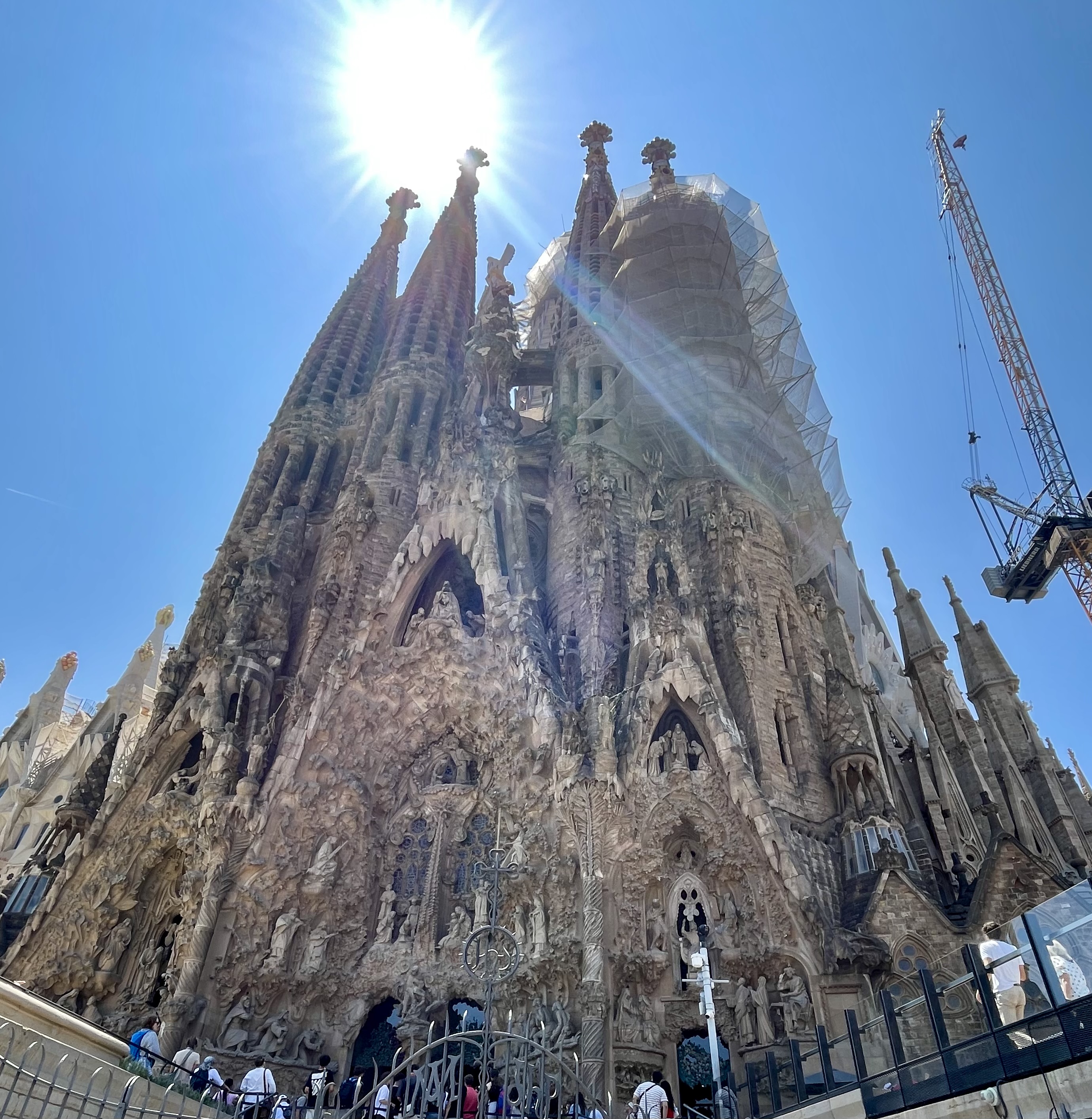
La Sagrada Familia was started in 1882 and Gaudí was hired in 1883 (after the original architect quit). It was originally planned in a Gothic-revival style but when Gaudí took over he had other plans! You’ll note that the timeline overlaps with his other projects like the houses above. But in 1914, Gaudí devoted all of this time and attention to La Sagrada Familia, moving into his workshop in the church in 1925. On 07 Jun 1926 when he was hit by a tram in the street, people thought he was a beggar (apparently a taxi driver refused to take him to the hospital). It took a bit for his colleagues to figure out he was missing and hunt him down in a hospital for poor people. No one recognized him in the hosptial either. His friends eventually found him. He died of his injuries 3 days later at the age of 73. At that time the church was approximately 20% complete. And it’s still not done. The current timeline puts completion around 2034 (for reference – it took 182 years to build Notre Dame in Paris). More details on the history and timeline of La Sagrada Familia can be found here https://sagradafamilia.org/en/history-of-the-temple.
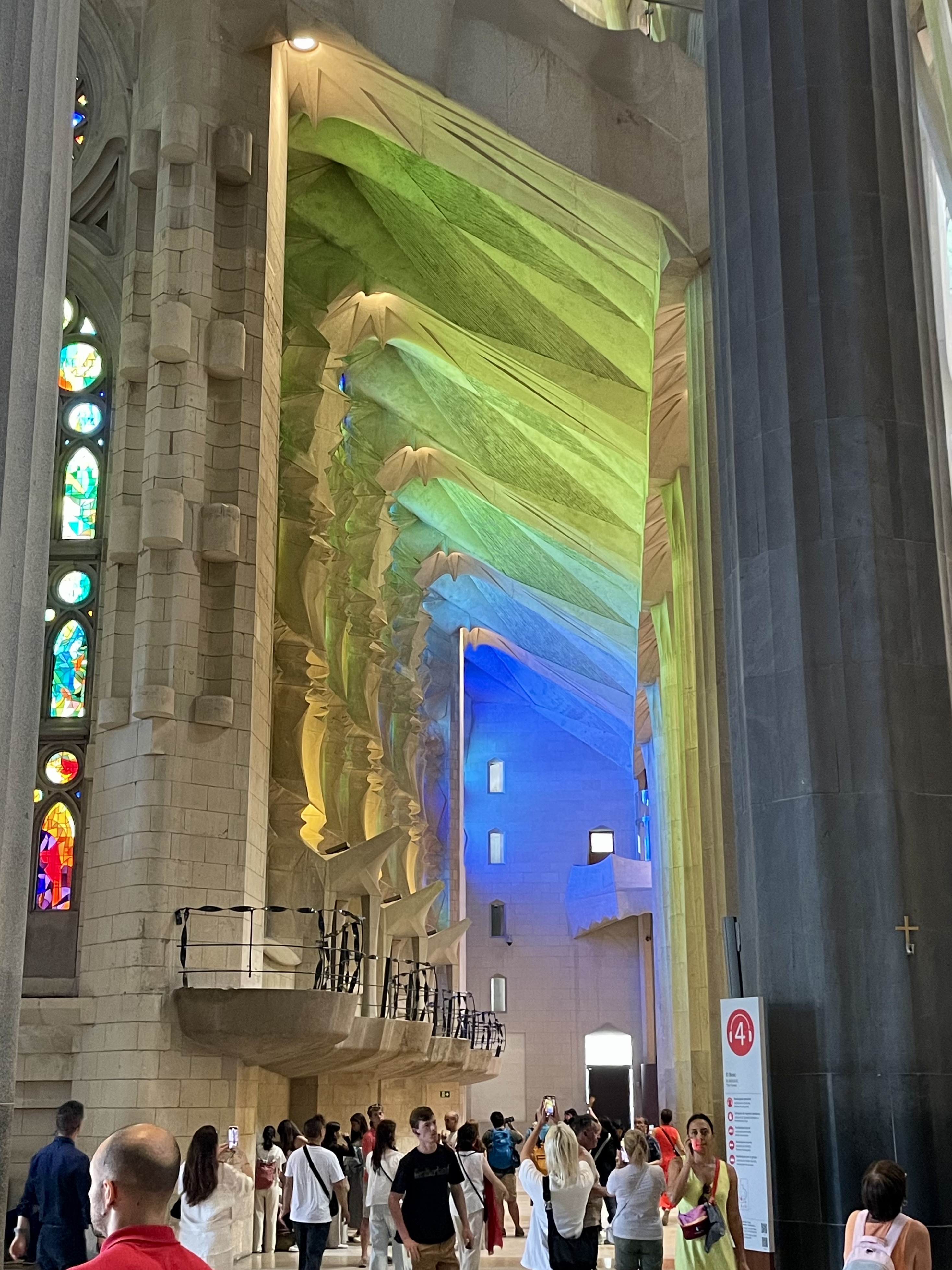
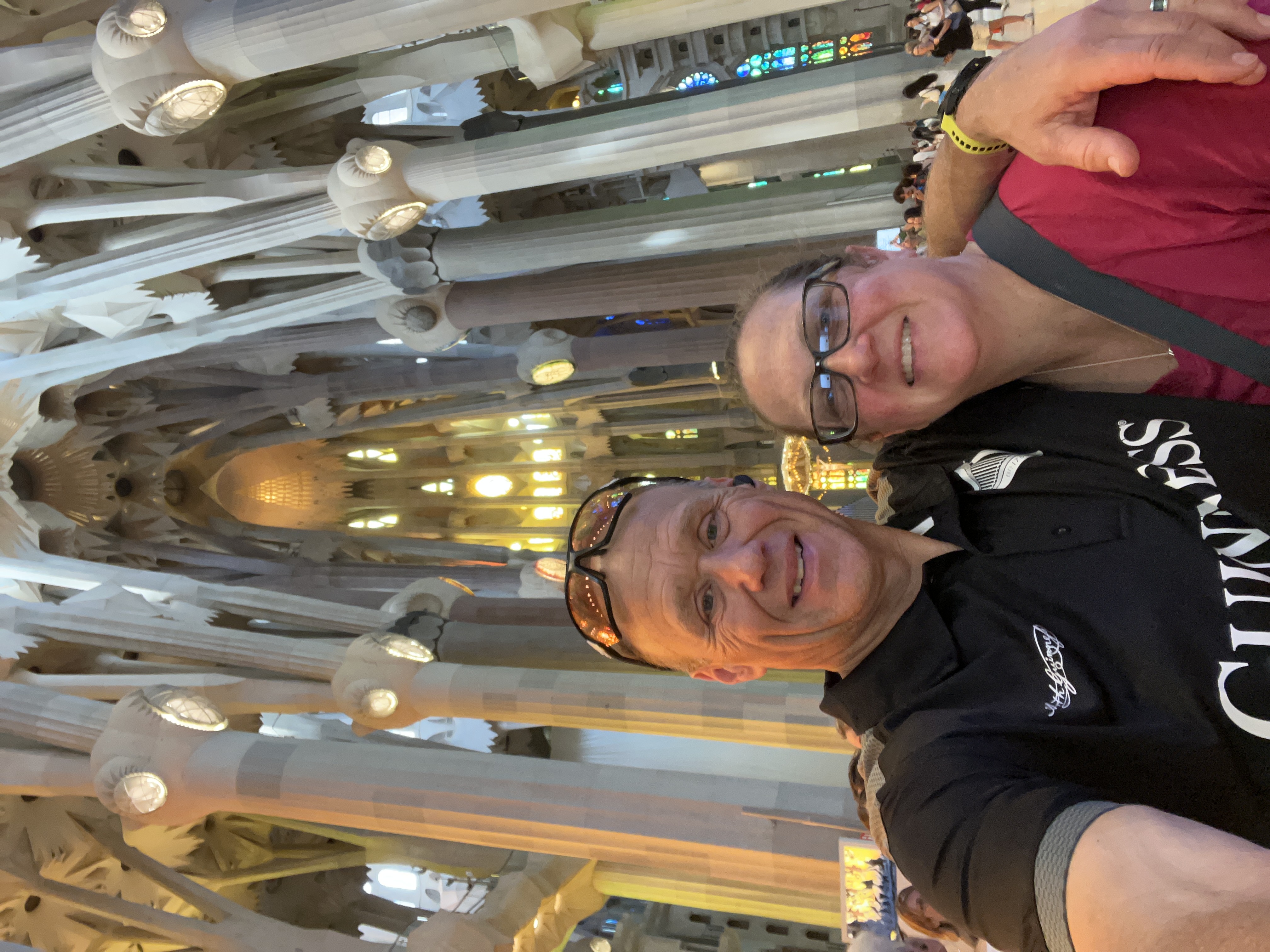
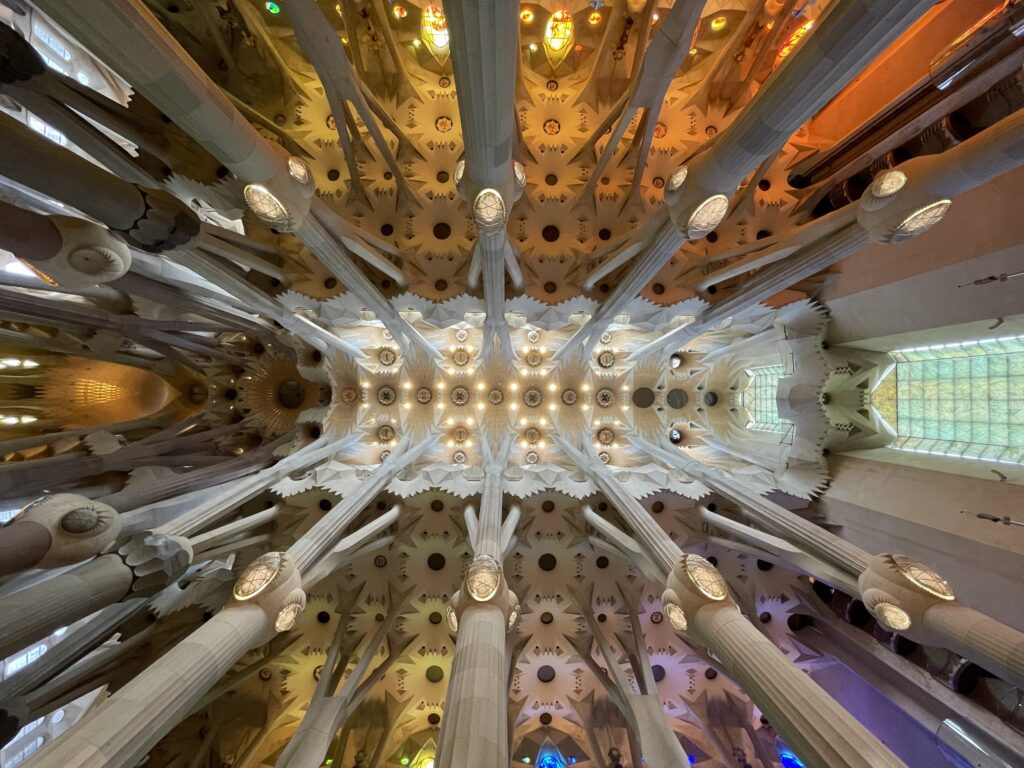
The pictures really don’t do it justice – it’s an incredible place. Every detail is intentional. Even the colors of the stained glass and which way they are facing in order to capture different light.
The amount of natural light in the church is amazing. And typical of other Gaudí projects. The windows are very intentional to let in light. All of the color you see above is coming from the stained-glass windows. This side had more blue and green while the opposite side has more red and orange.
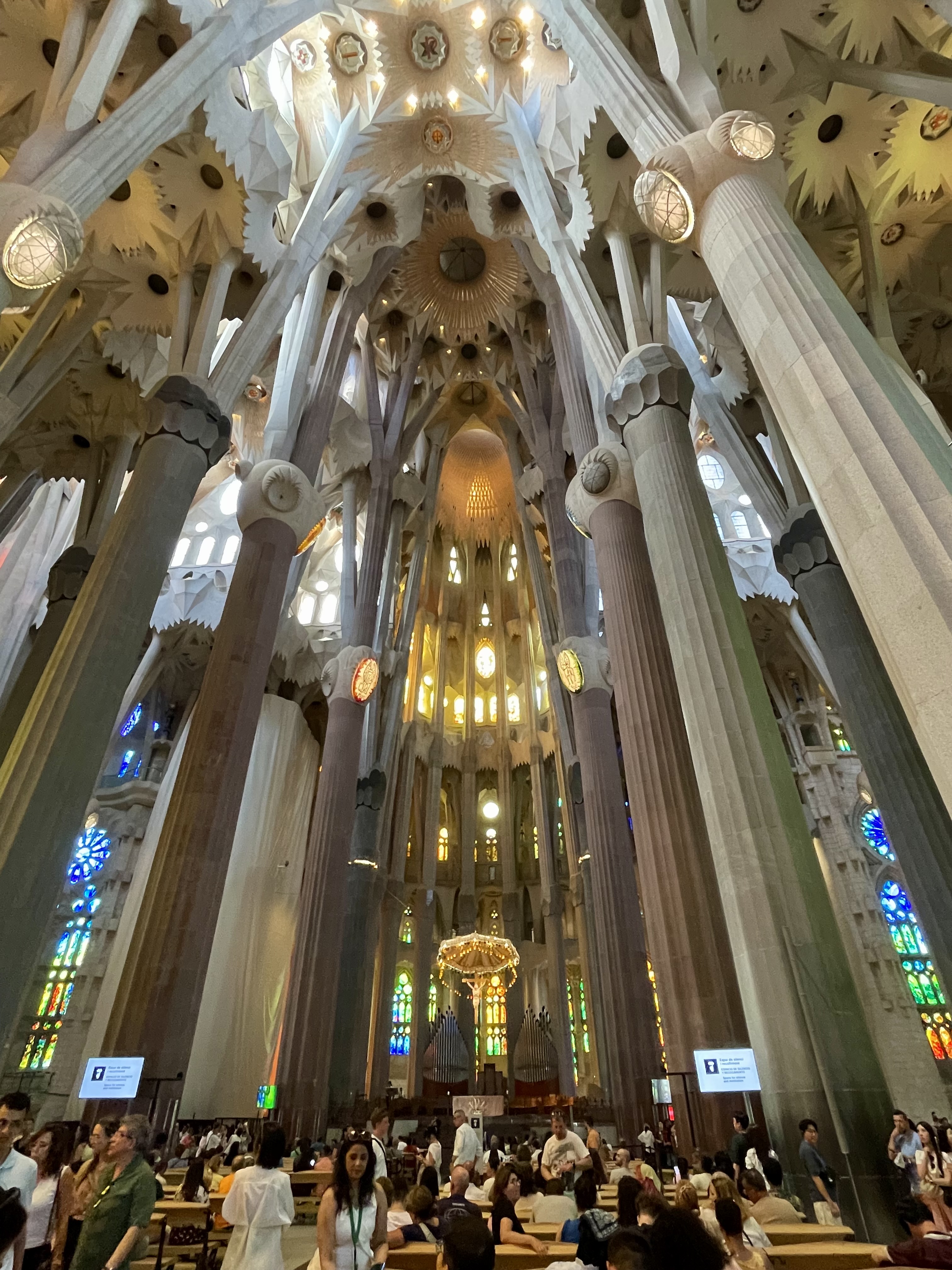
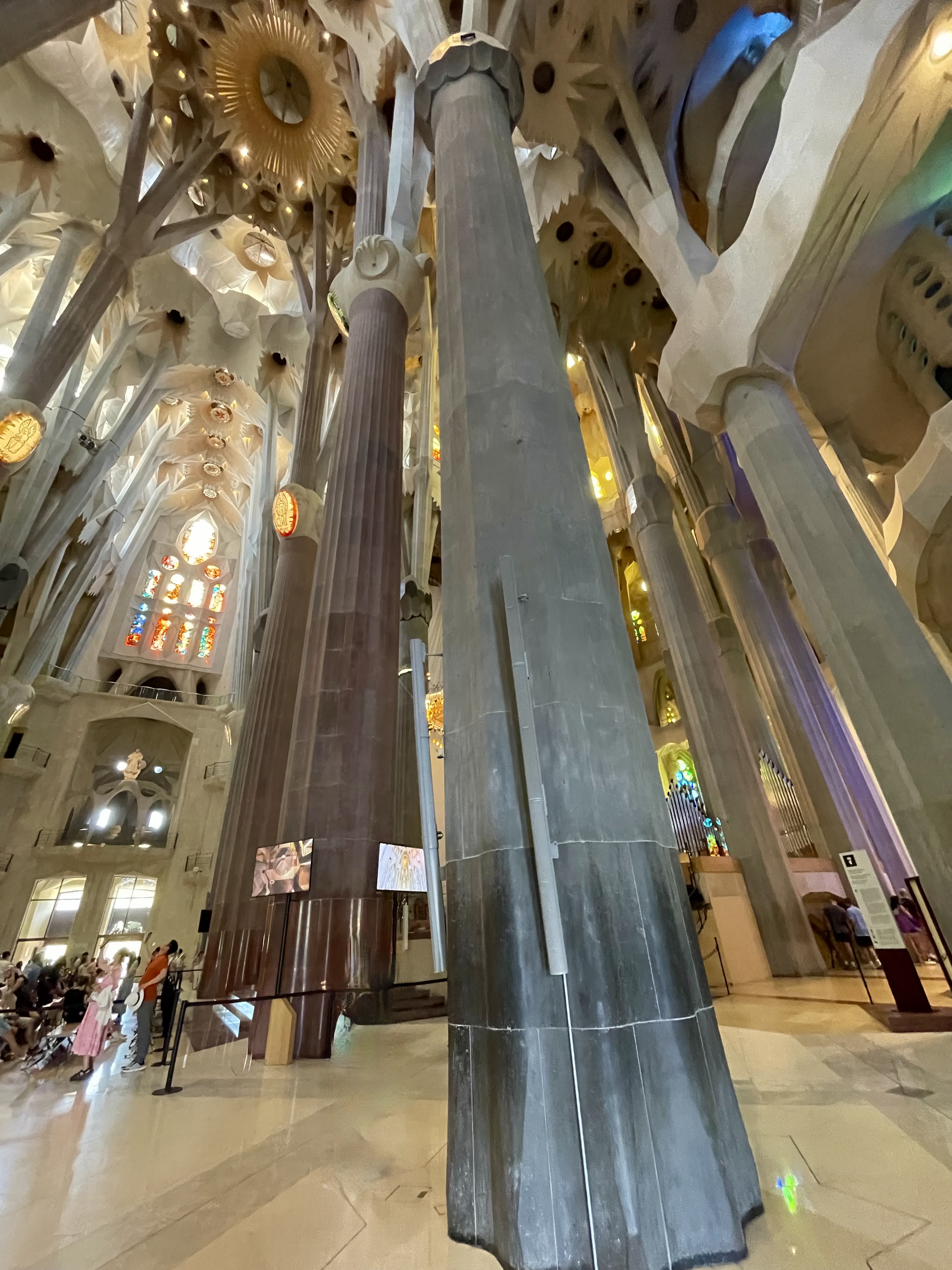
Looking up from the floor to ceiling, it looks like you are in a forest. The pillars flare out at the bottom and resemble tree trunks. Follow that up to the ceiling and it looks like foliage. Look a few pictures further down and you can see where some of this inspiration came from (another church).
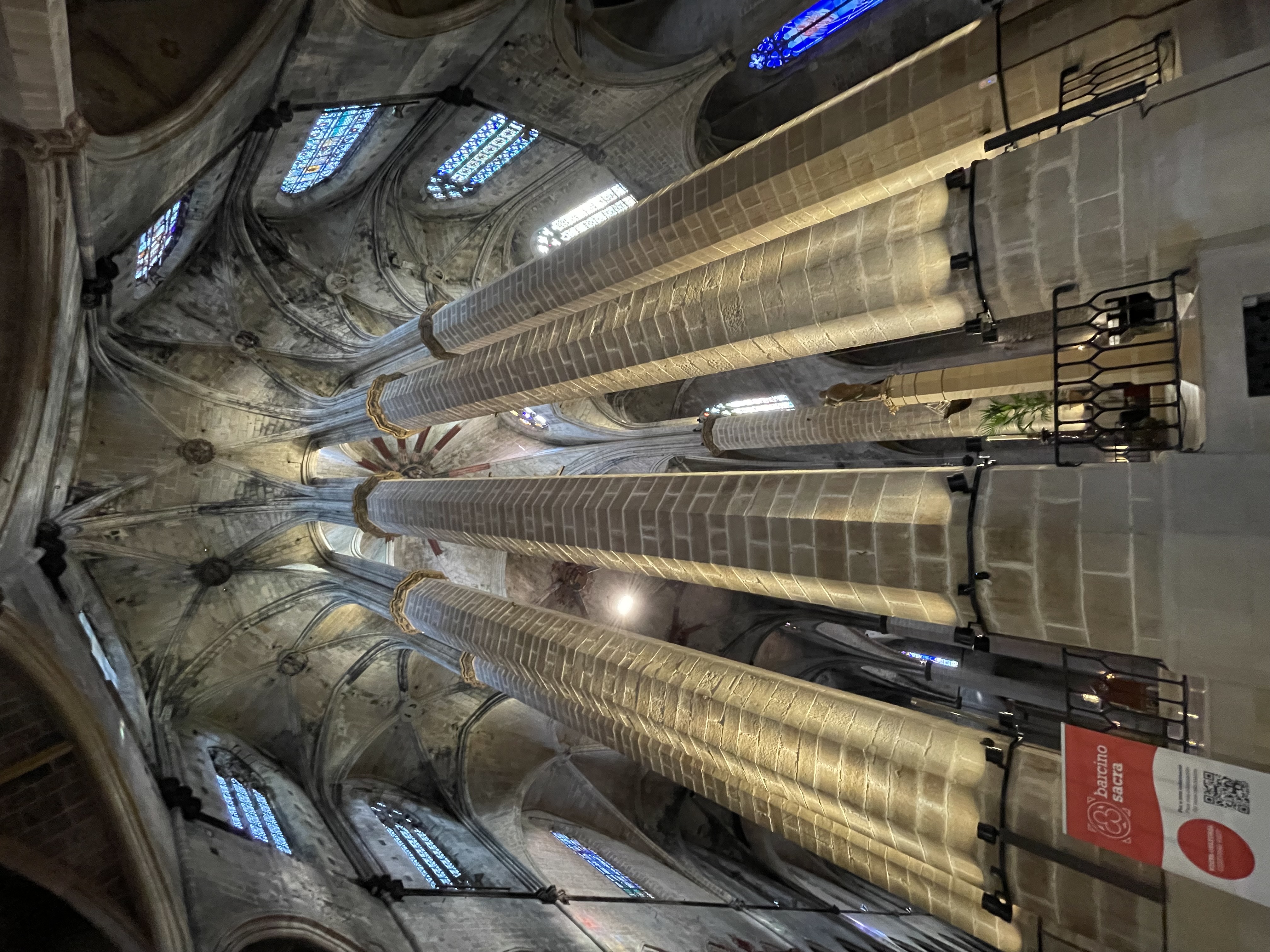
This is the Church of Santa Maria Del Mar. You can definitely see the influence on Gaudí and La Sagrada Familia.
And last but not least, moving onto Park Güell…..
This park was intended to be a housing development for 60 homes on 30 acres. Work started in 1900 but stalled in 1914 due to the outbreak of WWI and work never resumed. Only 2 homes were built and Gaudí ultimately bought and lived in one of them from 1906-1925 (at which time he moved into his workshop in La Sagrada Familia). That house is now the Gaudí House Museum (the museum is an an extra 6€ on top of the ticket to the park – a lot of places we saw said it wasn’t worth the extra entry fee; I thought it was kinda neat to see where he lived for a while even if it wasn’t a house he designed). You can read more on this history and timeline of the park here https://parkguell.barcelona/en/park-guell/over-hundred-years-history. It was ultimately opened as a municipal park in 1926.
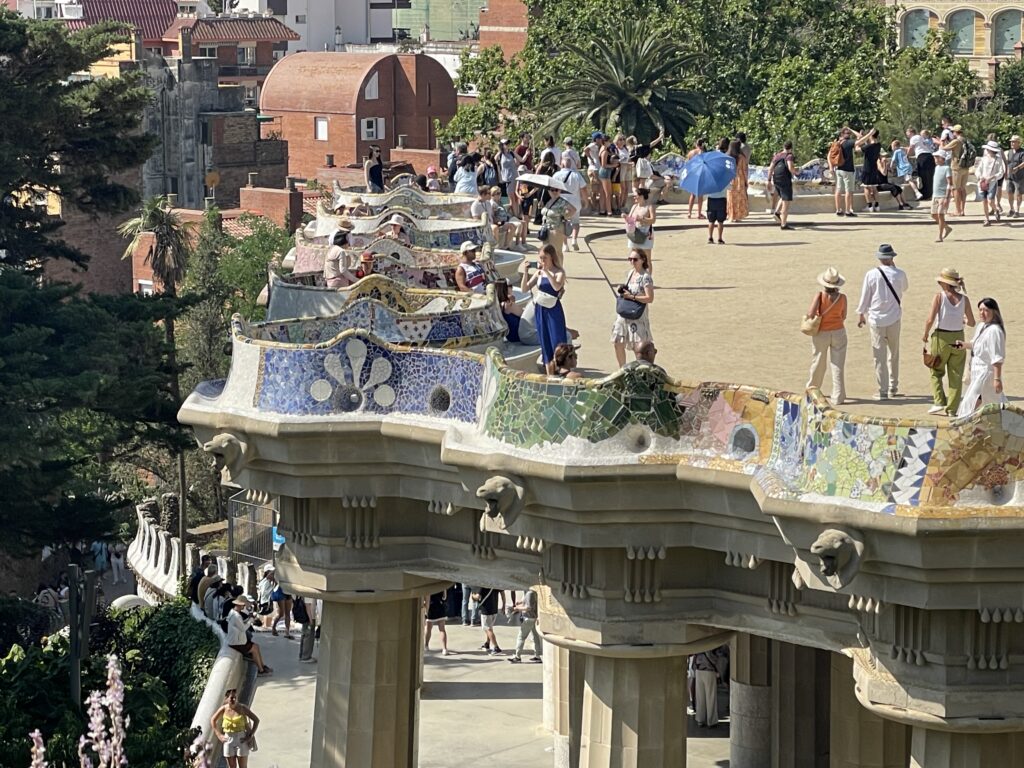
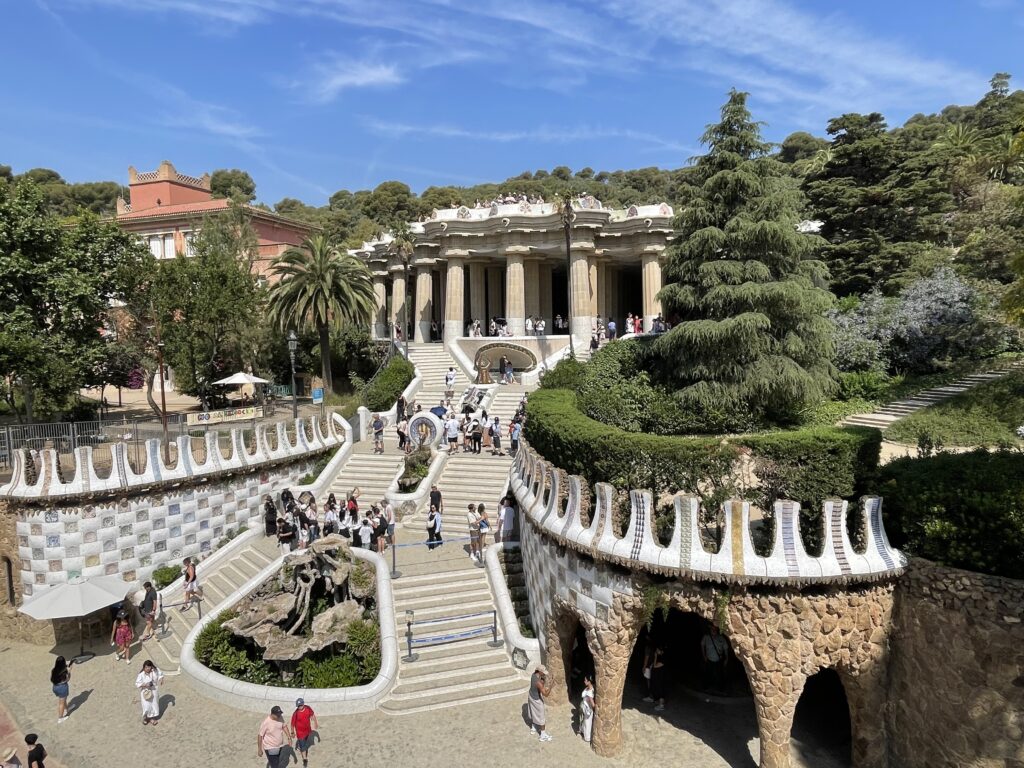
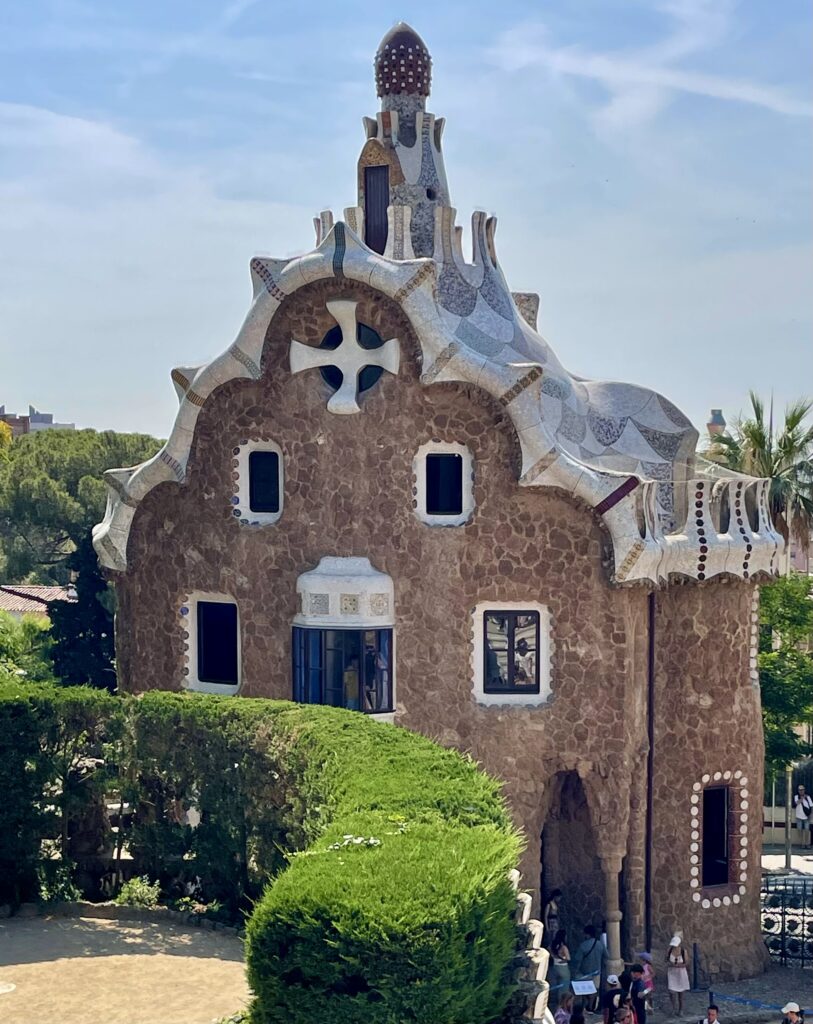
Most of the structures are in what’s called the Monument Zone (the park itself is quite a bit larger). This terrace had awesome views of Barcelona and the Mediterranean sea. You can also see more of the broken ceramic tile use in the park on all the curvy benches and other structures. It looks so cool and he also used reclaimed ceramic to do this … so the ultimate in “green” architecture! Most of the ceramics in the park were created by Josep Maria Jujol, Gaudí’s collaborator.
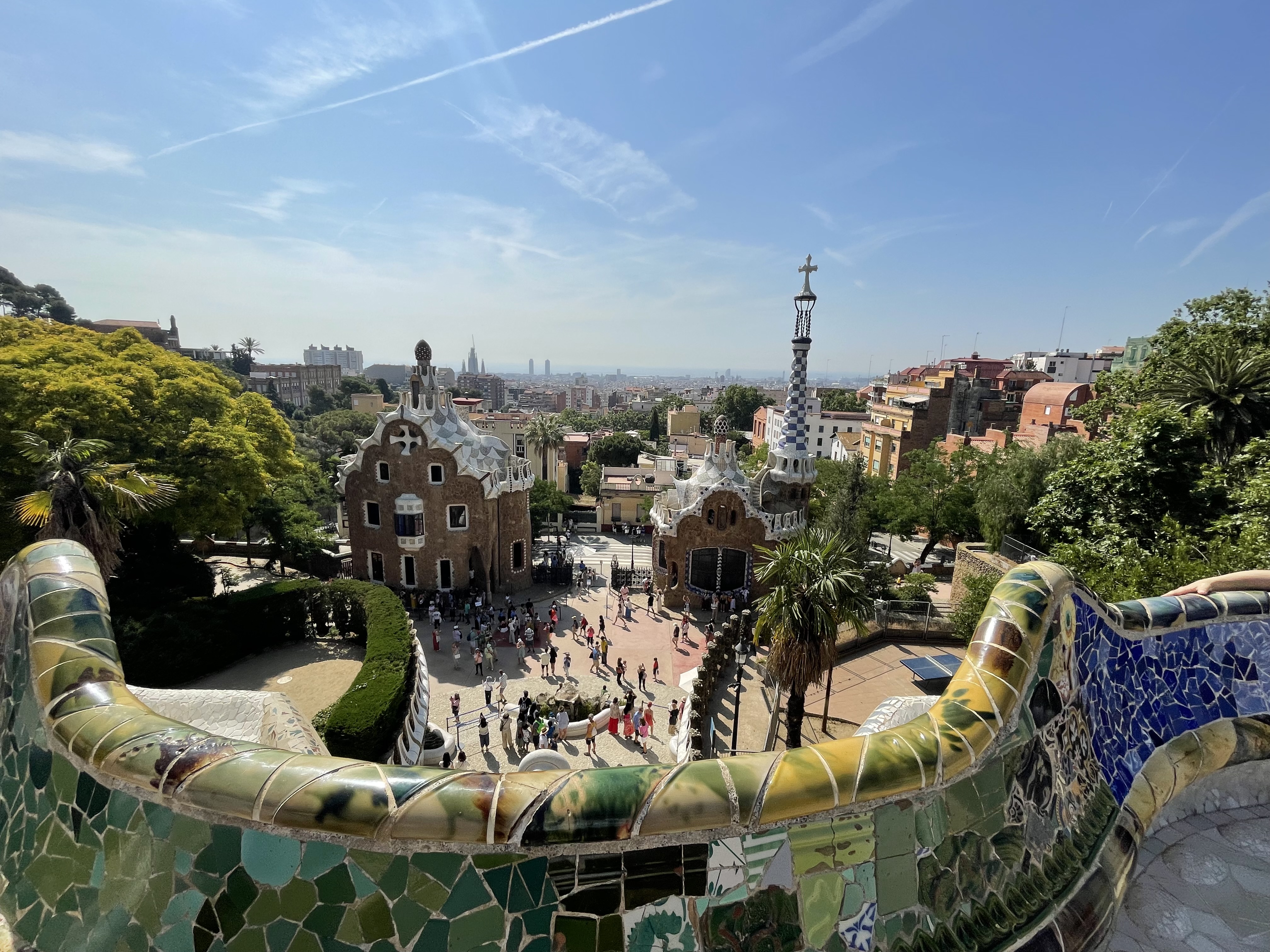
View from the terrace of one of the park entrances and beyond.
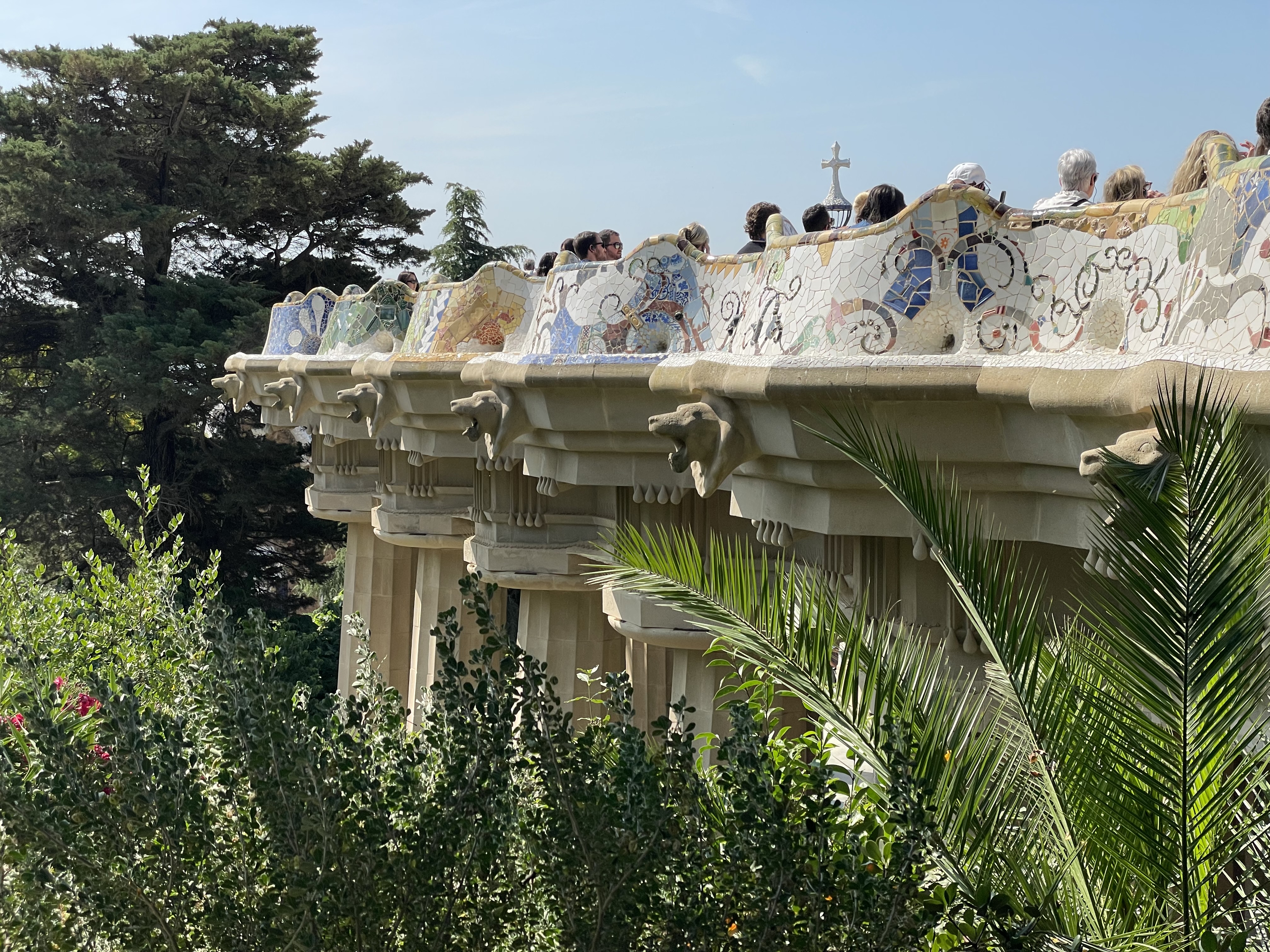
I hope you enjoyed this glimpse into Antoni Gaudí and Barcelona. And I hope even more you get to visit Barcelona to see it yourselves! From what we hear, Barcelona can get pretty crowded in the summer (and hot!!). Mid-June wasn’t too bad – there were crowds and it was relatively hot but not crazy on either front. If I wasn’t already going for a conference, going in the shoulder or off-seasons would probably be even better. Barcelona was also very easy to get around between walking and public transport (mostly metro, took a bus twice – both involving Park Güell), and never needed a taxi.
I’ve included links here for each official websites for these sites. I notived when you google each you come up with a lot of unofficial sites. These also have really great historical info for each place. I included in parentheses the cost of visiting each site.
Casa Botllò: https://www.casabatllo.es/en/online-tikets/ (general tickets are in the 30€ range)
Casa Milà (La Pedrera): https://www.lapedrera.com/en (29€)
La Sagrada Familia: https://sagradafamilia.org/en/home (26€, includes audio guide – note that it’s in an app on your phone that can be downloaded ahead of time and used offline; bring earbuds/headphones)
Park Güell: https://parkguell.barcelona/en (18€; 24€, if you include the Gaudí House Museum)